

A "lifetime" warranty on your auto glass doesn't actually mean the glass is indestructible for eternity. Most drivers assume these policies cover every future crack or chip, but the reality is much more specific. Understanding the windshield replacement lifetime warranty details is the only way to ensure your investment is truly protected against leaks, wind noise, and installation errors. If you're confused by the difference between "lifetime" and "limited" terms, you aren't alone.
You want the peace of mind that comes with a professional installation, especially when modern safety cameras are involved. We promise to clarify exactly what is covered, from physical glass defects to the technical precision of ADAS recalibration. This guide previews the essential steps for maintaining your warranty validity and explains why workmanship standards are the most critical factor in your vehicle's long-term safety. You'll gain the confidence to choose a provider that stands behind their work without the hidden loopholes. This ensures your safety systems function correctly and your vehicle remains leak-free for as long as you own it.
Key Takeaways
- Understand the specific windshield replacement lifetime warranty details to distinguish between workmanship issues like leaks and material defects like glass distortion.
- Learn why coverage typically applies only for as long as you own or lease the vehicle and why these guarantees are generally non-transferable.
- Discover why ADAS recalibration is now a critical component of any comprehensive glass warranty to ensure your vehicle's safety sensors function correctly.
- Identify common exclusions such as new rock chips, road debris damage, or pre-existing frame rust that can void your installation protection.
- Follow a professional checklist to select a provider that utilizes certified technicians and stands behind their work with a reliable, nationwide guarantee.
What is a Windshield Replacement Lifetime Warranty?
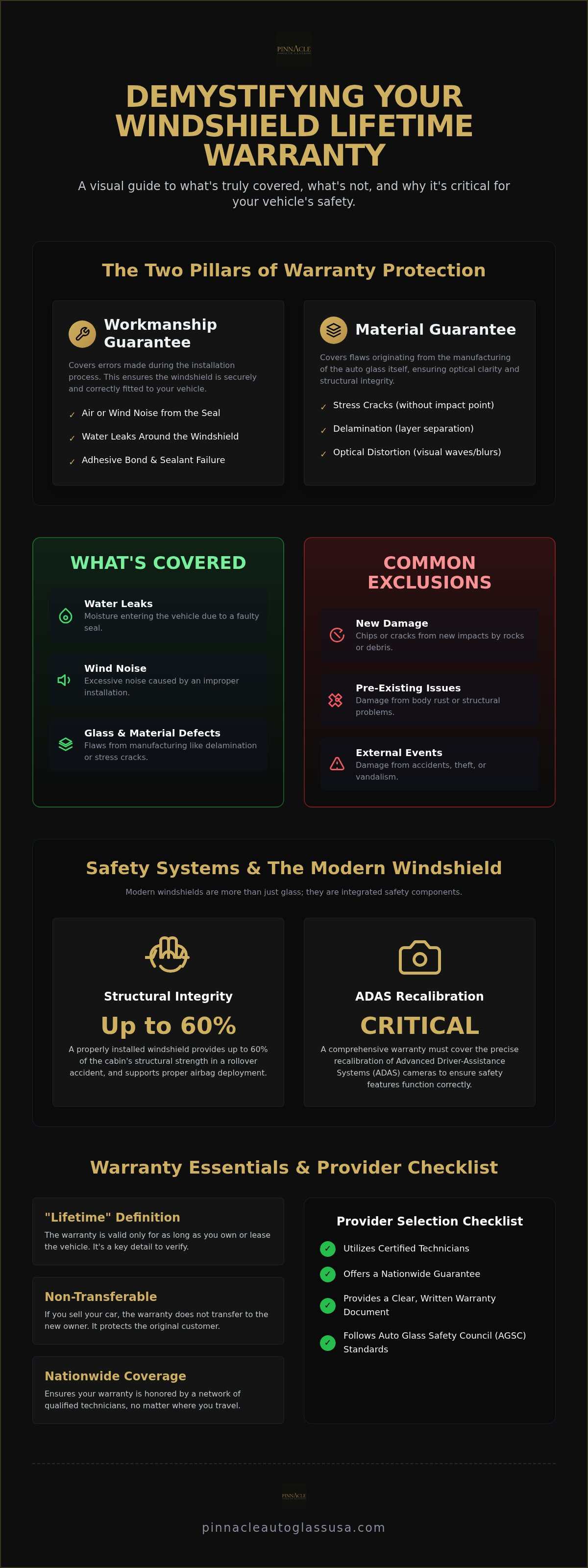
A windshield replacement lifetime warranty is a professional guarantee that protects you against defects in materials and workmanship. This type of coverage ensures the glass itself is free from manufacturing flaws and the installation process meets rigorous safety standards. Understanding the windshield replacement lifetime warranty details helps you avoid the costs of fixing water leaks or wind noise after a service. It acts as a safety net for your vehicle investment and your family's safety.
The "Own or Lease" clause is a standard industry provision. It means the warranty remains valid only as long as you own or lease the vehicle. If you decide to sell the car, the protection typically does not transfer to the new owner. This clause is a key part of the windshield replacement lifetime warranty details that drivers should verify before scheduling service. It's designed to protect the original customer who initiated the repair and ensures the service provider can track the vehicle's history accurately.
It helps to distinguish between a manufacturer warranty and an installation warranty. The manufacturer covers the laminated glass itself. This protects you from manufacturing issues like delamination, stress cracks, or optical distortion. The installation warranty covers the labor and the adhesive bond. This ensures the glass stays securely attached to the vehicle frame and remains watertight under all driving conditions. Both pillars are essential for a comprehensive guarantee.
A lifetime warranty is a commitment to the structural integrity of the vehicle for the duration of current ownership.
The Scope of National Coverage
Nationwide support is a critical feature for modern travelers and fleet operators. You need a service network that honors your guarantee regardless of your location. If a leak develops while you're hundreds of miles from home, a stable network ensures you can access a qualified technician without additional costs. Reliability is the cornerstone of a professional glass service. It provides the confidence that your vehicle stays protected during long-distance hauls or family road trips. This stability prevents you from being stranded with a safety issue in an unfamiliar area.
Why Warranty Standards Matter in 2026
In 2026, windshields play a vital role in vehicle safety ratings. The glass provides up to 60% of the structural support for the roof during a rollover accident. A failed adhesive bond is a severe safety hazard rather than a simple cosmetic issue. If the glass fails to hold during a collision, the passenger side airbag may not deploy correctly. High warranty standards ensure the installation maintains the vehicle's structural strength. This protects passengers and keeps the car's safety systems functioning as the manufacturer intended. Certified technicians follow these standards to prevent structural failure.
Workmanship vs. Materials: What is Actually Covered?
A comprehensive guarantee rests on two primary pillars: the quality of the glass and the precision of the installation. When you review windshield replacement lifetime warranty details, you'll find that coverage is split between material defects and workmanship errors. These two categories protect you from different types of failure. Knowing the difference helps you identify when a claim is necessary and what you should expect from a service provider.
Material defects involve flaws in the glass itself that occurred during manufacturing. Workmanship defects, on the other hand, result from mistakes made during the installation process. Most reputable providers follow the standards set by the Auto Glass Safety Council to minimize these risks. If a valid warranty claim is filed, the "Free Fix" protocol typically applies. This means the shop will repair the leak or replace the defective glass at no cost to you, provided the issue falls within the covered terms.
Identifying Material Defects in New Glass
Delamination is a common material defect where the PVB interlayer separates from the glass panes. This often appears as a milky or cloudy discoloration along the edges of the windshield. Stress cracks are another manufacturing concern. These cracks appear suddenly without any visible impact point from a rock or debris. They usually start from the edge of the glass due to internal tension or improper tempering during production. Optical distortion can also occur, creating "waves" or "blurring" in your field of vision. This often happens if the glass isn't cooled uniformly during the manufacturing process. These issues are rare with high-quality glass but are fully covered under a materials warranty because they compromise driver safety.
Recognizing Faulty Installation and Workmanship
Workmanship issues often manifest as audible or physical symptoms. A "whistling" windshield is a classic sign of an air gap in the urethane seal. This noise usually gets louder at highway speeds and can be incredibly distracting for the driver. Water intrusion is another serious red flag. If you notice damp carpets or droplets on the interior of the glass after rain, the adhesive bond has likely failed. These problems often stem from improper surface preparation or skipping the necessary primers. Loose or vibrating moldings are also a concern, as they can cause wind noise or even detach while driving. Following professional windshield replacement standards is the only way to prevent these failures. If you suspect your current seal is compromised, you can contact a glass expert to evaluate the installation integrity.
Recalibration and Technology: The New Warranty Frontier
The evolution of auto glass means a replacement is no longer just a physical installation. Modern windshields house complex cameras and sensors that govern your vehicle's safety responses. When you examine windshield replacement lifetime warranty details, you must ensure the electronic recalibration is included. A warranty that only covers water leaks but ignores sensor errors is functionally incomplete. In 2026, a windshield is only as good as the calibrated technology behind it.
Skipping the recalibration process creates "blind" safety systems that can't protect you in an emergency. If the camera is misaligned by even a single millimeter, your car might fail to brake automatically or drift out of its lane. This creates a critical need for ADAS recalibration after every glass swap. A professional guarantee should cover the labor required to reset these systems to factory specifications. This ensures your safety features remain as reliable as they were when the car left the dealership.
ADAS Recalibration Standards
Modern ADAS calibration auto glass requirements vary significantly by vehicle make and model. Static calibration happens in a controlled shop environment using specialized physical targets. Dynamic calibration requires a technician to drive the vehicle at specific speeds to let the sensors "learn" the road. Both methods ensure that Lane Departure Warning and Forward Collision systems rely on precise glass placement. If the installation isn't perfect, the tech won't work. Your windshield replacement lifetime warranty details should explicitly state that the shop stands behind the accuracy of these calibrations.
Technology Guarantees for Fleet and Commercial Vehicles
Logistics fleets and heavy-duty trucks face unique challenges due to their high mileage and strict schedules. For these operators, reducing fleet downtime with mobile glass repair is often the top priority. However, convenience must still include tech-safety guarantees. Companies that ignore recalibration warranties face significant liability risks if a collision occurs because of a faulty safety sensor. Professional service providers prioritize both speed and technical precision. They provide documentation that all safety systems were successfully recalibrated before the vehicle returns to the road. This protects the business from legal exposure and keeps drivers safe during long hauls.
Common Exclusions: When Your Warranty Does Not Apply
A lifetime warranty is not a replacement for comprehensive insurance. While it provides essential protection against errors, it does not cover every type of future damage. Reviewing the windshield replacement lifetime warranty details reveals several specific exclusions that every vehicle owner should understand. These limitations exist to distinguish between the quality of the service provided and the unpredictable nature of daily driving environments.
New damage from road debris is the most common reason for a denied warranty claim. If a rock or piece of gravel hits your glass while you're driving, this is considered an external impact. Your guarantee covers manufacturing flaws and installation mistakes, not environmental hazards. Similarly, "Acts of God" such as hail, severe storms, or falling tree limbs are excluded. These events are typically handled through your auto insurance provider rather than the glass shop's workmanship policy.
Unauthorized alterations will also void your protection immediately. Don't let a third-party mechanic or an uncertified shop attempt to adjust the glass or the adhesive seal. If the original bond is tampered with by anyone other than the initial service provider, the warranty is no longer valid. This ensures that the shop is only held responsible for work performed by their own technicians under controlled safety standards.
The Problem with Pinch Weld Rust
The pinch weld is the metal frame where your windshield is bonded to the vehicle. Technicians cannot offer a guarantee on glass bonded to a rusted or corroded frame. Corrosion creates a flaky surface that prevents the urethane adhesive from creating a structural, airtight seal. If rust is present, the oxidation process will continue under the seal, eventually causing leaks or bond failure. This condition must be professionally treated by an auto body specialist before a windshield repair or replacement can be warrantied. Bonding glass to rust is a significant safety risk that professional shops will not take.
Negligence and Improper Maintenance
Negligence can quickly compromise your coverage. Using harsh industrial chemicals or abrasive cleaners can degrade the glass surface and the surrounding moldings over time. You must also maintain your wiper blades, as worn-out wipers can scratch the glass and void the materials portion of your guarantee. Most providers enforce a 30-Day Notification rule for workmanship issues. If you notice a leak or wind noise, you must report it within 30 days of discovery to remain eligible for a free fix. Always keep your physical or digital invoice as proof of purchase to streamline the claim process. If you suspect an installation error, contact a certified technician to schedule a professional inspection.
How to Choose a Provider with a Reliable Warranty
Selecting a service provider is the most influential decision you'll make regarding your vehicle's long-term glass safety. You should evaluate the windshield replacement lifetime warranty details before the first piece of trim is removed. A robust guarantee reflects a shop's confidence in its technical precision and material selection. If a provider is vague about their terms, it often indicates a lack of standardized training or low-quality adhesive systems. Reliable shops provide written documentation of their coverage and are happy to answer specific questions about their process.
Use this checklist to evaluate any auto glass shop's guarantee:
- Does the warranty cover both water leaks and wind noise for the life of ownership?
- Is the guarantee valid at locations across the country or only at one local shop?
- Are the technicians specifically trained and certified in ADAS recalibration?
- Does the shop provide a written copy of the warranty terms and an itemized invoice?
Hiring a certified auto glass technician is the best way to ensure your warranty remains valid. These professionals follow industry-best practices that prevent the very defects warranties are designed to cover. Insurance companies often partner with specific shops because they trust these certification levels. While your insurer may cover the initial cost of the replacement, the shop's warranty is what protects you if a leak develops six months later. Always verify that your chosen provider has a stable, nationwide presence to honor claims if you move or travel.
The Claims Process: A Step-by-Step Guide
Filing a claim should be a straightforward experience if you have the right documentation. You'll typically need your original invoice, the vehicle identification number (VIN), and clear photos of the suspected defect. Once you report the issue, the shop will schedule a physical inspection. A technician will verify if the problem is a workmanship error or new damage from road debris. If the claim is approved, the resolution usually involves a free repair of the seal or a full glass replacement. Some providers may offer a credit if the specific glass is no longer available, though this is rare for modern vehicles.
Why Pinnacle Auto Glass Sets the Standard
We prioritize pinnacle auto glass quality levels in every installation. Our process integrates ADAS recalibration as a standard part of the safety guarantee, ensuring your tech works as well as your seal. This comprehensive approach serves both individual drivers and commercial fleet managers who need reliable, nationwide support. We provide clear, no-nonsense documentation for every service. This transparency ensures you understand your coverage from day one. Our commitment to excellence means we stand behind our work for as long as you own your vehicle.
Secure Your Vehicle's Future with Professional Glass Care
Your windshield is a vital safety barrier and a sophisticated housing for advanced vehicle technology. By mastering the windshield replacement lifetime warranty details, you can distinguish between simple glass defects and critical installation errors. Remember that professional coverage typically lasts as long as you own or lease the vehicle. It provides a necessary safety net against leaks, wind noise, and adhesive failure while excluding external hazards like new rock chips or storm damage.
Choosing a provider that prioritizes certified recalibration and structural integrity is the best way to avoid future out-of-pocket costs. We act as commercial fleet specialists and individual service experts to ensure every vehicle meets rigorous nationwide service standards. Our team consists of certified ADAS recalibration experts who ensure your safety sensors and structural bond remain perfect for the long haul. This comprehensive approach protects your investment and your passengers.
Get a Professional Replacement with a Lifetime Warranty today to keep your vehicle safe and secure. Drive with confidence knowing your glass is backed by industry leaders who value your safety as much as you do.
Frequently Asked Questions
Is a windshield replacement warranty transferable to a new owner?
No, a windshield replacement warranty is generally not transferable to a new owner. Most guarantees are valid only for the original purchaser for as long as they own or lease the vehicle. When you sell the car, the protection ends immediately. This is a core part of the windshield replacement lifetime warranty details that drivers should understand before scheduling service. It ensures the provider's liability is limited to the original customer relationship.
Does the lifetime warranty cover new rock chips or cracks?
No, standard lifetime warranties don't cover new rock chips or cracks caused by road debris. These warranties are designed to protect you against defects in materials and workmanship, such as adhesive failure or manufacturing flaws. New impacts are considered environmental damage rather than a service error. You should contact your insurance provider to handle these issues through your comprehensive coverage, as they fall outside the scope of an installation guarantee.
What happens if my windshield leaks after the warranty period?
A lifetime warranty typically remains active for as long as you own the vehicle, meaning there is no expiration date for the original purchaser. If you find a leak caused by a workmanship error five years later, the shop should still honor the repair. However, if the leak results from new damage or pre-existing frame rust, the warranty won't apply. You'll be responsible for the costs of any repairs linked to external factors.
Will my warranty be void if I don’t recalibrate my ADAS cameras?
Yes, your warranty may be voided if you decline the necessary ADAS recalibration after a windshield replacement. Modern windshield replacement lifetime warranty details often require that all safety cameras and sensors are reset to factory standards to ensure the installation is safe. If you skip this step, the provider cannot guarantee that your vehicle's safety systems will function correctly. This omission creates a significant liability risk and compromises the technical integrity of the installation.
How long do I have to report a defect under the lifetime warranty?
You typically have 30 days to report a defect once you notice it. Waiting longer can cause secondary issues like water damage to your interior or electrical components, which the shop won't cover. Reporting a leak or wind noise immediately allows the technician to fix the seal before it leads to more expensive problems. Always have your original invoice ready as proof of purchase when you call to initiate a warranty inspection or repair.
Does insurance cover the same things as a lifetime warranty?
No, insurance and warranties cover different types of risks. Insurance protects you against accidental damage, vandalism, and environmental events like hail or falling branches. A lifetime warranty specifically covers errors made by the technician or flaws in the glass itself. While insurance usually pays for the initial replacement, the warranty is your guarantee that the work was done to professional standards. Both are essential for long-term vehicle safety and financial protection.
What does "material defect" actually mean in a windshield?
A material defect is a manufacturing flaw in the glass that compromises its performance or safety. This includes optical distortion that creates waves in your vision or delamination, where the plastic interlayer separates from the glass panes. Stress cracks that form without an impact point also fall into this category. If these issues appear, the warranty covers the replacement of the defective glass. These flaws are different from workmanship errors like improper sealing.
Can I go to any shop for a warranty repair if I am traveling?
You must usually visit a shop within the original provider's network to maintain your coverage. If you chose a company with nationwide service capabilities, you can find an authorized location in most major areas to handle the repair. However, taking the vehicle to an unauthorized third-party shop will likely void your warranty. Always contact your original service provider first to get a referral to a qualified technician who can honor the guarantee while you're away.


