

Did you know your windshield provides up to 60% of your vehicle's structural integrity during a rollover? A single stray pebble can compromise that safety net in an instant. It's frustrating to watch a small chip slowly spiderweb across your line of sight; the anxiety over a $750 replacement bill is a burden no driver wants to carry. You need to know exactly how to prevent windshield cracks from spreading before the damage becomes permanent. Taking action within the first 24 hours is the most effective way to avoid total glass failure and maintain your safety on the road.
We understand that you want to stabilize your vehicle without falling for DIY myths that don't deliver professional results. This 2026 stabilization guide provides the immediate steps you must take to protect your glass and your budget. You'll learn how to identify the "point of no return" for repairs and why professional resin bonding is a necessary race against physics. We'll also break down the critical role of ADAS recalibration in modern glass maintenance. This guide gives you a clear, expert-led roadmap to preserve your windshield and maintain your vehicle's structural strength.
Key Takeaways
- Apply clear packing tape immediately to block moisture and debris from entering the glass layers.
- Minimize thermal stress by parking in the shade and avoiding sudden temperature changes from air conditioning.
- Learn the professional methods for how to prevent windshield cracks from spreading by utilizing industrial-grade vacuum bonding over standard DIY kits.
- Recognize the 6-inch threshold and edge-damage rules that determine if a windshield is repairable or needs replacement.
- Restore the structural integrity of your vehicle to ensure maximum safety and roof support during a collision.
Why Windshield Cracks Spread: The Physics of Damaged Glass
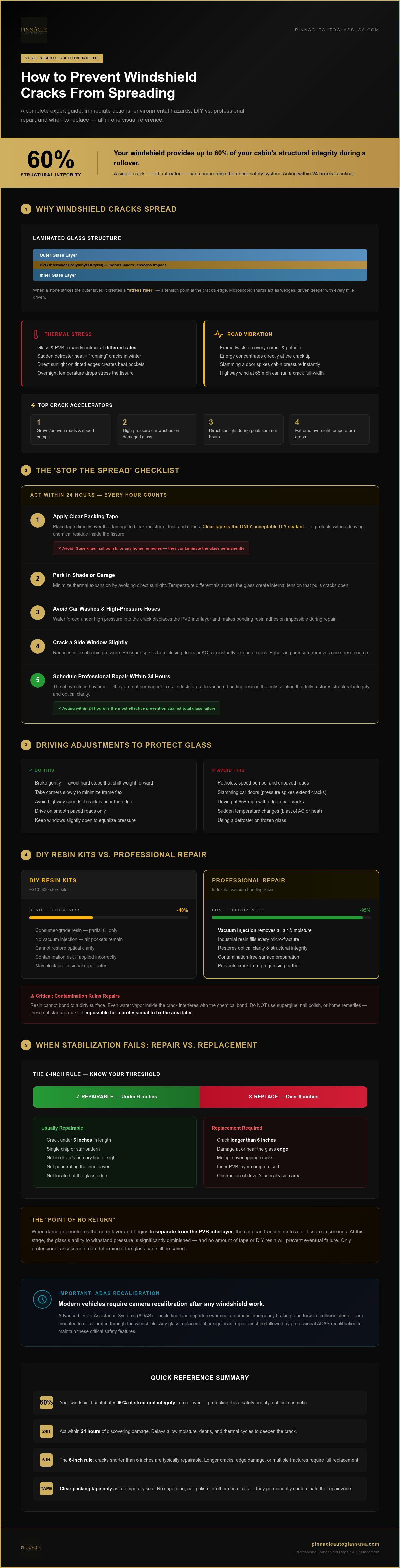
Windshields are sophisticated safety components. They are engineered using laminated glass, a structure featuring two layers of glass bonded by a polyvinyl butyral (PVB) interlayer. This design is intended to remain intact during an impact; however, it also creates a unique environment for cracks to grow. When a stone hits your glass, it creates a "stress riser." This is a localized area where tension concentrates at the edge of the damage. Microscopic shards at the tip of the crack act as wedges. As your vehicle moves, these shards are driven deeper into the glass, forcing the crack to expand. Learning these mechanics is the first step in understanding how to prevent windshield cracks from spreading.
Most chips have a "point of no return." This occurs when the damage penetrates the outer layer and begins to separate from the PVB interlayer. Once this structural bond is compromised, the chip can transition into a full fissure in seconds. At this stage, the glass's ability to withstand pressure is significantly diminished.
Thermal Expansion and Contraction
Temperature fluctuations are the most common cause of rapid crack growth. Glass and plastic interlayers expand and contract at different rates. During winter, using your defroster is the primary cause of "running" cracks. The sudden heat causes the glass near the vents to expand while the rest of the pane remains frozen. This creates massive internal tension. Direct sunlight on dark-tinted glass edges also creates heat pockets that can trigger a crack to spread across the entire field of vision.
Structural Tension and Road Vibration
Your windshield provides up to 60% of your cabin's structural integrity in a rollover. Because the glass is a stressed member of the vehicle's frame, it absorbs constant pressure from chassis flex. Every time you take a sharp corner or hit a pothole, the frame twists. This movement focuses energy directly into the crack's tip. Even the simple act of slamming a car door increases cabin pressure. This sudden spike can instantly double the length of a crack.
Common factors that accelerate glass failure include:
- Driving on uneven gravel roads or over speed bumps.
- Using high-pressure car washes on damaged glass.
- Parking in direct sunlight during peak summer hours.
- Extreme overnight temperature drops.
The 'Stop the Spread' Checklist: Immediate Actions
Stabilizing a damaged windshield requires immediate intervention to avoid a total replacement. You must act quickly to neutralize the environmental and physical forces that pull at the glass layers. Learning how to prevent windshield cracks from spreading begins with these five essential steps:
- Apply clear packing tape over the damage to keep out dirt and moisture.
- Park in a shaded area or garage to minimize thermal expansion.
- Avoid using the car wash or high-pressure hoses near the damage.
- Reduce internal pressure by slightly cracking a side window.
- Schedule a professional windshield repair within 24 hours.
These actions are the most effective way regarding how to prevent windshield cracks from spreading before a technician arrives. They buy you the time needed to organize a permanent solution without the damage spiraling out of control.
Contamination Control
Resin cannot bond to a dirty surface. If dust, oil, or rain enter the crack, the repair will likely fail or remain highly visible. Understanding the science of windshield cracks reveals that even water vapor can interfere with the chemical bond of industrial resins. Do not use superglue, nail polish, or other home remedies. These substances contaminate the glass and often make it impossible for a professional to fix the area later. Clear tape is the only acceptable DIY sealant because it protects the area without leaving a permanent chemical residue inside the fissure.
Driving Adjustments to Protect the Glass
Your vehicle's frame flexes constantly during transit. To protect the glass, avoid potholes, speed bumps, and unpaved roads that cause excessive vibration. Gentle braking is also critical. Hard stops shift the vehicle's weight forward, putting immense pressure on the front glass. If the crack is near the edge of the windshield, avoid highway speeds. Wind resistance at 65 mph creates a high-pressure environment that can cause a crack to run across the entire pane in seconds. If you're unsure about the stability of your glass, consulting a specialist in windshield repair can prevent a small chip from becoming a total loss.
Time is your biggest enemy. The longer you wait, the higher the risk of contamination or sudden expansion. Most small chips are easily fixable if they stay clean and dry, but once a crack exceeds the size of a credit card, your options become much more expensive.
Environmental Hazards to Avoid with Cracked Glass
The environment acts as a constant catalyst for glass failure. Even if you've followed the initial checklist, external conditions can override your efforts. Understanding how to prevent windshield cracks from spreading requires a focus on thermal and hydrostatic forces. When moisture enters a fissure and freezes, it undergoes the "Ice Wedge" effect. Water expands as it turns to ice, exerting massive pressure against the glass layers. This force is often enough to turn a small chip into a 12-inch crack overnight.
Sudden temperature shifts are equally destructive. Moving your vehicle from a 90-degree exterior and immediately blasting the air conditioning creates thermal shock. The outer glass layer remains hot while the inner layer cools rapidly. This differential causes the glass to twist at a molecular level, focusing stress directly on the crack's tip. High wind speeds also play a role. At highway velocities, the air pressure pushing against the windshield creates a constant load. This pressure can force a crack to "run" toward the edges of the frame.
The Danger of Extreme Heat
Sun-baked glass becomes increasingly brittle. In high-heat environments, the PVB interlayer can soften, losing its ability to provide structural support to the glass layers. If you use a sunshade that touches the glass, it traps heat directly against the damage. This localized "hot spot" accelerates stress fractures. For those driving at high altitudes, UV radiation is more intense. These rays can degrade the chemical bond of the interlayer over time, making the windshield less resilient to road vibrations.
Moisture and Hydrostatic Pressure
Rainwater and car wash spray do more than just contaminate the glass. They create hydrostatic pressure. When water is trapped in a narrow fissure, it acts like a hydraulic lever. Any vibration from the road is amplified by this trapped fluid, pushing the crack further apart. Moisture also creates several technical hurdles for technicians:
- It prevents the specialized resin from curing properly.
- It interferes with the chemical bond to the glass surface.
- It can lead to "invisible" moisture pockets that ruin the repair's clarity.
A wet crack is significantly harder to stabilize than a dry one. Always keep the damaged area covered and dry to ensure a successful windshield repair later. Time is your biggest enemy when moisture is involved, as the interlayer can begin to delaminate if exposed to water for extended periods.
DIY Resin Kits vs. Professional Windshield Repair
Choosing a repair method is the most critical decision regarding how to prevent windshield cracks from spreading. While a store-bought kit seems convenient, the chemistry often fails to meet modern safety standards. Consumer resins typically have a high viscosity. They merely fill the surface of a crack rather than penetrating the microscopic fissures at the tip. Professional-grade resins are engineered with specific bonding strengths designed for various glass temperatures and damage types. If the resin doesn't reach the very end of the damage, the crack will continue to grow beneath the surface.
Optical clarity is another major concern. Professional resins match the refractive index of automotive glass, making the repair nearly invisible. DIY kits often leave a blurry or distorted patch that can distract the driver and fail safety inspections. If you apply a DIY kit and it fails, the hardened resin blocks any future professional repair attempts. This usually forces a full windshield replacement because the contaminated area cannot be cleaned or re-injected.
The Professional Resin Injection Process
Technicians utilize specialized vacuum tools to extract air and moisture from the damage before injection. This creates a low-pressure environment that pulls the resin deep into the glass layers. A professional bridge tool is a precision instrument that attaches to the glass to stabilize the injection site and prevent further cracking during the procedure. Once the resin is injected, high-intensity UV lights trigger a rapid chemical reaction. This creates a permanent structural bond that restores the original strength of the glass. For a reliable fix, you should always book a professional windshield repair.
Why DIY Kits Often Fail
DIY attempts frequently backfire due to trapped air bubbles. Without a vacuum seal, air remains inside the crack, creating a weak point that will eventually fail under road vibration. Improper curing is another common issue. Consumer resins often turn yellow or become brittle when exposed to high 2026-level UV indexes. There is also a significant risk that the plastic bridge tool included in retail kits will apply uneven pressure. This can cause the glass to crack further during the application process, turning a simple repair into an expensive replacement job.
When Stabilization Fails: Repair vs. Replacement
Even with a clear strategy for how to prevent windshield cracks from spreading, some damage is fundamentally beyond restoration. The industry standard for a safe repair is the 6-inch rule. If a crack exceeds the length of a standard dollar bill, the structural bond is too weak to be reinforced by resin alone. At this stage, the glass can no longer guarantee your safety during an impact. A compromised windshield loses its ability to support the roof during a rollover, a scenario where the glass typically provides 60% of the cabin's structural strength. It also serves as the backstop for passenger airbag deployment. If the glass isn't secure, the force of the airbag can displace the windshield rather than protecting the occupant.
Location is just as critical as the size of the damage. Cracks that touch the edge of the glass frame compromise the factory seal and the structural integrity of the entire pane. These fissures allow the glass to flex excessively under road vibration, which can lead to a sudden and total failure. If your damage is near the perimeter of the frame, you likely require a new windshield to maintain vehicle safety standards.
The ADAS Factor in 2026 Vehicles
Modern safety systems rely on cameras and sensors mounted directly behind the rearview mirror. These Advanced Driver Assistance Systems (ADAS) require 100% optical clarity to function correctly. If a crack enters this sensitive "camera window," the ROLAGS standard dictates that a repair is unsafe. Even a high-quality professional resin can cause "ghosting," a minor visual distortion that confuses the camera's depth perception. This can trigger false collision warnings or cause emergency braking systems to malfunction. Professional ADAS calibration auto glass services are mandatory after a replacement to ensure these safety systems are aligned to factory specifications.
Determining Your Next Steps
Use the "Quarter Test" for chips and the "Rule of Thumb" for cracks to assess your damage. If a chip is larger than a quarter or a crack is wider than your thumb, the glass is likely structurally unsound. You should never ignore damage that has "spider-webbed" in multiple directions from a single impact point. This pattern indicates that the internal PVB interlayer has begun to delaminate. While you may have initially researched how to prevent windshield cracks from spreading to manage costs, your final decision should prioritize safety over short-term savings. A professional assessment is the only way to confirm if your vehicle remains roadworthy.
Secure Your Safety with Professional Glass Care
Protecting your vehicle starts with immediate action. You now understand that while tape and temperature control provide a temporary shield, professional resin bonding is the only way to restore the glass to its original strength. Learning how to prevent windshield cracks from spreading is a critical skill; it's about more than visibility. It's about maintaining the structural integrity of your cabin and ensuring your advanced safety systems remain fully operational. Prompt intervention is the difference between a simple repair and an expensive replacement.
Our team provides the high-level expertise needed to handle complex glass damage. We offer professional-grade resin bonding for maximum safety and expert ADAS recalibration to keep your sensors accurate. Whether you need assistance with a personal vehicle or a commercial fleet, our mobile service brings the solution directly to you. Don't let a small chip compromise your safety or lead to a total loss. Schedule a Professional Windshield Inspection with Pinnacle Auto Glass today to keep your glass clear and your cabin secure. We are ready to help you get back on the road with confidence.
Frequently Asked Questions
Can I use superglue to stop a windshield crack from spreading?
No, you should never use superglue on a windshield crack. Superglue is a surface adhesive that doesn't have the refractive index or bonding strength required for automotive glass. It acts as a contaminant that fills the fissure with low-quality material; this makes it impossible for a professional to inject high-grade resin later. Using this household item often ruins your chances of a successful repair and forces a full replacement.
Will clear nail polish really stabilize a cracked windshield?
Clear nail polish won't stabilize a cracked windshield. While it might temporarily seal the surface from moisture, it provides zero structural support. Automotive glass is a stressed member of your vehicle's frame, and nail polish can't withstand the constant flexing and vibration of the road. It also creates a chemical barrier that prevents industrial resins from bonding correctly during a professional repair session.
How long can I drive with a cracked windshield before it's dangerous?
You should drive as little as possible until the damage is stabilized. Every mile driven introduces road vibrations and chassis flex that put pressure on the crack's tip. Most small chips can spread within 24 to 48 hours depending on environmental conditions. If the crack obstructs your vision or exceeds federal size limits, it's legally and physically dangerous to continue operating the vehicle.
Does insurance cover the cost of preventing a crack from spreading?
Many insurance companies will cover the full cost of professional windshield repair to avoid the higher expense of a replacement. They often waive your deductible for these services because stabilizing the glass is a proactive safety measure. Contact your provider to confirm your coverage details. This is the most cost-effective way for how to prevent windshield cracks from spreading while maintaining your vehicle's structural integrity.
Why did my windshield crack spread overnight when the car was parked?
Your windshield likely spread due to thermal expansion and contraction. As temperatures drop at night, the glass contracts at a different rate than the plastic interlayer. This creates internal tension that pulls at the edges of the damage. Understanding how to prevent windshield cracks from spreading requires managing these temperature shifts by parking in a garage or shaded area. Moisture can also freeze inside the fissure, acting like a wedge that forces the glass to run.
Is it safe to go through a car wash with a small windshield chip?
It is not safe to take a vehicle with a windshield chip through a car wash. High-pressure jets and mechanical brushes can cause immediate spreading. Contamination risks include:
- High-pressure water entry into the glass layers.
- Chemical residue from soaps that prevents resin bonding.
- Thermal shock from cold water on a sun-heated windshield.
This damage often becomes unrepairable after a single wash cycle.
Can a professional repair a crack that is longer than 6 inches?
Professional repair is generally limited to cracks under 6 inches in length. Once a fissure exceeds this standard, the structural bond is too compromised to be safely restored with resin. Driving with a long crack is hazardous because the windshield provides up to 60% of the cabin's strength in a rollover. For cracks of this size, a full windshield replacement is necessary to meet industry safety standards.
What happens if a windshield crack reaches the edge of the glass?
If a crack reaches the edge of the glass, the windshield must be replaced. Fissures that touch the perimeter frame compromise the structural seal and are prone to rapid expansion due to frame vibration. Because the edge of the glass is a high-stress zone, resin injections are rarely successful or safe in this area. A full replacement ensures your vehicle maintains its factory-specified roof support and airbag deployment capabilities.


