
Filing an insurance claim for a cracked windshield might seem like the logical choice, but it is often the most expensive mistake a vehicle owner can make. If your deductible is $500 or higher, you may find that paying for a windshield replacement without insurance is actually the more affordable path. Many drivers feel trapped by high deductibles that exceed the cost of the glass itself. Others worry that a small claim today will lead to a significant premium increase tomorrow.
You deserve a clear understanding of when to skip the claim and how to protect your insurance record from unnecessary "claim clutter." This guide provides a strategic look at the break-even point for out-of-pocket repairs in 2026. We will explore the differences between OEM and aftermarket glass, the critical role of ADAS recalibration, and how to ensure your vehicle remains structurally sound. By the end of this article, you will know exactly how to secure professional installation and transparent pricing without involving your insurance provider.
Key Takeaways
- Learn the "Break-Even" rule to determine if paying cash is more economical than your insurance deductible.
- Understand how choosing a windshield replacement without insurance prevents "claim clutter" on your record and avoids potential premium hikes.
- Discover why ADAS recalibration is a non-negotiable safety step for modern vehicles regardless of your payment method.
- Compare the cost and quality differences between OEM, OEE, and aftermarket glass options for your specific vehicle.
- Identify the technical standards, such as adhesive quality and technician certification, that ensure a safe, professional installation.
Why Consider Windshield Replacement Without Insurance?
Out-of-pocket or "self-pay" auto glass service means you pay the technician directly for parts and labor. This choice is increasingly common in 2026 as drivers look for ways to simplify vehicle maintenance. When you choose windshield replacement without insurance, you're opting for a direct transaction that cuts out the middleman. This isn't just about the physical laminated safety glass; it's a strategic move to maintain control over your vehicle's service history and your financial records.
Speed is one of the most immediate benefits of self-paying. Insurance adjusters often require several days to review a claim and authorize repairs. This administrative delay can leave you driving with a dangerous crack for longer than necessary. By paying cash, you bypass the red tape. You can schedule the installation as soon as the glass is available, getting your vehicle back to a safe, operable condition without waiting for a corporate approval code.
Self-paying is also the only option for many drivers with specific policy types. If you carry a liability-only policy, your insurance company will not cover damage to your own vehicle. Other drivers may have comprehensive coverage that specifically excludes glass or requires an expensive separate rider. In these situations, managing the windshield replacement without insurance allows you to shop for competitive pricing and professional service on your own terms.
The High Deductible Dilemma
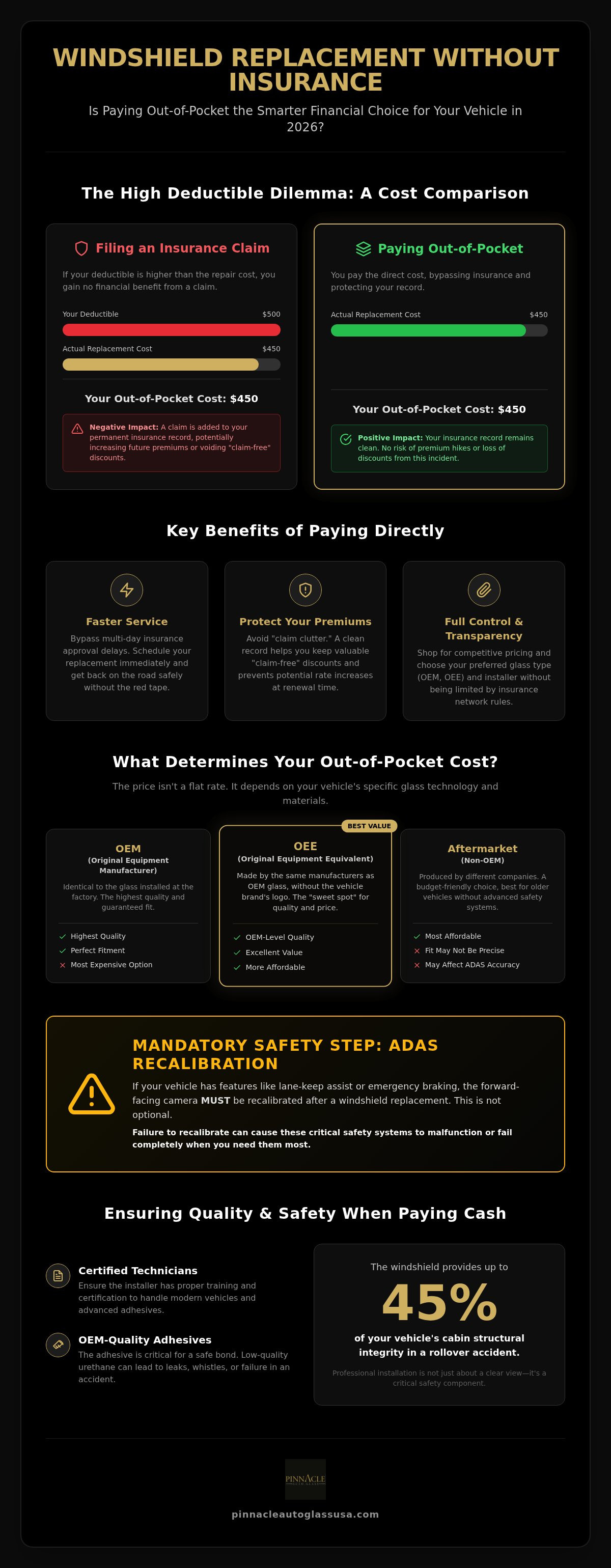
Modern insurance policies frequently carry deductibles of $500 or $1,000. These amounts often match or exceed the total cost of a standard replacement. If a technician quotes you a cash price of $450, but your deductible is $500, filing a claim provides zero financial benefit. You would pay the full $450 out-of-pocket regardless, but the insurance company would still record the incident on your permanent file. Choosing to pay cash in this scenario is the only logical financial decision.
Protecting Your Insurance Premiums
Every claim you file, no matter how small, becomes part of your "claim record." Carriers use this data to calculate your future premiums. While a single glass claim might not double your rate, it can disqualify you from "claim-free" discounts that save you hundreds of dollars annually. Insurance companies are particularly sensitive to how often you use your policy. Claim frequency is the total number of claims filed within a specific window of time, and it serves as a major risk factor for policy non-renewal.
Factors That Influence Your Out-of-Pocket Replacement Cost
The price of a windshield replacement without insurance isn't a flat rate. It fluctuates based on the technology embedded in your glass and the structural requirements of your vehicle. For a 2026 model, the glass is often a sophisticated component rather than a simple transparent shield. Understanding these variables helps you determine if paying cash is Smarter Than Filing a Claim based on your specific vehicle profile.
Your vehicle's make and model dictate the base cost of the raw materials. Luxury brands often use specialized glass with specific curvature or thickness that aftermarket manufacturers may not produce. You generally have three choices: Original Equipment Manufacturer (OEM), Original Equipment Equivalent (OEE), or aftermarket glass. OEM glass is identical to the factory original and typically carries a higher price. OEE glass serves as a "sweet spot" for many drivers, offering the same quality as OEM at a lower cost. Aftermarket options provide a budget-friendly alternative for older vehicles, though they may lack the precise fitment required for newer safety systems.
Hidden features also drive up the complexity. Many modern windshields include acoustic interlayers designed to reduce cabin noise. Others feature integrated rain sensors that trigger wipers automatically. These components require careful handling and specific glass types to function correctly. Cutting corners with a "cheap" installation often results in water leaks or annoying wind whistles that cost more to fix later. Professional labor ensures the structural integrity of your vehicle remains intact, as the windshield provides up to 45% of cabin structural integrity in a rollover.
The Role of ADAS Recalibration
Advanced Driver Assistance Systems (ADAS) use cameras mounted behind the windshield to manage lane-keeping and emergency braking. When you replace the glass, these cameras must be recalibrated to ensure they "see" the road accurately. This is a mandatory safety step, not an optional upgrade. If the sensors are off by even a fraction of a degree, your safety systems could fail when you need them most. You can find more technical details in our guide to ADAS calibration auto glass.
Glass Features: Tinting, Heating, and HUDs
Specialized coatings are necessary for vehicles equipped with a Heads-Up Display (HUD). Without the correct HUD-compatible glass, the projected image will appear blurry or doubled. Similarly, integrated heating elements and built-in antennae add to the manufacturing cost. Because of these variations, providing your Vehicle Identification Number (VIN) is the only way to receive an accurate out-of-pocket quote. If you're unsure which features your vehicle has, a quick consultation with the experts at Pinnacle Auto Glass can clarify your requirements and provide a transparent estimate.
The Math: When Self-Paying Is Smarter Than Filing a Claim
Deciding on a windshield replacement without insurance requires a cold look at the numbers. It's about more than the immediate invoice. You have to weigh the upfront cost against the long-term impact on your policy. Many drivers find that the convenience of a claim is outweighed by the hidden costs of future premium hikes.
The "Break-Even" Rule is a simple tool for this decision. If your out-of-pocket quote is within $100 of your deductible, you should almost always pay cash. For example, if you have a $500 deductible and the service costs $580, paying the full amount yourself protects your record for a mere $80 difference. This small "premium" buys you claim-free status for another year and avoids a permanent mark on your insurance history.
Consider the long-term math of a premium increase. Many carriers raise rates by roughly 10% after a comprehensive claim. If you pay $1,500 annually for auto insurance, that's an extra $150 per year. Over a three-year period, that single glass claim could cost you $450 in additional premiums. When you add that to your original deductible, the "free" insurance replacement becomes significantly more expensive than a one-time cash payment. In 2026, protecting your rate is often the smartest financial move.
Before committing to a full replacement, ask if the damage is fixable. A professional windshield repair can often stop a crack from spreading for a fraction of the replacement cost. This is the most efficient way to save money while maintaining the strength of your glass. It's a fast, reliable solution that avoids the higher costs of new glass entirely.
The Self-Pay vs. Insurance Comparison
Don't just look at the dollar signs. Factor in the "time cost" of your day. Filing a claim involves phone calls, waiting for adjusters, and potential delays in scheduling. A self-pay transaction is immediate. You choose the shop, agree on the price, and get the job done. Professional installers Ensure Quality and Safety by following the same rigorous standards for cash customers as they do for insurance jobs. Your safety guarantee doesn't change just because you're paying the bill yourself.
Commercial and Fleet Considerations
For business owners, the stakes are even higher. Insurance brokers evaluate "loss runs," which show the frequency of claims across your entire fleet. Too many minor glass claims can make your business look high-risk. This leads to higher premiums or even policy non-renewal. Most fleet operators prefer self-pay to keep their loss runs clean. It allows for centralized billing and faster turnaround times. To see how these factors influence the final bill, check our guide on how much does windshield replacement cost.
How to Ensure Quality and Safety When Paying Cash
When you manage a windshield replacement without insurance, you're the primary inspector. You must ensure the shop prioritizes safety over speed. Start by verifying technician certifications. Look for teams trained by the Auto Glass Safety Council (AGSC) or equivalent industry bodies. These standards ensure that the installer follows rigorous procedures for glass removal and bonding. A professional shop will be transparent about their credentials and the materials they use.
Ask specifically about the adhesive being used. The quality of the urethane determines the structural integrity of your vehicle. Professional-grade adhesives provide a specific "Drive-Away Time" (DAT) that tells you exactly when the car is safe to operate. If a shop cannot provide a specific DAT, they're likely using subpar materials. Before the glass goes in, inspect it for distortions, blemishes, or scratches. Budget shops often buy "B-grade" glass to lower their costs, but these defects can cause eye strain and visibility issues. High-quality glass should be clear and free of waves or ripples.
A professional installation must include a lifetime warranty against leaks and manufacturer defects. Paying cash shouldn't mean losing your protection. At Pinnacle Auto Glass, we provide the same high-tier warranty to our cash customers as we do for insurance-covered claims. This ensures that your investment is protected long after the installation is complete.
The Risk of "Tailgate" Installers
Be wary of uncertified mobile installers who offer the lowest possible cash price. These "tailgate" installers often skip critical steps, such as using proper primers or allowing necessary curing times. In a collision, an improperly bonded windshield can pop out. This leads to the failure of passenger-side airbags, which rely on the glass for support during deployment. Always choose a provider with an established mobile or physical presence to ensure you have a point of contact for future warranty follow-ups.
Post-Installation Care for Self-Pay Customers
Your role in safety continues after the technician leaves. Respect the "Drive-Away Time" requirements to allow the urethane to bond fully. Don't drive the vehicle until the specified time has passed. Avoid high-pressure car washes for the first 24 to 48 hours. The water jets can shift the glass or compromise the seal before it cures. Once you're back on the road, listen for wind whistles or "hissing" sounds at highway speeds. These are early signs of a poor seal that needs immediate professional attention.
If you're ready for a secure, high-quality installation, get a professional windshield replacement quote from our certified team today.
Getting a Transparent Quote and Professional Service with Pinnacle
Pinnacle Auto Glass removes the administrative hurdles from the self-pay process. We provide direct, no-nonsense pricing that reflects the true cost of professional-grade materials and labor. By choosing Pinnacle Auto Glass, you gain access to a team that handles everything from personal sedans to specialized commercial truck glass. We prioritize your safety by treating every out-of-pocket customer with the same urgency and care as an insurance claim.
Our commitment to safety includes certified ADAS recalibration as a standard part of our professional service. We ensure your lane-departure warnings and emergency braking systems work perfectly before we finish the job. To secure the most accurate and competitive quote for your windshield replacement without insurance, please have your VIN ready. This allows us to verify your vehicle’s specific glass features and provide a transparent, final price. This precision eliminates the "bait-and-switch" pricing often found with budget providers.
Mobile vs. In-Shop Service Options
We provide both mobile and in-shop service options to maximize your convenience. Mobile service is the preferred choice for busy professionals and fleet managers who need to minimize vehicle downtime. We bring the expertise to your home or workplace. However, certain complex static ADAS recalibrations are best performed in a controlled shop environment. This ensures the highest level of precision for your vehicle’s safety sensors. Pinnacle offers the same rigorous professional standards and lifetime warranty regardless of where the work is performed.
Ready to Restore Your View?
Paying for a windshield replacement without insurance is a strategic financial choice that protects your long-term insurance eligibility. You avoid the risk of premium hikes while ensuring your vehicle receives high-tier, professional-grade glass. This path offers a faster turnaround and total control over the parts used on your vehicle. Our team is ready to restore your view with efficiency and expertise. Contact Pinnacle Auto Glass today for a competitive out-of-pocket estimate and experience a service designed around your needs.
Secure Your Safety and Your Savings
Managing a windshield replacement without insurance is a proactive way to maintain your vehicle and protect your financial standing. By following the "Break-Even" rule, you can avoid unnecessary claims that lead to long-term premium increases. You don't have to sacrifice quality when you choose to pay cash. Professional installation ensures that your vehicle's structural integrity remains intact while keeping your insurance record clean for the future.
Pinnacle Auto Glass supports your decision with expert service tailored to your needs. We are Certified ADAS Recalibration Specialists who ensure every safety sensor is perfectly aligned. Our Professional Mobile Service Available brings this expertise directly to your location, saving you time and hassle. Every job comes with a Lifetime Warranty on Workmanship, giving you total peace of mind. Take control of your auto glass maintenance today with a team that values transparency and technical excellence.
Get a Transparent Out-of-Pocket Quote from Pinnacle Auto Glass and get back on the road with confidence.
Frequently Asked Questions
Is it cheaper to pay for a windshield replacement without insurance?
It's often more economical to pay cash if the total service cost is close to your deductible. Choosing a windshield replacement without insurance allows you to avoid the long-term financial impact of a claim. You save money by protecting your "claim-free" discounts which can vanish after even a minor glass claim.
Will paying for my own windshield prevent an insurance premium increase?
Yes, self-paying ensures the incident never reaches your insurance record. Carriers use claim frequency to determine risk and set rates. By handling the repair privately, you keep your history clean and prevent the "claim clutter" that often leads to higher annual premiums or policy non-renewal.
Does Pinnacle Auto Glass offer a warranty for out-of-pocket customers?
We provide the same lifetime warranty on workmanship for cash customers as we do for insurance clients. This covers manufacturer defects and leaks for as long as you own the vehicle. We maintain high professional standards regardless of the payment method to ensure your safety and satisfaction.
How much does the average windshield replacement cost without insurance in 2026?
Industry data from 2026 shows that base costs for standard glass typically range from $250 to $400 for older vehicles. Modern vehicles with integrated sensors or luxury features can see industry averages between $500 and $1,000. These figures fluctuate based on the vehicle make and whether you select OEM or aftermarket materials.
Is ADAS recalibration included in the cash price quote?
We provide transparent, all-inclusive quotes that clearly outline the costs for both the glass and the necessary recalibration. Recalibration is a mandatory safety requirement for vehicles with driver-assistance cameras. We ensure these systems are fully functional before the vehicle is returned to you.
Can I choose between OEM and aftermarket glass when paying cash?
Self-pay customers have total control over the grade of glass used for their vehicle. You can choose Original Equipment Manufacturer (OEM) glass for a factory-identical fit or high-quality aftermarket glass for a more budget-friendly solution. We also offer Original Equipment Equivalent (OEE) glass as a mid-range option.
How long does a self-pay windshield replacement take from start to finish?
The physical installation usually takes about 60 minutes. If your vehicle requires ADAS recalibration, you should plan for an additional 60 to 90 minutes of technical work. We also specify a "Drive-Away Time" to ensure the adhesives have bonded sufficiently for your safety before you leave.
What happens if I have a high deductible and need a new windshield?
High deductibles often make insurance coverage redundant for glass repairs. If a windshield replacement without insurance costs less than your $500 or $1,000 deductible, the insurance company pays nothing while still recording the incident. Paying cash is the smartest way to manage the cost without impacting your policy.


