
Your driveway is the new high-tech service bay, and it's just as safe as a specialized facility. You likely feel that choosing mobile auto glass repair means sacrificing technical precision for the sake of convenience. It's a common concern. Between unpredictable weather affecting adhesive seals and the complexity of modern safety sensors, you might think a brick-and-mortar shop is your only reliable option. New 2026 regulations, such as the New York auto glass legislation enacted in late 2025, now mandate strict transparency and documentation regarding these safety systems and their functionality.
This guide demonstrates how professional mobile auto glass repair brings shop-quality safety and precision technology directly to your vehicle, anywhere in the country. You'll learn how to restore vehicle safety without losing a full day at the shop. We'll cover the essentials of verified on-site ADAS recalibration, weather-resistant installation protocols, and seamless insurance coordination for personal and commercial fleet vehicles. This is your roadmap to professional results without the downtime. We provide the technical expertise to get you back on the road with total confidence in your vehicle's structural integrity.
Key Takeaways
- Understand how modern mobile units replicate laboratory-grade safety standards through on-site ADAS recalibration and precision technology.
- Learn how professional mobile auto glass repair restores vehicle safety without the high downtime associated with traditional shop visits.
- Identify the critical preparation steps, from workspace leveling to vehicle verification, that ensure a successful mobile installation.
- Discover specialized solutions for commercial fleets and heavy trucks designed to maintain operational efficiency and safety compliance.
- Compare the time and cost-effectiveness of mobile service versus in-shop repairs to make an informed decision for your vehicle.
What is Mobile Auto Glass Repair and Why Does it Matter?
Mobile auto glass repair is a specialized on-site service that brings factory-standard equipment and technical expertise directly to your vehicle. It is no longer just a basic "van with a toolkit" operation. Today's mobile units function as portable laboratories. They are designed to restore the structural integrity of your vehicle wherever it is parked. This shift is critical because your windshield is a primary safety component. It supports the roof during rollovers and ensures proper airbag deployment. Professional mobile auto glass repair ensures that these safety features remain intact without requiring you to sacrifice a full day at a service center.
Maintaining national road safety standards is a top priority for mobile technicians. This is especially true as states update their requirements. For example, New York enacted legislation in late 2025 requiring shops to provide strict documentation regarding safety systems and recalibration needs. High-quality mobile services meet these rigorous standards by using laminated safety glass that meets or exceeds original equipment manufacturer (OEM) specifications. This commitment to quality ensures that every on-site installation provides the same protection as one performed in a traditional shop environment.
The Technology Behind On-Site Glass Solutions
Modern mobile units are equipped with precision tools that replicate a controlled shop environment. Technicians use advanced extraction devices to remove damaged glass without harming the vehicle's frame or paint. One of the most significant advancements for 2026 is the use of high-viscosity, rapid-cure adhesives. These specialized chemicals allow for a safe drive-away time of just 30 to 60 minutes, even in varying humidity levels. Technicians also utilize calibrated climate-control covers to ensure the adhesive cures correctly regardless of the outside temperature. This level of technical control guarantees a factory-grade seal every time.
Convenience vs. Safety: Breaking the Misconception
A common myth suggests that mobile service is a "quick fix" that compromises quality. This is incorrect. Mobile technicians follow the same rigorous safety protocols as shop-based staff. The key is to ensure you are working with a certified auto glass technician who understands the complexities of modern vehicle frames. Choosing mobile auto glass repair early also prevents minor issues from escalating. A simple chip repair can often be completed on-site in under 30 minutes. Addressing these small flaws immediately prevents them from becoming large cracks that compromise your safety and eventually require a full replacement.
The Technical Process: Ensuring Mobile Installation Quality
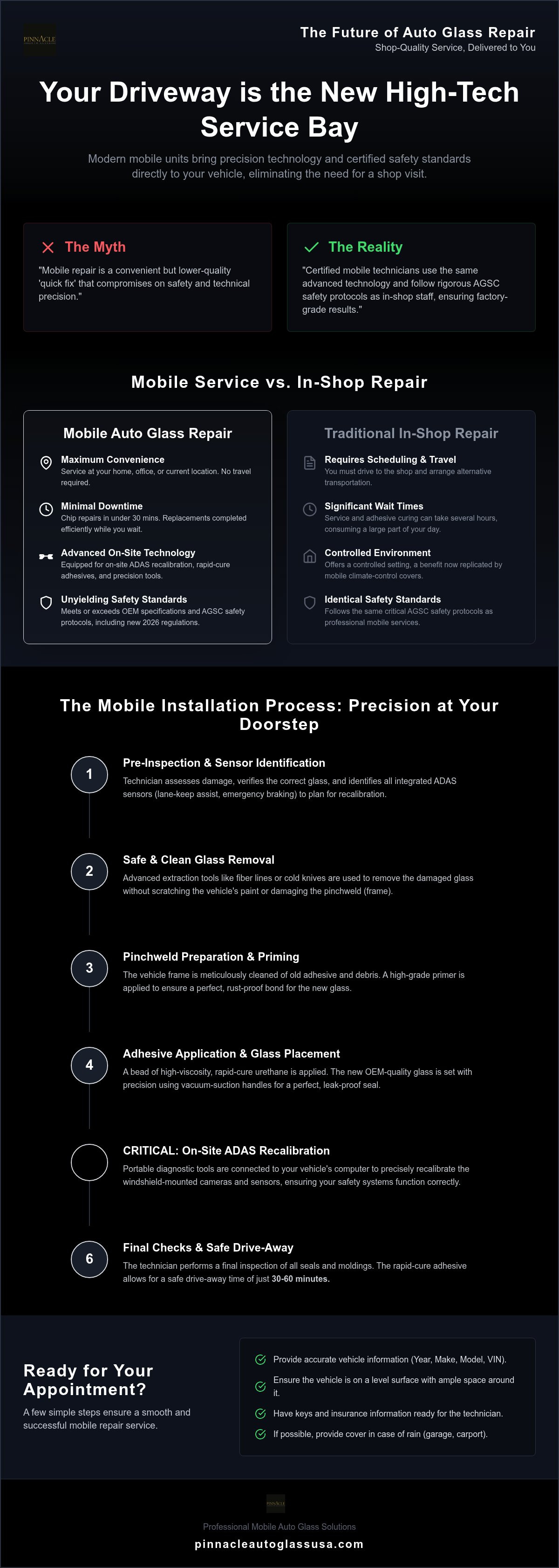
Executing a high-quality mobile auto glass repair requires a disciplined, multi-step workflow. It begins with a comprehensive pre-inspection. Technicians evaluate the existing glass damage and identify all integrated safety sensors. This step is vital for vehicles equipped with Advanced Driver Assistance Systems (ADAS). Once the assessment is complete, the technician uses specialized tools to remove the damaged unit. They favor fiber lines or cold knives to ensure the vehicle’s paint and pinchweld remain undamaged. This level of care prevents future rust and maintains the structural integrity of the frame.
The next phase focuses on bond integrity. Technicians clean the pinchweld thoroughly to remove old adhesive and debris. They then apply a high-grade primer to any exposed metal. This step follows the strict protocols established by the Auto Glass Safety Council (AGSC). Precision placement follows. Using vacuum-suction handles or mechanical setting tools, the technician seats the new glass perfectly. A final safety check ensures all moldings are flush and the adhesive has a continuous, leak-proof seal. If you need a professional assessment, you can schedule a mobile inspection today.
Mobile ADAS Recalibration: A Safety Necessity
Modern windshields are more than just glass; they are tech-heavy safety components. Cameras and sensors for lane-keep assist and emergency braking are mounted directly to the glass. Any replacement shifts these sensors by fractions of a millimeter. This shift can cause safety systems to malfunction. Technicians must perform ADAS calibration and auto glass alignment simultaneously. Mobile units use two primary methods. Static recalibration involves setting up physical targets in a level environment. Dynamic recalibration requires driving the vehicle at specific speeds to reset the software. Both ensure your safety tech works exactly as the manufacturer intended.
Weather and Environmental Safety Standards
Environmental control is a major factor in on-site success. Professional technicians monitor ambient temperature and humidity before starting. For 2026 mobile auto glass repair installations, high-performance adhesives require specific temperature windows to bond correctly. If it’s raining or too windy, technicians use specialized canopies to create a dry, debris-free workspace. The most critical factor is the Safe Drive-Away Time (SDAT). Most modern adhesives allow for a safe drive-away time of 30 to 60 minutes. You must respect this window. It allows the adhesive to cure enough to hold the windshield in place during a collision or airbag deployment. This methodical approach ensures your vehicle remains a safe environment for every passenger.
Mobile vs. In-Shop: Choosing the Best Service Option
Deciding between a shop visit and mobile auto glass repair often comes down to your schedule and the specific technical needs of your vehicle. For most drivers, the time commitment is the deciding factor. A traditional shop visit requires you to drop off your vehicle, arrange alternative transportation, and wait several hours for the adhesive to cure. Mobile service eliminates this downtime. Technicians arrive at your home or office, completing the work while you continue your day. This efficiency makes it the most cost-effective choice for busy professionals who cannot afford to lose a full day of productivity.
Technical parity between mobile units and fixed locations has reached an all-time high. Modern mobile service vehicles carry the same advanced diagnostic tools and high-grade materials found in permanent bays. Every installation, regardless of location, must adhere to the Federal Motor Vehicle Safety Standard No. 205. This regulation ensures that the glass used meets specific transparency and strength requirements. When choosing your service method, use a clear framework to evaluate your needs. You can find a detailed breakdown in our professional windshield replacement guide to help you decide which path fits your vehicle's safety profile.
When to Opt for Mobile Service
Mobile service is the ideal solution for standard windshield replacements and rock chip repairs. It is the primary choice for commercial fleets that need to maintain high operational uptime. Keeping a vehicle on-site for glass work ensures that drivers are back on the road immediately after the safe drive-away time. Additionally, if your glass damage is severe enough to obstruct your view, driving to a shop is a safety hazard. In these cases, mobile auto glass repair is the only responsible option. It prevents you from operating a vehicle that is legally and physically unsafe to drive.
When an In-Shop Visit is Recommended
There are specific scenarios where a controlled shop environment is necessary. If you do not have access to a covered workspace and the weather involves heavy rain, snow, or extreme temperatures, an indoor bay is safer. Some highly complex ADAS systems require specialized indoor lighting conditions to calibrate the cameras perfectly. Also, if your vehicle has sustained damage to the metal frame or roof pillars, it may require structural repairs that go beyond a simple glass replacement. In these rare instances, a fixed location provides the heavy equipment needed for comprehensive bodywork and safety restoration.
Preparation Checklist for Your Mobile Glass Appointment
Successful mobile auto glass repair relies on proper site preparation. Your technician needs specific conditions to deliver a factory-quality result. Start by verifying your vehicle’s exact specifications. This includes the year, make, model, and any integrated features like rain sensors or heated wipers. Providing the Vehicle Identification Number (VIN) is the most reliable way to ensure the technician arrives with the correct glass. This prevents delays and ensures that all safety features remain functional after the installation.
Next, identify a suitable workspace. The area must be level and firm. This is essential for accurate ADAS recalibration. If your vehicle is on a steep incline, the sensors may not align correctly during the reset process. You also need to ensure there is at least three feet of clearance around the front and sides of the vehicle. This allows the technician to maneuver tools and glass safely. Clear communication regarding your location helps the technician arrive on time and ready to work.
Before the technician leaves the site, perform a final walkthrough to verify the quality of the service. Follow these steps for a thorough inspection:
- Check for uniform gaps between the glass and the vehicle body.
- Verify that the interior trim and rearview mirror have been reinstalled correctly.
- Test any sensors or cameras that were recalibrated on-site to ensure they are active.
- Confirm the specific Safe Drive-Away Time (SDAT) for your adhesive.
Ready to restore your vehicle's safety? You can request a mobile service quote online right now.
Workspace and Environmental Requirements
Environmental factors directly impact the success of mobile auto glass repair. During peak summer heat, try to provide a shaded or covered area. Direct sunlight can cause the metal frame to expand, which may interfere with the adhesive bond. If your vehicle is parked in a high-traffic or public area, use safety cones to create a secure perimeter. This protects both the technician and passersby from accidental injury. A controlled environment ensures the adhesive cures according to manufacturer specifications.
Documentation and Insurance Coordination
Coordinating with your insurance provider shouldn't be a burden. To expedite your windshield repair or replacement claim, have your policy number and the date of damage ready. Most comprehensive policies cover glass services, though your specific deductible will apply. In states like Florida, insurers are often required to waive deductibles for windshield services. Pinnacle Auto Glass simplifies this process for national and commercial clients. We handle the paperwork directly with your carrier. This ensures that all safety standards and recalibration requirements are documented for your long-term records.
Specialized Mobile Solutions for Fleet and Commercial Vehicles
Commercial vehicles operate under intense conditions. High mileage and frequent highway travel significantly increase the risk of windshield damage. For a logistics manager, a single cracked windshield isn't just a safety issue; it's a potential service interruption. Traditional repair methods often involve taking vehicles out of rotation for several days. This is where professional mobile auto glass repair becomes a strategic asset. By bringing the service to your depot or distribution center, you eliminate the logistical headache of transporting heavy-duty trucks to a fixed location. It keeps your drivers on the road and your cargo moving without unnecessary delays.
National fleet managers prioritize mobile-first partnerships because they provide a scalable solution to maintenance. Whether you manage a dozen delivery vans or a transcontinental trucking fleet, on-site service ensures that your assets stay on schedule. This approach is central to reducing fleet downtime with mobile glass repair, as it allows for maintenance during loading or mandatory rest periods. Our technicians are trained to handle the specific requirements of commercial truck glass. These installations often involve larger dimensions and specialized mounting systems compared to standard passenger vehicles. We ensure every job meets the rigorous national technician certification standards established for 2026.
Customized Fleet Maintenance Programs
Proactive care is the most effective way to manage glass costs across a large fleet. We offer scheduled on-site inspections designed to identify minor chips before they evolve into full-frame cracks. This preventive strategy is particularly valuable for centralized logistics hubs where multiple vehicles can be serviced in a single visit. We also provide standardized safety reporting for every repair. This documentation ensures your fleet remains compliant with federal safety regulations and internal audit requirements. Bulk service options allow you to maintain a high standard of vehicle integrity without complicating your operational budget or scheduling.
The Pinnacle Mobile Advantage
We provide technical leadership in mobile safety systems for the commercial sector. Every replacement utilizes high-quality OEM-spec glass to ensure durability and a perfect fit. Our mobile units carry advanced recalibration technology directly to your fleet yard. This means your trucks' lane-departure and collision-avoidance systems are reset and verified on-site immediately after the glass is set. You gain direct access to expert technicians who understand the urgency of commercial glass needs. This commitment to quality and speed makes mobile auto glass repair the superior choice for modern logistics operations. We focus on getting your vehicles back in service safely and efficiently.
Secure Your Vehicle's Safety with On-Site Precision
Professional mobile auto glass repair has evolved into a high-tech safety service that matches laboratory-grade quality. You no longer need to sacrifice a full day at a repair center to ensure your vehicle remains structurally sound. By integrating expert ADAS recalibration directly into the on-site workflow, our technicians verify that every camera and sensor functions exactly as the manufacturer intended. This precision is available for every vehicle make, ensuring that personal cars and heavy-duty commercial trucks receive the same rigorous attention to detail.
Efficiency doesn't mean cutting corners. A successful installation relies on certified technicians, high-grade materials, and seamless insurance claim processing. These elements work together to restore your visibility and safety without disrupting your operational schedule. You can schedule your professional mobile auto glass service with Pinnacle Auto Glass today to experience this modern approach to vehicle maintenance. Trust the expertise of a national leader to keep you moving safely. Your peace of mind is just one appointment away.
Frequently Asked Questions
Is mobile auto glass repair as safe as in-shop service?
Yes, mobile auto glass repair is just as safe as in-shop service when performed by certified technicians. Every on-site installation must adhere to the same Federal Motor Vehicle Safety Standards and Auto Glass Safety Council protocols. Technicians use high-grade adhesives and precision tools to ensure structural integrity. The primary difference is the location, not the quality of the engineering or the final safety result.
How long does a mobile windshield replacement take in 2026?
A standard mobile windshield replacement typically takes between 60 and 90 minutes to complete. This timeframe includes the pre-inspection, glass removal, surface preparation, and the setting of the new glass. If your vehicle requires ADAS recalibration, the process may take longer depending on whether a static or dynamic reset is required. Technicians prioritize precision over speed to ensure a factory-grade seal.
Can ADAS systems be accurately recalibrated during a mobile appointment?
Yes, ADAS systems are accurately recalibrated during mobile appointments using portable diagnostic equipment. Technicians perform either static calibration with physical targets or dynamic calibration by driving the vehicle under specific conditions. As long as the vehicle is parked on a level surface with adequate clearance, mobile units can restore your safety sensors to manufacturer specifications right in your driveway.
What happens if it starts raining during my mobile glass repair?
Technicians monitor the weather closely and will use specialized canopies to keep the workspace dry if light rain occurs. However, moisture interferes with the bonding process of most adhesives. If the weather becomes severe or high winds prevent a safe installation, the technician will reschedule the appointment. This ensures the mobile auto glass repair maintains its structural integrity and leak-proof seal.
Does auto insurance cover the cost of mobile glass services?
Most comprehensive auto insurance policies cover the cost of mobile glass services. Many insurance providers waive the deductible for windshield repairs to encourage drivers to fix small chips before they become large cracks. Our team handles the insurance coordination directly, processing the paperwork with your carrier to ensure a seamless experience. You should verify your specific coverage and deductible thresholds before the service begins.
How long do I have to wait to drive my car after a mobile windshield replacement?
You must wait for the Safe Drive-Away Time (SDAT) to pass before operating your vehicle, which is typically 30 to 60 minutes after installation. This window allows the high-viscosity adhesive to cure sufficiently to hold the windshield in place during an accident. Driving too soon can compromise the seal and your safety. Your technician will provide a specific time based on the adhesive used and current environmental conditions.
Do I need to be present during the mobile glass repair service?
You don't need to stand by the vehicle for the entire duration, but you must be available at the start and end of the appointment. The technician needs access to the interior of the vehicle and will require a signature on the pre-inspection and final safety check documents. For commercial fleet services, a designated site manager can often handle these requirements to minimize driver downtime.
What is the maximum size chip that can be repaired by a mobile unit?
Mobile units can generally repair chips that are smaller than a quarter or single cracks less than six inches long. If the damage is in the driver's direct line of vision or has reached the edge of the glass, a full replacement is usually required for safety. Addressing small chips through mobile auto glass repair quickly prevents them from spreading and maintains the original factory seal of your windshield.


