

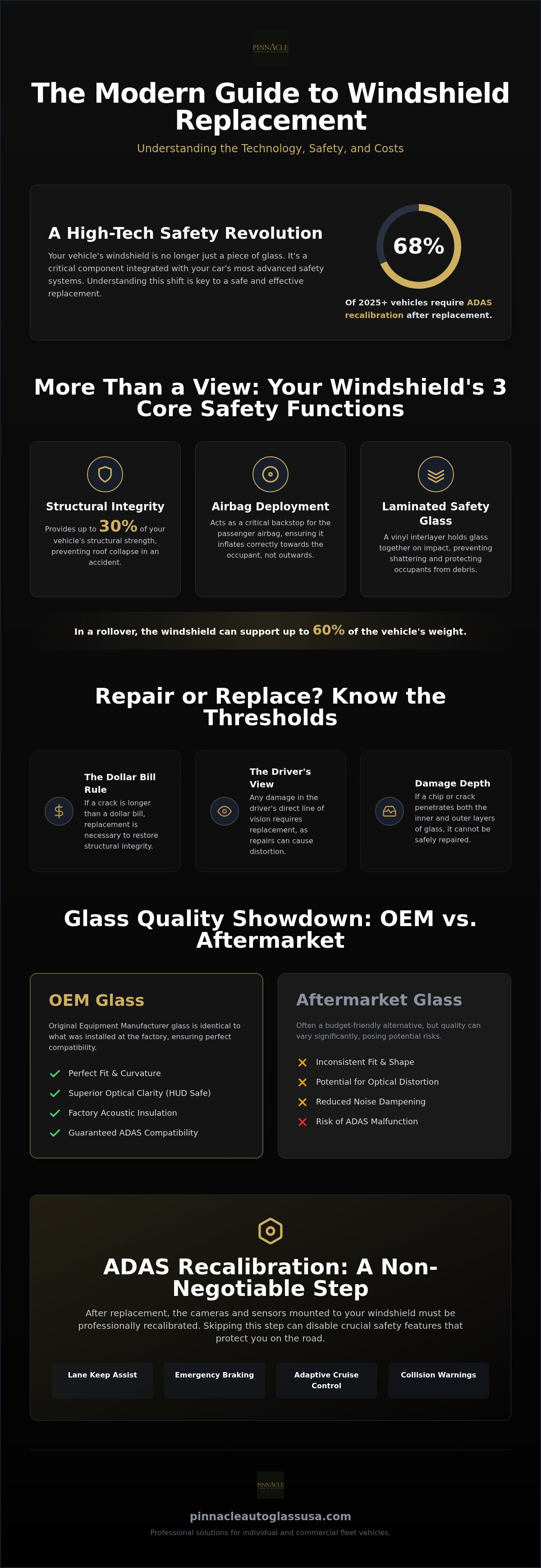
Did you know that as of 2025, approximately 68% of new mid-to-premium vehicles require a complex ADAS recalibration after a standard glass swap? Many drivers researching windshield replacement costs are surprised to find that the price isn't just about the glass anymore. It's a high-tech procedure that affects your car's primary safety systems. You likely feel the pressure of choosing between a quick fix and a repair that keeps your Lane Assist and emergency braking functional. It's frustrating to worry about leaks or tech failures while your vehicle sits in the shop.
We understand that you need a reliable, crystal-clear view without the technical headaches. This guide will help you master the technical, safety, and financial aspects of windshield replacement to ensure your vehicle remains a protective shield on the road. We'll explain understanding recent legislative changes affecting insurance deductible rules, the necessity of professional ADAS calibration, and how to manage insurance claims efficiently. You'll gain the clarity needed to get your car back in peak condition with minimal downtime.
Key Takeaways
- Understand the windshield’s role as a critical structural component that supports roof integrity and proper airbag deployment.
- Compare OEM and aftermarket glass standards to choose materials that offer superior optical clarity and a precise fit.
- Learn why ADAS recalibration is a mandatory step for restoring the alignment of safety sensors and cameras after a glass swap.
- Evaluate the variables influencing windshield replacement cost Florida residents pay, including recent changes to insurance deductible laws.
- Identify key criteria for choosing a professional partner who specializes in both individual and commercial fleet glass solutions.
Beyond the Crack: Why Windshield Glass Replacement is a Safety Priority
Modern vehicles treat the windshield as a fundamental structural element. It isn't just there to block the wind; it's engineered to work in tandem with the vehicle's frame. If you're weighing the windshield replacement cost Florida service providers offer, remember that you're paying for the restoration of your car's safety cage. A compromised windshield is a weak link in an otherwise robust safety system.
The industry often references the "30% Rule." In most passenger vehicles, the windshield provides up to 30% of the cabin's structural strength. This structural support is vital during a rollover accident where the glass prevents the roof from collapsing. Without a properly bonded windshield, the risk of a roof crush increases significantly. This is why professional installation and high-quality adhesives are non-negotiable.
Safety also comes from the composition of the glass itself. Modern vehicles use laminated safety glass, which consists of a durable vinyl layer sandwiched between two sheets of glass. This technology prevents the glass from shattering into sharp shards during high-speed impacts. Instead, the glass stays intact, protecting occupants from flying debris and helping to keep them inside the vehicle during a crash.
By 2026, vehicle standards have made professional installation even more critical. New models integrate camera mounts and sensors directly onto the glass. A poor installation doesn't just risk a leak; it can disable your vehicle’s most advanced safety features. You need a solution that respects the engineering of your car.
The Structural Role of Automotive Glass
Your windshield serves as the primary backstop for the passenger-side airbag. When an airbag deploys, it strikes the glass first to expand toward the passenger. If the adhesive bond is weak or the glass is cracked, the force can push the windshield out of the frame. This causes the airbag to deploy out of position, leaving the passenger unprotected. The windshield provides approximately 30% of a vehicle's total structural integrity, and this figure can rise to 60% during a rollover event.
Signs Your Damage Has Crossed the Replacement Threshold
Knowing when to repair and when to replace is essential for your safety. While small chips are often fixable, certain types of damage demand immediate glass replacement:
- The Dollar Bill Rule: If a crack is longer than a dollar bill, the glass's structural integrity is likely compromised.
- The Acute Area: Any damage in the driver’s direct line of vision requires replacement because repairs can leave slight distortions that impair visibility.
- Double-Layer Penetration: If a chip or crack penetrates both the inner and outer layers of the laminated glass, it cannot be safely repaired.
Don't wait for a small crack to spiderweb across your vision. Evaluating the windshield replacement cost Florida drivers face today is a small price for maintaining your vehicle's protective shield.
Material Quality: Comparing OEM vs. Aftermarket Windshields
Your choice of glass directly impacts your vehicle's performance and safety. While many drivers focus solely on the windshield replacement cost Florida shops quote, the material standard is what determines long-term satisfaction. There are two primary categories of replacement glass: OEM and OEE.
OEM (Original Equipment Manufacturer) glass is produced by the same company that made your vehicle's factory glass. It matches the original specifications for thickness, curvature, and tint exactly. For owners who want to further enhance these properties with high-performance films, Sun Guard Tint offers expert automotive applications that serve as a gold standard for comfort and UV protection. OEE (Original Equipment Equivalent) glass is made by other manufacturers to similar standards. While OEE is often more affordable, budget-tier aftermarket glass can fall short in several critical areas.
Optical clarity is the most immediate difference. High-end glass provides a distortion-free view across the entire surface. Lower-quality alternatives often have slight "waves" or thickness variations. These imperfections are especially problematic for vehicles equipped with Heads-Up Displays (HUD). Poor glass quality can cause ghosting or blurred images, making the HUD difficult to read. Additionally, factory-spec glass is engineered for acoustic insulation. Thinner, cheaper glass allows more wind and road noise to penetrate the cabin, degrading your driving experience.
The Hidden Risks of Economy Glass
Economy glass often lacks the precision required for modern vehicle sensors. Even a minor deviation in the glass's curvature can interfere with ADAS recalibration. If the camera's view is slightly distorted by the glass, the safety system may provide inaccurate warnings or fail to engage. Inconsistent fitment is another common issue. If the glass doesn't seat perfectly in the frame, you may experience persistent water leaks or whistling wind noise at highway speeds. These issues often lead to higher costs later when the glass must be removed and resealed.
Choosing the Right Glass for Your Vehicle Make
For luxury and tech-heavy vehicles, OEM glass is often non-negotiable. The integrated technology in these cars depends on exact tolerances that only factory glass can guarantee. For standard vehicles, OEE glass from a reputable manufacturer serves as a reliable, cost-effective alternative. It's helpful to review the technical differences between OEM vs Aftermarket windshield quality before making a final decision. If you aren't sure which option is best for your car, you can consult with a professional to find the right balance of price and performance. Balancing the windshield replacement cost Florida providers offer with the necessity of high-quality materials ensures your vehicle remains safe for years to come.
The ADAS Factor: Why Recalibration is Non-Negotiable
Advanced Driver Assistance Systems (ADAS) have transformed the windshield from a simple viewing port into a high-tech sensor hub. These systems rely on forward-facing cameras and sensors mounted directly behind the rearview mirror. When you calculate the windshield replacement cost Florida insurance policies typically cover, recalibration is now a standard requirement. The glass and the technology are no longer separate components; they function as a single unit.
Removing a windshield disrupts the precise alignment of these sensors by default. Even a microscopic shift in the glass position changes the camera's field of vision. In the 2026 automotive landscape, skipping this step isn't just a technical oversight. It's a significant safety and legal liability. If your Lane Keep Assist or Automatic Emergency Braking fails because of improper calibration, the responsibility falls on the owner and the service provider. Professional shops treat recalibration as a mandatory part of the safety workflow.
Most modern vehicles require one of two recalibration methods. Static recalibration occurs in a controlled shop environment using specialized target boards and laser levels to reset the camera's baseline. Dynamic recalibration requires the vehicle to be driven at specific speeds on well-marked roads while connected to a diagnostic tool. Some 2026 models even require a "dual" recalibration that combines both methods to ensure total accuracy.
Cameras, Lasers, and Lane Departure Systems
The forward-facing camera "sees" the road by interpreting light as it passes through the glass. Every piece of glass has a specific refractive index that affects how light bends. If the glass quality is poor or the camera is off-center, the system receives distorted data. This leads to delayed response times or phantom braking events. You can review our ADAS Calibration Reference Guide for more technical details on how glass curvature impacts sensor performance.
The Recalibration Process: What to Expect
A professional service begins with a pre-scan to identify any existing faults in the safety system. After the glass is installed and the adhesive has cured, technicians perform the actual alignment. This involves either setting up physical targets in the bay or taking the vehicle for a calibration drive. A post-scan then confirms that all systems are communicating correctly. A single degree of camera misalignment can translate to a 10-foot error in the vehicle's projected path at highway speeds. This precision is why specialized equipment is essential for every replacement. Balancing the windshield replacement cost Florida residents pay with these safety requirements ensures your tech-heavy vehicle remains a protective shield on the road.
The Professional Replacement Process: A Step-by-Step Guide
Precision is the hallmark of a professional glass installation. While many car owners prioritize the windshield replacement cost Florida providers quote, the actual value lies in the technical execution. A rushed job often leads to air whistles, water leaks, or structural failure during an accident. Our process follows a rigorous five-step safety protocol to ensure your vehicle is restored to factory standards.
- Step 1: Vehicle Protection and Prep. Technicians cover the hood and interior to prevent debris damage. They remove the wipers, cowl, and trim to access the glass edge safely.
- Step 2: Precision Extraction. Using specialized fiber wire or power tools, the technician cuts the old urethane bead. This method prevents paint scratches on the vehicle frame.
- Step 3: Pinchweld Preparation. The old adhesive is trimmed to a thin layer. Technicians apply professional primers to the metal frame to prevent corrosion and ensure a molecular bond.
- Step 4: Urethane Application and Setting. A high-modulus urethane bead is applied using a powered caulking gun. The new glass is set into place with suction cups for perfect alignment.
- Step 5: Recalibration and Inspection. The technician performs the ADAS recalibration and a final safety check. This ensures all sensors are active before you drive away.
The Science of the Bond: Urethane and Primers
The bond between your glass and the vehicle frame is a chemical feat. Professional shops never use standard silicone because it lacks the structural strength required for automotive safety. Instead, we use high-modulus urethane that acts as a structural adhesive. Primers are equally critical; they create a surface where the urethane can bond at a molecular level. This prevents the glass from popping out during an airbag deployment. Safe Drive-Away Time (SDAT) is the period required for this bond to become structural. In Florida's high humidity, this time can vary, but most modern adhesives allow for road use within 60 minutes of installation.
Post-Service Care for Your New Windshield
Your involvement in the safety process continues after the installation. Follow these rules to protect the curing seal:
- The 24-Hour Rule: Avoid high-pressure car washes for at least one full day. The force can displace the curing urethane.
- Pressure Management: Leave one window cracked about an inch. This prevents air pressure spikes from "popping" the seal when you slam the car doors.
- Retention Tape: Don't remove the blue painter's tape for 24 hours. It holds the glass in place while the adhesive reaches its initial set.
By following these steps, you ensure that the windshield replacement cost Florida drivers pay results in a permanent, leak-free solution. If you're ready for a high-standard installation, schedule your professional glass service with our expert team today.
Selecting the Right Partner for Personal and Fleet Glass
Choosing a glass provider requires a balance of technical skill and administrative efficiency. You shouldn't settle for a shop that only handles the physical installation. A premier partner must demonstrate expertise in ADAS recalibration, insurance claim processing, and specialized glass types. Much like the reliability homeowners expect from Long Island Windows and Siding for exterior upgrades, the goal for any driver is a safe, high-quality restoration with minimal vehicle downtime.
Professional certification and the use of modern technology are the primary benchmarks for quality. Ensure your chosen specialist uses high-modulus urethanes and follows the safety protocols detailed earlier in this guide. For commercial clients, the stakes are even higher. Heavy-duty glass for semi-trucks and box trucks involves unique challenges, such as larger glass panes and specialized gasket seals. These vehicles require technicians who understand the specific structural needs of heavy-duty frames.
Mobile service has become the industry standard for modern fleet management. It eliminates the logistical headache of transporting large commercial vehicles to a fixed location. Instead, technicians perform the replacement and recalibration at your warehouse or yard. This flexibility is essential for maintaining a productive supply chain.
Fleet and Commercial Glass Management
Commercial operators need a partner that understands the cost of an idle vehicle. We provide customized scheduling to keep delivery vans and service trucks on the move without unnecessary delays. By using mobile technology, we manage glass maintenance for large-scale fleets directly at the vehicle's location. This proactive approach prevents small chips from turning into costly replacements. You can see how to reduce fleet downtime with mobile glass repair efficiently in our strategic guide.
Insurance and Cost Management
Managing the windshield replacement cost Florida residents face often depends on insurance coverage. The claims process differs significantly between comprehensive and liability-only policies. Under Florida's 2023 legislative updates, car owners should verify if a deductible applies to their specific glass claim. We assist by navigating these state-specific statutes and working directly with your carrier to ensure seamless processing. For a deeper look at the variables that impact your out-of-pocket expenses, consult our Windshield Replacement Cost Guide for pricing factors. Understanding these financial dynamics ensures you receive the best value without compromising on the safety of your vehicle.
Restore Your Vehicle's Safety Standards Today
Modern auto glass is a structural safety shield and a precision hub for your vehicle's driver assistance technology. You now understand that a professional installation involves more than just swapping glass. It requires high-quality materials and mandatory ADAS recalibration to keep your safety systems functional. Navigating the windshield replacement cost Florida residents pay is simpler when you prioritize long-term reliability over a quick fix. Don't compromise on safety. Choosing a partner that handles both the glass and the tech ensures your vehicle remains a protective shield on the road.
Pinnacle Auto Glass provides national service for personal and commercial fleets. We are certified ADAS recalibration specialists offering expert mobile and in-shop glass solutions for all vehicle makes. Our team is ready to help you manage insurance claims and restore your vehicle to factory standards with minimal downtime. Get a Professional Windshield Replacement Quote from Pinnacle Auto Glass today. Take the guesswork out of your glass care and drive with the confidence that your vehicle is fully protected.
Frequently Asked Questions
How long does a professional windshield replacement actually take?
A standard windshield replacement takes approximately 60 to 90 minutes to complete. This timeframe includes the removal of the old glass, cleaning the pinchweld, and setting the new windshield. However, the total time your vehicle is out of service includes the curing period for the adhesive. We prioritize safety and ensure all trim and cowls are reinstalled correctly before returning your keys for a final inspection.
Can I drive my car immediately after the glass is installed?
You shouldn't drive your vehicle until the high-modulus urethane has reached its Safe Drive-Away Time (SDAT). In most cases, this requires at least 60 minutes of curing time after the glass is set. Driving too early risks the glass shifting or the seal failing during an impact. Our technicians will provide a specific time when it's safe to get back on the road based on current humidity and temperature conditions.
Will my insurance rates go up if I file a glass replacement claim?
Filing a comprehensive glass claim in Florida typically doesn't result in a rate increase because these are considered "no-fault" incidents. While insurance companies used to waive the deductible entirely, a 2023 law change now allows some insurers to apply your comprehensive deductible to the total windshield replacement cost Florida residents incur. It's best to verify your specific policy terms with your agent before starting the claim to avoid surprises.
Does every new windshield require ADAS recalibration?
Recalibration is only necessary if your vehicle is equipped with Advanced Driver Assistance Systems (ADAS). If your car features lane assist, automatic braking, or adaptive cruise control, the forward-facing camera must be reset after a glass swap. Vehicles without these tech features don't require the recalibration process. We perform a pre-scan on every vehicle to determine exactly which safety systems are present and require professional attention.
What is the difference between a repair and a full replacement?
A repair is suitable for small chips or cracks that are smaller than a dollar bill and not in the driver's direct line of sight. Replacement is mandatory when the damage is structural, penetrates both layers of glass, or is located in the driver's acute area. Repairing a chip is a fast process that prevents the damage from spreading, while replacement restores the vehicle’s full structural integrity and optical clarity.
What happens if my ADAS system isn’t recalibrated correctly?
An incorrectly recalibrated ADAS system can lead to dangerous malfunctions or total system failure. If the camera is off by even one degree, your lane departure warnings or emergency braking may activate at the wrong time or fail to trigger when needed. This creates a significant safety risk for you and other drivers. Professional recalibration ensures that all cameras and sensors see the road exactly as the manufacturer intended.
Is mobile windshield replacement as safe as in-shop service?
Mobile windshield replacement is just as safe as in-shop service when performed by certified technicians using professional-grade tools. The primary difference is the environment. For a mobile install to be successful, the vehicle must be in a dry area to ensure the adhesive cures properly. Some complex ADAS recalibrations require a controlled shop environment, but many standard replacements are perfectly suited for mobile dispatch to your home or office.
How do I know if the glass being used is high-quality OEM or OEE?
You can verify the quality of your glass by inspecting the "bug" or glass monogram located in the corner of the windshield. OEM glass will feature the vehicle manufacturer's logo, while OEE glass will show the name of a reputable glass manufacturer like Pilkington or Vitro. Both standards meet federal safety requirements, but OEM glass ensures an exact match to the factory specifications for thickness, tint, and the windshield replacement cost Florida providers estimate.


