
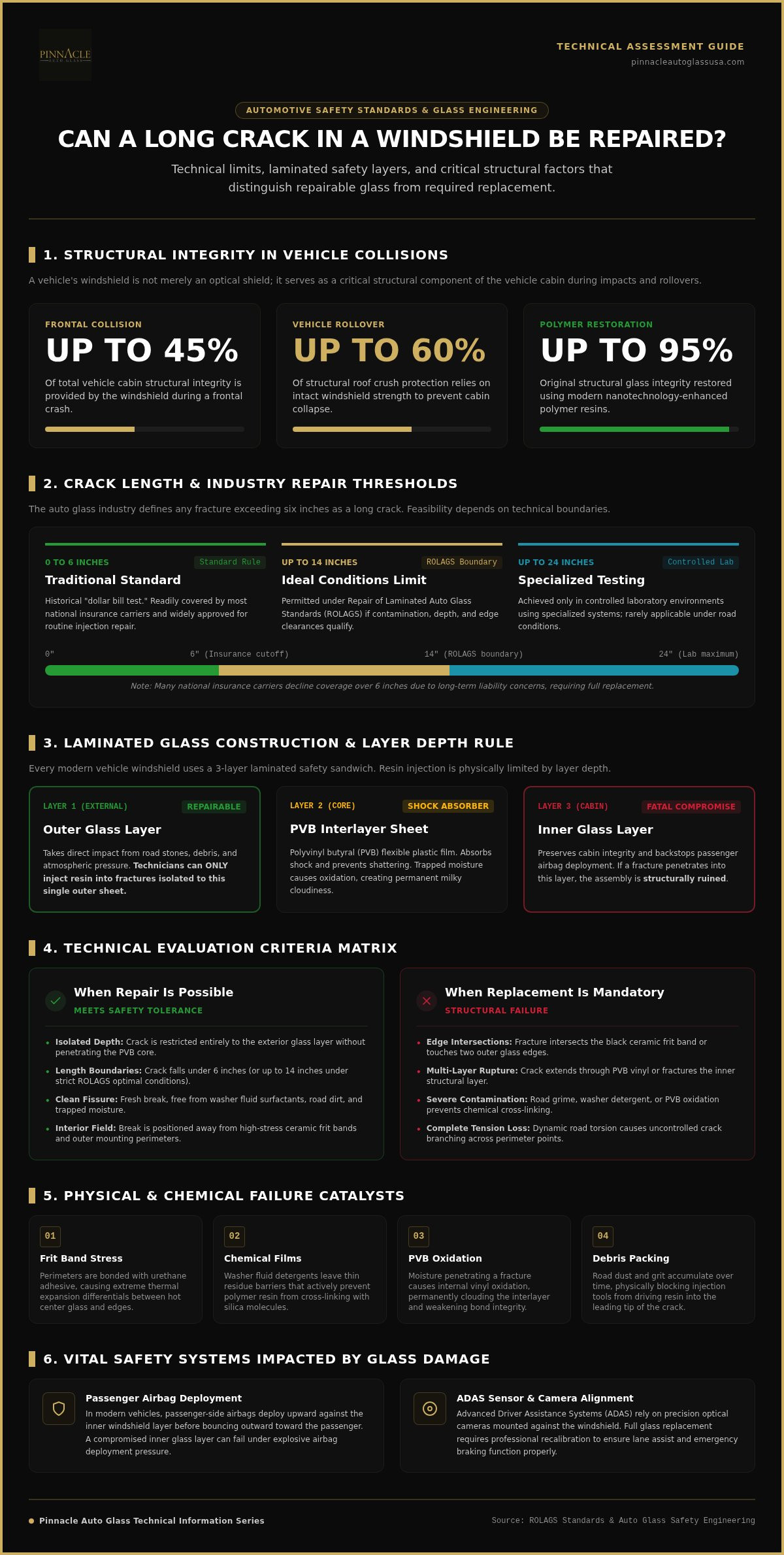
Your windshield provides up to 45% of your vehicle's structural integrity in a frontal collision and up to 60% in a rollover. When a fracture suddenly spreads across the glass, your immediate thought is practical: can a long crack in a windshield be repaired, or are you facing an unexpected full replacement?
It is completely natural to worry about surprise expenses while wondering whether a repaired crack will pass inspection or keep your cabin secure. While modern resins can stabilize longer cracks than ever before, glass length is only part of the equation. Safe decisions also depend on crack depth, outer edge proximity, and the precise sensors powering your advanced driver assistance systems.
You will discover the exact technical criteria technicians use to evaluate damage, along with the safety realities surrounding airbag deployment and roof crush support. Here is what you need to know to assess the damage, understand your options, and schedule the right service with confidence.
Key Takeaways
- Evaluate your damage against modern safety thresholds to determine: can a long crack in a windshield be repaired, or does it require full glass replacement?
- Discover why crack location, outer glass edge contact, and road debris contamination often matter more than physical length.
- Learn how compromised automotive glass affects cabin structural strength, rollover roof support, and passenger airbag deployment.
- Apply immediate triage steps to protect active fractures from dirt, moisture, and temperature fluctuations that accelerate spreading.
- Understand why vehicles equipped with safety cameras require professional ADAS recalibration to maintain proper system alignment after glass replacement.
Can a Long Crack in a Windshield Be Repaired? Industry Standards
In the auto glass industry, any fracture spanning longer than six inches falls into the long crack category. Drivers dealing with spreading damage frequently ask: can a long crack in a windshield be repaired safely, or is replacement mandatory? The answer depends heavily on technical standards rather than length alone.
The Repair of Laminated Auto Glass Standard (ROLAGS) defines allowable repair boundaries across automotive glass. Under ROLAGS guidelines, select cracks up to 14 inches can be stabilized under ideal conditions. In controlled laboratory testing, some specialized systems even manage cracks up to 24 inches. However, superficial outer fissures differ entirely from multi-layer structural splits. Reviewing established windshield safety and repair standards shows that depth, optical distortion, and contamination determine actual real-world feasibility.
The Six-Inch Guideline Versus Modern Resin Capabilities
For decades, technicians relied on the standard dollar bill test. If damage spanned longer than six inches, shops immediately recommended a total glass replacement. That metric originated because older curing resins lacked the mechanical strength needed to bridge extended spans without failing under stress.
Modern auto glass technology has advanced significantly. Today's high-tensile, nanotechnology-enhanced polymer resins can restore up to 95% of original structural glass integrity. Even so, many national insurance carriers still refuse to cover repairs exceeding six inches. Insurers prioritize long-term liability, often opting to fund full replacements rather than risk secondary crack propagation down the road.
Understanding Automotive Laminated Safety Glass Construction
Every modern vehicle windshield uses a laminated safety glass sandwich engineered for cabin protection:
- Outer glass layer: Takes direct impact from road stones, debris, and atmospheric pressures.
- Polyvinyl butyral (PVB) interlayer: A flexible plastic sheet that absorbs shock and prevents dangerous glass shattering.
- Inner glass layer: Preserves cabin integrity and supports passenger airbag deployment.
When asking if a long crack in a windshield can be repaired, layer depth is critical. Technicians can only inject resin into fractures isolated to the outer sheet. If a crack penetrates through the PVB vinyl and fractures the inner glass, the assembly is structurally ruined. Driving over speed bumps, hitting potholes, and enduring normal road vibration introduces continuous torsion. These dynamic forces flex the frame and rapidly force hairline fractures across the entire windshield perimeter.
Critical Factors Determining If Long Windshield Cracks Are Repairable
Determining whether a fracture is serviceable involves far more than running a tape measure across the glass. Technicians weigh physical location, atmospheric contamination, and optical distortion before attempting any fix. When assessing whether a long crack in a windshield can be repaired, these mechanical variables directly dictate your vehicle's safety margin.
Crack Location and Perimeter Edge Stress
Windshield perimeters endure continuous mechanical load. The outer edge is bonded to the vehicle frame using high-strength urethane adhesive. This creates an intense thermal expansion differential between the hot center glass and the insulated border.
Cracks that intersect the black ceramic frit band compromise this structural bond immediately. If a fracture touches two outer edges, the physical tension across the glass panel collapses completely. In these instances, attempting a resin fill is unsafe; total windshield replacement is the only responsible option.
Contamination and Time Factors in Resin Adhesion
A fresh crack is clean, narrow, and receptive to bonding chemistry. Over time, road grime, windshield washer fluid, and moisture penetrate the fissure:
- Chemical interference: Washer detergents leave chemical films that prevent liquid resin from cross-linking with silica molecules.
- PVB interlayer oxidation: Trapped moisture clouds the inner plastic sheet, creating permanent milkiness.
- Debris packing: Road grit prevents injection tools from forcing resin to the true tip of the fracture.
Prompt attention is essential. Waiting days allows road vibrations to expand the break while dirt ruins bonding adhesion. Having a certified technician from Pinnacle Auto Glass inspect the fracture quickly can save an otherwise repairable windshield.
Driver Viewing Zone and Visual Distortion Limits
Federal guidelines strictly regulate driver visibility. Under Federal Motor Vehicle Safety Standard 205, automotive glazing must maintain clear optical quality without compromising driver sightlines. Even the best resin repairs leave faint refraction blemishes when cured under ultraviolet light.
In the direct viewing zone, usually defined as the area swept by the driver-side wiper, residual scars cause headlights to flare during night driving. Any crack exceeding federal limits or disrupting your primary visual field automatically disqualifies the glass from a simple patch, requiring a full replacement to pass safety inspections.
Repair vs. Replacement: Structural Realities and ADAS Requirements
Deciding between a resin fill and full glass replacement is rarely just a visual preference. Vehicle engineering treats front auto glass as an active safety component rather than a simple cosmetic shield. When evaluating whether a long crack in a windshield can be repaired, technicians must factor in severe collision dynamics and onboard computer vision requirements.
Structural Integrity and Vehicle Safety Systems
A vehicle windshield delivers up to 45% of cabin structural strength in a head-on collision and up to 60% in a rollover event. It keeps the roof pillars from caving downward onto passenger seating rows during catastrophic impacts. Guidelines from the Auto Glass Safety Council (AGSC) highlight how glass, adhesives, and vehicle frames interact under extreme physical loads.
Passenger safety systems introduce another major structural demand:
- Airbag deployment backstop: The passenger-side airbag fires upward at roughly 200 miles per hour, bouncing off the inner glass surface toward the occupant.
- Deflection resistance: Fractured glass can shatter outwardly under explosive deployment force, causing the airbag to deploy out of position.
- High-modulus adhesives: Full replacements rely on specialized polyurethane adhesives engineered to withstand these violent directional pressures without detaching.
Advanced Driver Assistance Systems and Sensor Windows
Modern passenger and commercial vehicles rely on Advanced Driver Assistance Systems (ADAS) to monitor roadways. Nearly 9 out of 10 model year 2023 vehicles use forward-facing cameras mounted directly behind the upper windshield glass to manage automatic emergency braking, forward collision warnings, and lane departure alerts.
These optical cameras require an unobstructed view through flawless glass. When a fracture crosses into a camera aperture or sensor sweeping window, even high-grade resin repair is disqualified. Cured resin bends light at microscopic variations, which misdirects camera perception and leads to false emergency braking triggers or missed hazard alerts. In these situations, safe vehicle operation mandates complete replacement followed by precision ADAS calibration auto glass procedures. Technicians perform static or dynamic recalibration to reset camera targeting parameters to factory specifications before you drive.
What to Do When a Long Crack Appears: Prevention and Triage
The first 24 to 48 hours after glass damage occurs are decisive. Drivers wondering whether a long crack in a windshield can be repaired often run out of time because thermal movement or roadway bumps cause the fracture to run to the frame. Simple triage measures protect the break before it spreads beyond service thresholds.
Immediate Steps to Prevent Crack Spreading
Active fractures react rapidly to environmental stress. Take these protective steps immediately after discovering the damage:
- Seal the break: Apply a strip of clear packing tape over the exterior surface. This simple barrier keeps out road grime and washer chemicals without obstructing vision. Never use opaque duct tape.
- Moderate interior temperatures: Avoid blasting maximum air conditioning or high heat defrosters directly onto cold glass. Thermal shock expands glass unevenly, instantly splitting a fracture outward.
- Park strategically: Keep the car inside a garage or under steady shade. Direct midday sunlight superheats the glass center while the bonded frame stays cooler.
- Reduce mechanical shock: Close car doors gently with a window cracked slightly to vent cabin air pressure. Steer clear of rough gravel roads, deep potholes, and automated car washes that use high-pressure spray jets.
Why DIY Repair Kits Fail on Long Windshield Cracks
Retail store repair kits feature basic plastic syringes and thin consumer-grade resins. These retail packs are engineered solely for small, isolated rock chips under one inch. They cannot generate the controlled hydraulic pressure or vacuum suction required to drive high-viscosity resin along extended fracture lines.
When off-the-shelf resins cure unevenly under sunlight, they leave cloudy, trapped air pockets along the crack fissure. Even worse, that cured retail resin permanently clogs the glass fissure. Technicians cannot flush out hardened retail adhesive to re-inject commercial compounds later. Attempting a DIY fix on extended damage destroys your chance of an effective repair and guarantees you will need a full windshield replacement instead.
Do not risk compromising your cabin glass. If you spot active damage, contact Pinnacle Auto Glass to schedule a mobile inspection before the crack expands to the outer frame.
Professional Auto Glass Solutions: Restoring Structural Security
When unexpected glass damage strikes, drivers need a dependable answer: can a long crack in a windshield be repaired, or does driver safety demand a new installation? Certified auto glass technicians resolve this question through methodical evaluation rather than guesswork. Accurate diagnostics separate candidates for minor stabilization from vehicles that require structural glass replacement.
Comprehensive Inspection and Honest Safety Guidance
Professional glass restoration starts with a multi-point evaluation. Technicians assess three physical markers before selecting a repair pathway:
- Crack anatomy: Measuring exact fracture length and checking whether it reaches outer edges.
- Depth analysis: Verifying that fractures remain confined strictly to the exterior glass sheet.
- Sensor clearance: Confirming the impact area sits clear of ADAS optical camera sightlines and wiper sweep zones.
Qualified damage undergoes advanced windshield repair using precision injector bridges. These tools draw out microscopic air pockets with vacuum suction before forcing high-tensile, OEM-grade polymer resin deep into the fissure. The solution cures under specific ultraviolet wavelengths to restore strength. If your damage exceeds safety boundaries, review our windshield replacement cost breakdown to help plan your service budget transparently without sales pressure.
Precision Installation and Complete Recalibration
When long fractures violate safety criteria, a full windshield replacement is necessary to restore passenger compartment safety. Technicians remove damaged glass carefully, prep the vehicle frame with OEM pinchweld primers, and apply high-modulus polyurethane adhesives. This bond supports proper roof crush resistance and provides the essential backstop for passenger airbag deployment.
Safe drive-away time standards are strictly enforced. Vehicles must remain stationary until the urethane cures to full structural strength. Following physical installation, certified specialists perform complete static and dynamic camera recalibration. This realigns front-facing safety sensors to exact factory tolerances, ensuring collision mitigation, lane-keeping, and pedestrian detection systems operate reliably.
Do not compromise cabin security with questionable patches or delayed care. Schedule an inspection with Pinnacle Auto Glass to restore your vehicle glass with certified mobile or in-shop service.
Restore Your Vehicle's Structural Safety Today
When deciding whether can a long crack in a windshield be repaired, remember that automotive glass safety limits involve far more than a simple ruler. Physical crack placement, inner glass layer depth, and front-facing sensor sightlines ultimately determine whether resin stabilization is viable or total glass replacement is necessary. Taking prompt action keeps dirt and weather from ruining repair opportunities while protecting your vehicle's cabin stability.
Don't leave driver protection, airbag performance, or vehicle roadworthiness to chance. Pinnacle Auto Glass delivers dependable nationwide mobile and facility service for personal vehicles and commercial fleets alike. Our certified technicians follow rigorous federal vehicle safety standards, utilizing OEM-grade adhesives and delivering integrated ADAS camera recalibration with every modern glass replacement.
Take control of your vehicle's safety before an active fracture spreads across your line of sight. Schedule your professional glass inspection with Pinnacle Auto Glass today to resolve your glass damage quickly and drive with total confidence.
Frequently Asked Questions
Can a crack longer than six inches be repaired legally?
Yes, cracks longer than six inches can be repaired legally if they meet federal visibility standards and do not disrupt the driver's primary viewing area. Federal rules prohibit driving with severe visual obstructions or intersecting damage in the line of sight. Evaluating whether can a long crack in a windshield be repaired legally requires checking that the fracture does not cross sensor pathways or impair required road perspective.
How much does it cost to repair a long windshield crack?
Repair pricing varies widely based on fracture complexity, resin quantity, and vehicle technology requirements. Standard repairs for small impacts cost significantly less than complete structural replacements, which often require dedicated recalibration procedures. Factors like glass thickness, crack length, and whether the service is mobile or in-shop will influence total billing. Technicians provide detailed estimates after evaluating the fracture in person.
Will a repaired long crack still be visible to the driver?
Yes, a repaired long crack will remain faintly visible after professional resin injection and curing. Modern high-tensile resins restore optical transparency and structural stability up to 95%, but they cannot recreate untouched factory glass. You will usually notice a faint, translucent line resembling a light scratch or thin water thread where the fracture originally formed across the panel.
Can temperature changes cause a small rock chip to become a long crack?
Yes, drastic temperature changes are the leading cause of minor rock chips expanding into long fissures. Automotive glass expands under intense heat and contracts rapidly in freezing weather. Blasting a defroster on a frosty morning or switching on high air conditioning during a hot afternoon creates sudden thermal gradients. This uneven mechanical expansion forces trapped stress points to split outward instantly.
Does vehicle insurance cover windshield replacement for long cracks?
Most comprehensive auto insurance policies cover glass replacement when extensive fractures exceed repair limits. Depending on your specific policy terms and optional endorsements, insurers often pay for OEM-standard replacements minus your standard deductible. Certain comprehensive policies waive deductibles entirely for minor fills, prioritizing rapid repair before spreading fractures demand higher full replacement payouts and ADAS recalibration fees.
Can a windshield crack spread while driving slowly on smooth roads?
Yes, cracks can spread while cruising on smooth pavement at low speeds. A vehicle body naturally flexes, twists, and experiences torsional chassis loads during routine turns, gradual stops, and minor acceleration changes. Normal cabin air pressure fluctuations, subtle engine vibrations, and wind resistance against the exterior glass provide enough mechanical stress to advance an active fracture across the outer pane.
Why do cracks reaching the windshield edge almost always require replacement?
Cracks reaching the outer border compromise structural bonding along the vehicle frame. The perimeter sits anchored in high-strength polyurethane, subjecting that area to intense vehicle vibrations and twisting forces. When asking if can a long crack in a windshield be repaired once it reaches the molding, technicians confirm that edge fractures destroy structural seal strength, making safe resin bonding technically impossible.
How long after windshield replacement is the vehicle safe to drive?
Vehicles require approximately thirty minutes to an hour of curing time after replacement before they are safe to operate. This window represents the minimum drive-away time required for high-modulus polyurethane adhesives to bond securely with the chassis pinchweld. Technicians verify adhesive set times and ensure any onboard camera calibrations finish successfully before releasing the vehicle back onto public roads.


