

Your windshield can split from edge to edge without a single pebble, hailstone, or piece of road debris ever touching the glass. Walking out to your vehicle and finding a sudden fracture across the glass is deeply frustrating. You look closely for an impact point, find zero chips or pitted marks, and immediately ask: what is a stress crack in a windshield? It feels baffling because drivers naturally expect auto glass to crack only after a direct, forceful strike.
In reality, these fractures develop from internal structural tension, rapid temperature fluctuations, or improper glass installation. Knowing whether you're dealing with an impact mark or internal stress is essential for your safety on the road. In this guide, you'll learn how to identify genuine stress fractures, understand the root thermal and mechanical triggers, and determine whether your glass requires repair or full replacement. Here is how to evaluate the damage and take decisive action to protect your vehicle.
Key Takeaways
- Learn what is a stress crack in a windshield and how to distinguish smooth internal fractures from typical projectile impact marks.
- Uncover the environmental and mechanical triggers behind sudden glass failure, including severe thermal shock and chassis torsion.
- Understand the critical structural role your windshield plays in supporting roof integrity during a rollover and enabling proper airbag deployment.
- Discover why fractures originating near the outer glass perimeter almost always require complete windshield replacement instead of resin repair.
- Find out how to navigate comprehensive insurance claims for non-impact damage and why precision installation is vital to prevent recurring stress fractures.
What Is a Stress Crack in a Windshield?
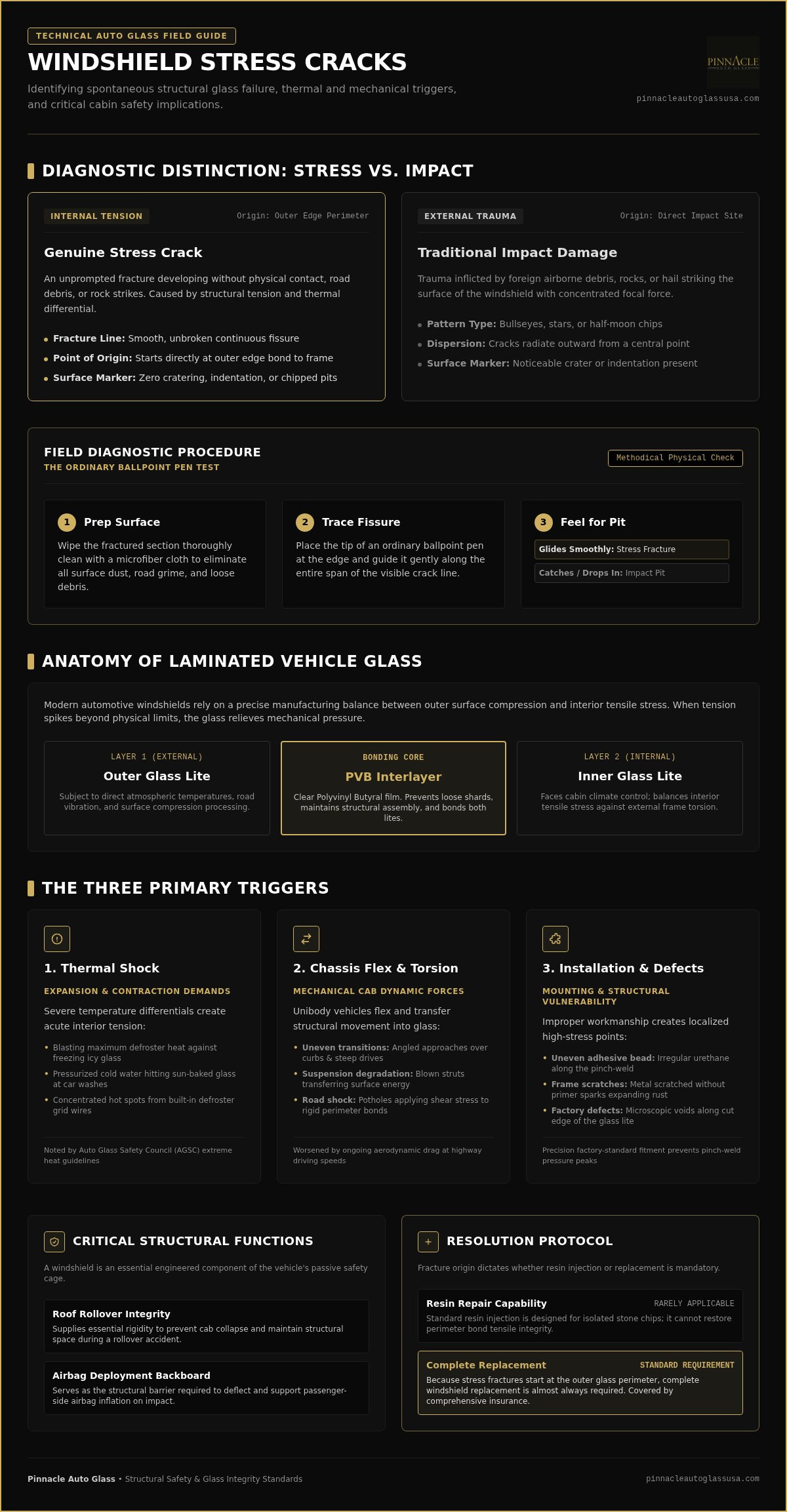
A stress crack is an unprompted fracture that develops without any direct physical collision, stone strike, or airborne debris hitting the glass. If you find yourself asking what is a stress crack in a windshield after spotting a clean line across your glass, the cause lies in internal structural tension rather than external trauma. Unlike impact breaks that display a cratered point of contact, a stress crack appears as a smooth, long line that almost always begins along the outer edge of the windshield where the glass bonds to the vehicle frame.
The Anatomy of Laminated Vehicle Glass
Every modern front automotive windshield is built from laminated safety glass, which consists of two distinct glass lites bonded by an inner layer of clear polyvinyl butyral (PVB). During manufacturing, precise thermal processing creates a balance between outer surface compression and interior tensile stress. When a stress crack occurs, the PVB layer holds the assembly intact, preventing the panes from shattering into loose shards while allowing the single fractured lite to relieve built-up mechanical or thermal tension.
How to Identify a Stress Crack: The Pen Test
To determine whether your damage is an impact break or a genuine stress fracture, perform a simple diagnostic using an ordinary ballpoint pen:
- Prep the surface: Wipe the fractured area clean with a microfiber towel to remove loose dirt and dust.
- Trace the fissure: Place the ballpoint tip at the start of the crack and run it gently along the entire length of the fracture line.
- Feel for an impact pit: If the pen glides smoothly across the glass without catching or dropping into an indentation, the damage is a genuine stress crack. If the pen catches in a small pit, a projectile caused an impact fracture.
Knowing what is a stress crack in a windshield helps you separate internal tension issues from traditional damage. While chips, bullseyes, and star breaks radiate outward from a central crater, true stress cracks run in smooth, unbroken lines directly from the outer perimeter.
Primary Causes of Windshield Stress Fractures
Drivers investigating what is a stress crack in a windshield are usually dealing with internal structural tension rather than accidental damage. Auto glass constantly absorbs mechanical and environmental forces. When those forces exceed the material threshold of the outer glass pane, a fracture splits across the pane. These breaks almost always trace back to three specific triggers.
Extreme Temperature Fluctuations and Thermal Shock
Thermal expansion and contraction place heavy physical demands on vehicle glass. Blasting maximum defroster heat against a freezing windshield on an icy morning causes the inner glass pane to expand rapidly while cold outer edges resist movement. The reverse happens in summer heat when cold pressurized water hits sun-baked glass at a car wash. According to guidelines from the Auto Glass Safety Council, extreme temperature differentials significantly increase tension within the glass laminate, leaving it vulnerable to sudden cracking. Built-in defroster grid wires around wiper blades can also create concentrated thermal hot spots that trigger fractures.
Chassis Flex and Structural Torsion
Modern passenger cabins rely on unibody structures that twist slightly under real-world driving conditions:
- Uneven road transitions: Angled approaches over steep driveways, curbs, or railroad tracks flex the cabin frame.
- Suspension degradation: Blown struts or worn bushings fail to absorb surface shock, transferring sharp mechanical energy straight into the glass frame.
- Potholes and speed bumps: Sudden mechanical impacts apply sharp shear stress directly to rigid perimeter bonds.
Continuous aerodynamic drag at highway speeds also presses against the glass, steadily worsening any microscopic perimeter flaws.
Faulty Previous Installations and Glass Defects
Improper workmanship remains a frequent cause of unprompted glass failure. When an inexperienced technician applies an uneven bead of urethane adhesive, it creates localized pressure points along the pinch-weld. Technicians who scratch the metal frame paint during glass removal without applying a primer invite rust formation, which expands under the adhesive and cracks the glass from underneath. If you suspect improper mounting or frame tension caused your fissure, scheduling an evaluation with Pinnacle Auto Glass ensures proper fitment that meets exact factory standards. In rare cases, microscopic voids along the cut edge from the factory manufacturing process can also fail under everyday road stress.
Why Driving with a Stress Crack Poses Serious Safety Risks
A cracked windshield does far more than spoil your vehicle's curb appeal. Drivers asking what is a stress crack in a windshield frequently assume the issue is purely aesthetic because no rock struck the surface. That assumption is dangerous. Your front glass functions as a load-bearing structural barrier. Any fracture along its edge compromises the core engineering protecting everyone inside the vehicle.
Structural Integrity and Rollover Protection
Automotive engineers rely on the windshield to support the vehicle roof during a collision. In a rollover accident, the glass can contribute up to 60% of the passenger cabin's structural strength. Government crash testing enforced under Federal Motor Vehicle Safety Standards mandates strict retention and roof crush limits. Because stress cracks originate at the glass perimeter, they degrade the urethane bond holding the windshield to the vehicle frame. Once that seal is weakened, the roof is far more vulnerable to cave-in upon impact. Review factory structural requirements in our complete guide to professional windshield replacement.
Passenger Airbag Deployment Failure
Your front passenger airbag relies entirely on intact auto glass to work correctly. Consider the mechanics during a severe frontal collision:
- Explosive force: The passenger-side airbag deploys upward and strikes the inside of the windshield at speeds exceeding 100 mph.
- Deflection angle: A structurally sound windshield serves as a rigid backstop, bouncing the expanding cushion backward toward the passenger's chest.
- Structural blowout: Glass split by a stress fracture lacks adhesive shear resistance. The forceful airbag strike can shatter or pop the glass outward, allowing the airbag to deploy outside the vehicle and leaving the occupant unprotected.
Disruption to Forward-Facing ADAS Cameras
Modern vehicles mount advanced driver-assistance hardware behind the upper rearview mirror. Features like automatic emergency braking and lane-keeping assistance depend entirely on clear optical views through the glass. Even a hairline stress fracture bends incoming sunlight and creates refraction errors across the camera lens. These optical distortions confuse system algorithms, triggering false alarms or disabling emergency braking entirely. Check calibration necessities in our comprehensive guide on ADAS calibration auto glass to keep automated safety systems running accurately.
Can a Windshield Stress Crack Be Repaired or Replaced?
Drivers often hope an optical resin injection can halt the spread of a sudden glass fracture. Once you discover what is a stress crack in a windshield, however, you quickly find that the technical criteria for repair differ sharply from standard stone chips. While small surface pits under the size of a quarter are prime candidates for resin stabilization, spontaneous stress fractures present a completely different mechanical challenge that almost universally demands full glass replacement.
Why Edge Cracks Resist Standard Resin Repair
Perimeter glass zones endure the heaviest mechanical loads in your vehicle. Standard repair methods involve drilling a microscopic relief hole and injecting liquid UV-curable resin between the fractured glass walls. This technique works well on isolated impact points in the center glass area. It fails on stress fractures. Because these fractures originate along the perimeter bonding area, dynamic frame twist constantly pulls the crack apart. The resin cannot withstand those ongoing shear forces, causing the crack to quickly jump the repair boundary. Read our complete guide on windshield repair to understand the physical limitations of resin bonding.
Repair vs. Replacement Decision Rubric
Industry safety protocols mandate specific guidelines when evaluating whether damaged glass can be saved or requires complete removal. Use this criteria to evaluate your damage:
| Damage Characteristic | Windshield Repair Candidate | Full Replacement Required |
|---|---|---|
| Origin Point | Center glass area, well away from outer borders | Perimeter edge touching or underneath the frame |
| Crack Length | Under six inches, with an impact pit present | Exceeds six inches or runs edge-to-edge |
| Structural Support | Zero compromise to perimeter adhesive bead | Degraded urethane bonding and cabin stiffness |
| Sensor Line of Sight | Located outside safety camera optical paths | Passes through forward-facing ADAS camera zone |
Attempting DIY repair kits on edge-originating fissures wastes time and compromises your cabin protection. To ensure your vehicle meets strict federal crash standards, schedule professional windshield replacement with Pinnacle Auto Glass and restore your vehicle safely.
Professional Replacement, Insurance, and Long-Term Prevention
Resolving sudden auto glass damage requires a coordinated approach that addresses financial coverage, certified technical installation, and ongoing vehicle care. Once you confirm what is a stress crack in a windshield and verify that repair isn't an option, moving forward with professional service restores structural safety to your passenger cabin.
Navigating Comprehensive Auto Insurance Claims
Insurance providers categorize spontaneous glass fractures differently from crash damage. Stress cracks fall under comprehensive auto insurance rather than collision coverage. Because these cracks happen without an impact event or driver error, filing a glass claim generally does not count as an at-fault accident or trigger rate increases. Depending on your state laws and policy terms, your deductible may be waived entirely, or you may pay a set out-of-pocket amount. Learn what influences out-of-pocket expenses in our guide on how much does windshield replacement cost.
What to Expect During Certified Glass Replacement
Proper auto glass installation eliminates the mechanical binding and uneven contact points that cause glass failure. Certified technicians follow a precise, multi-step installation workflow:
- Pinch-weld preparation: Technicians strip old urethane down to a uniform thin base layer, treat bare metal scratches with anti-corrosion primer, and clear away debris.
- Precision urethane application: A continuous, high-modulus polyurethane adhesive bead is laid at the exact factory height to eliminate localized pressure spots.
- Sensor recalibration: Both dynamic road testing and static optical target setups align your forward-facing safety cameras back to OEM tolerances.
- Adhesive curing: Technicians mandate a minimum safe drive-away time, ensuring the urethane cures sufficiently to hold the glass firmly during sudden braking.
Proactive Habits to Prevent Future Stress Cracks
Smart everyday habits significantly lower the thermal and physical stresses placed on your new glass. Avoid blasting high-heat defrosters against ice-cold windshields; start your heater at a moderate setting and increase it gradually as the engine warms. In high summer temperatures, park in covered or shaded garages to prevent severe heat buildup across perimeter edges. Cracking your side windows roughly a quarter inch on hot days equalizes interior cabin air pressure and reduces internal thermal strain.
Understanding what is a stress crack in a windshield gives you the upper hand when dealing with sudden glass fractures. Taking prompt action with certified professionals protects your vehicle's safety systems and ensures lasting cabin protection.
Restore Your Vehicle's Structural Safety Today
Now that you understand what is a stress crack in a windshield, you can take prompt control of your vehicle's safety. Spontaneous edge fractures do far more than impair visibility. They weaken roof rollover support, interfere with proper passenger airbag deployment, and disrupt sensitive forward-facing ADAS cameras. Because chassis torsion and thermal shifts continuously pull at perimeter fissures, complete glass replacement is the only permanent, dependable solution.
Fixing structural glass damage doesn't have to disrupt your routine. Pinnacle Auto Glass delivers precision OEM-grade glass installations that strictly adhere to federal motor vehicle safety standards. Our team provides comprehensive mobile auto glass service, handles certified static and dynamic ADAS recalibrations, and assists with insurance claims for personal and fleet vehicles. Schedule your professional windshield replacement with Pinnacle Auto Glass today to restore your cabin's strength and hit the road with complete peace of mind.
Frequently Asked Questions
Can a stress crack in a windshield spread on its own while parked?
Yes, a stress crack can spread across the glass even while your vehicle sits stationary in a driveway. Daily ambient temperature swings cause the glass to expand during daylight hours and contract at night. This continuous thermal movement puts pressure on the fractured edge. Even without road vibrations, that internal stress forces the fissure to creep further across the pane over time.
Will insurance cover a stress crack if nothing actually hit the car?
Comprehensive auto insurance policies typically cover spontaneous glass damage. Because a stress crack occurs without an impact event or collision, insurers treat it as a comprehensive glass claim rather than an at-fault accident. Depending on your specific policy terms and coverage options, your provider may cover the replacement with a standard deductible or waive the out-of-pocket cost entirely.
Can you pass an annual vehicle safety inspection with a windshield stress crack?
Passing an annual safety inspection depends on the crack's size and path. Most vehicle safety standards fail any automobile with cracks that run across the driver's direct field of view or intersect the wiper sweep path. Even if the crack starts along the passenger side, inspectors will fail the vehicle if the fracture compromises structural cabin integrity or distorts forward visibility.
How can a technician tell the difference between a rock chip and a stress crack?
Certified auto glass technicians determine what is a stress crack in a windshield by inspecting the glass surface for an impact origin. Using an optical magnifier or a smooth probe, the technician checks the entire fissure. Impact breaks display a distinct point of contact with crushed surface glass, whereas a genuine stress crack presents a completely smooth line originating at the outer perimeter.
Is it legal to drive with a stress crack across the windshield?
Driving with a cracked windshield can result in a traffic citation depending on where the fracture sits. Traffic laws prohibit driving with defective equipment that obstructs driver vision. If a police officer determines that a perimeter fissure crosses your line of sight or creates dangerous glare from sunlight and oncoming headlights, you can be pulled over and ticketed.
Can using maximum defrost on a freezing morning crack my windshield?
Blasting full defrost heat directly onto an ice-cold windshield is a primary catalyst for glass fractures. The immediate thermal shock forces the interior glass surface to expand rapidly while the freezing exterior pane resists expansion. This sharp temperature gradient generates immense tensile stress along the perimeter bond. To avoid cracking, warm your vehicle cabin gradually using moderate heater settings.
Why do stress cracks almost always start at the very edge of the windshield?
The perimeter edge represents the most vulnerable zone on any piece of automotive glass. The outer border absorbs chassis flexing, vehicle vibration, and dynamic road torsion directly through the polyurethane adhesive. Additionally, factory cutting leaves microscopic imperfections along the perimeter edge. When thermal or mechanical tension spikes, those micro-flaws act as weak points, making what is a stress crack in a windshield almost exclusively an edge-originating issue.


