
Your windshield provides up to 60% of your vehicle's structural integrity during a rollover accident. Even a minor chip can compromise this safety barrier or lead to an expensive citation if you don't know the rules. Understanding the legal crack size for windshield compliance is essential for every driver who wants to avoid unexpected fines and stay safe on the road.
It's stressful to wonder if a small starburst in your glass will result in a failed inspection or a police officer pulling you over. You want clear answers about whether you can simply repair the damage or if a full replacement is necessary. We understand that interpreting federal FMCSA standards alongside shifting state laws feels overwhelming.
This guide clarifies the exact measurements and locations that define a legal windshield in 2026. We'll break down the 3/4 inch federal rule, explain how modern ADAS sensors impact your repair options, and provide a roadmap for restoring your vehicle's safety. You'll gain the technical knowledge needed to make an informed decision and keep your car road-legal.
Key Takeaways
- Understand the federal FMCSA standards that define when glass damage becomes a safety violation for both commercial and passenger vehicles.
- Learn how to use the "Dollar Bill Rule" and the "Quarter Rule" to measure the legal crack size for windshield compliance.
- Identify the Critical Vision Area (CVA) and why damage in this specific zone often mandates an immediate replacement.
- Recognize how cracks interfering with ADAS cameras and sensors impact your vehicle's safety and legal status.
- See how certified technicians maintain road-legal status by using high-quality glass that meets original equipment manufacturer specifications.
Federal and State Windshield Laws: Understanding the Basics
The Department of Transportation (DOT) establishes strict safety standards for automotive glass to protect everyone on the road. Your windshield is more than a window. It's a critical safety component made of laminated safety glass. This specialized material is designed to stay in one piece upon impact. It provides up to 45% of a vehicle's structural strength in a frontal collision. When this glass is compromised, the vehicle's entire safety system is at risk. Authorities use these facts to determine the legal crack size for windshield compliance.
Regulations often center on the concept of "obstruction of vision." A distorted or damaged area is legally defined as any condition that interferes with the driver's clear view of the road. While federal laws provide a framework, state-level inspections often apply these rules to local traffic stops. If your glass has multiple cracks or a large spiderweb pattern, it likely fails both federal and state safety benchmarks. Staying informed about these requirements helps you avoid fines and ensures your vehicle remains safe for all occupants.
FMCSA Standards for Commercial Vehicles
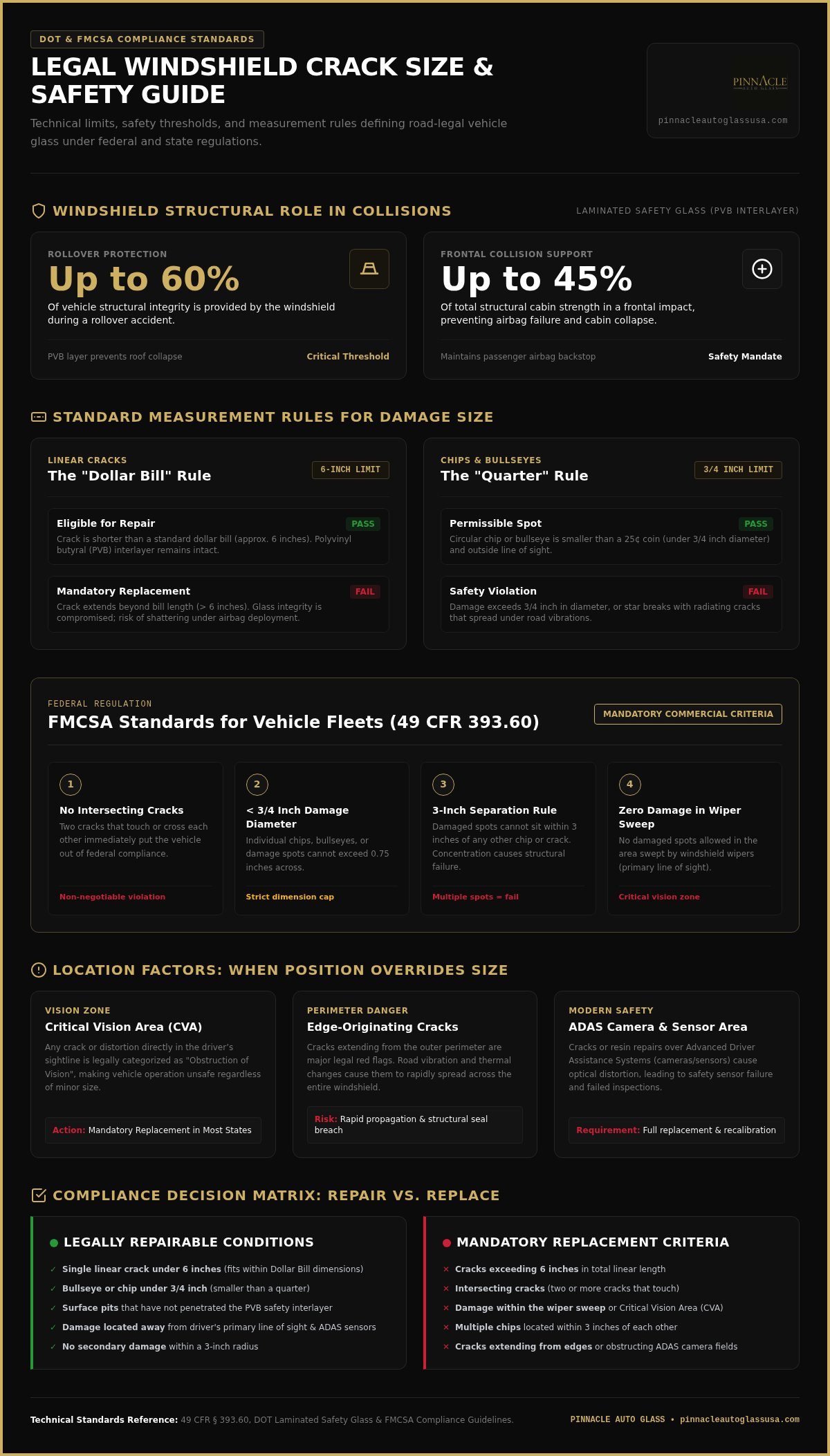
The Federal Motor Carrier Safety Administration (FMCSA) maintains rigorous standards for trucks and commercial fleets under 49 CFR 393.60. This regulation states that cracks cannot intersect each other. If you have two cracks that touch, the vehicle is technically out of compliance. Additionally, individual chips or damaged spots must be smaller than 3/4 of an inch in diameter. These spots cannot be located within three inches of any other damage. The FMCSA also mandates that no damage can exist in the area swept by the windshield wipers, as this directly blocks the driver's primary line of sight.
Passenger Vehicle Safety Inspection Criteria
For passenger vehicles, the rules are often left to the discretion of law enforcement or state inspection programs. Most states define a vehicle as "unsafe to operate" if any damage impairs the driver's vision to the front or sides. You might receive a "fix-it" ticket, which requires a repair within a set timeframe, or a mandatory replacement order if the damage is severe. Cracks that extend from the outer edge of the glass are a major legal red flag. These edge cracks spread rapidly due to temperature changes and road vibration. To ensure your vehicle remains compliant, consulting certified auto glass technicians is the best way to verify if your glass meets current DOT standards.
Measuring Windshield Damage: What Sizes Are Legally Permissible?
Measuring damage accurately is the first step toward road compliance. Most drivers use common items to gauge the legal crack size for windshield safety. The "Dollar Bill Rule" is a reliable industry benchmark. If a standard bill covers the entire length of a crack, the damage is typically eligible for repair. If the crack extends beyond the bill, it's likely too long to fix legally. Technicians use precision tools to verify these measurements, ensuring the glass still meets DOT requirements for structural support.
For circular chips and bullseyes, the "Quarter Rule" is the standard. If a chip is smaller than a twenty-five-cent coin, it usually doesn't obstruct vision enough to warrant a ticket. However, Federal regulations set a strict 3/4 inch limit for commercial vehicles. If multiple chips appear within a three-inch radius, the structural integrity of the glass is considered failed. This concentration of damage requires a full replacement to meet safety standards. Even small chips can be illegal if they sit directly in the driver's line of sight.
The 6-Inch Benchmark for Cracks
Industry standards generally cap repairs at 6 inches. Cracks exceeding this length often penetrate the PVB (polyvinyl butyral) interlayer. This plastic layer is what gives laminated glass its strength. When the PVB is compromised, the windshield can't properly support the roof during a rollover. The 6-inch rule serves as the primary threshold for legal repair versus mandatory replacement. Beyond this size, the risk of the glass shattering during an airbag deployment increases significantly.
Chip and Bullseye Size Limitations
You must distinguish between minor surface pits and structural chips. Surface pits are small nicks that don't penetrate the outer glass layer. Structural chips like bullseyes or star breaks involve deep fractures that weaken the unit. Star breaks spread faster than other types because their "legs" extend outward with every road bump. Legal limits allow for small chips outside the driver's line of sight, but anything exceeding 3/4 of an inch is a violation. If you aren't sure if your damage qualifies, you can schedule a professional windshield repair to get an expert assessment.
Why Location Matters More Than Size: The Critical Vision Area
Size isn't the only factor in determining the legal crack size for windshield compliance. The location of the damage often dictates whether a vehicle is road-legal. Road safety officers prioritize visibility over almost everything else during a traffic stop. The Critical Vision Area (CVA) is the most sensitive zone on your glass. This is the space directly above the steering wheel where you focus while driving. Any damage in the CVA is frequently considered an immediate legal violation, regardless of its size. Even a small chip can refract light and create a dangerous glare during night driving.
Beyond the CVA, certain "no-go" zones exist near the edges and sensor housings. Modern vehicles rely on cameras and sensors mounted behind the glass. Damage in these areas isn't just a visibility issue; it's a technology failure. Cracks near the frame are equally concerning because they compromise the structural integrity of the vehicle's roof. If the glass can't hold the weight of the car during a rollover, the occupants face extreme risk. Understanding these zones helps you decide if a simple repair is even an option.
The Dimensions of the Critical Vision Area
Technicians measure the CVA as an 8.5 inch by 11 inch zone centered in the driver's line of sight. This "acute area" must remain completely clear. Most safety standards prohibit repairs in this zone because the resin used in the process causes visual distortion. While the resin fills the crack, it doesn't perfectly mimic the clarity of original glass. This slight blur is enough to fail a safety inspection in many states. If you can see the crack while looking straight ahead at the road, it's likely in the CVA.
Edge Cracks and Structural Safety
The 2-inch rule is a standard guideline for structural stability. Any crack that starts or ends within two inches of the windshield's edge is a major safety hazard. Federal windshield retention requirements mandate that the glass stays bonded to the frame during a crash. Edge damage interferes with the urethane adhesive that holds the glass in place. When evaluating the legal crack size for windshield safety, inspectors look closely at these border areas. Damage here makes the windshield more likely to fail or detach during an accident. Edge cracks also spread much faster than center cracks due to the physical stress concentrated at the vehicle's frame. Replacing the glass is the only way to ensure the roof remains supported.
Repairing vs. Replacing: When Does Legality Mandate a New Windshield?
Deciding whether to patch or swap your glass isn't just about cost. It's about maintaining the safety systems your vehicle relies on to avoid collisions. Modern Advanced Driver Assistance Systems (ADAS) use cameras and sensors mounted directly behind the glass. If a crack, regardless of its size, sits within the field of view for these sensors, the law typically mandates an immediate windshield replacement. These systems require perfect optical clarity to function. Even a high-quality repair can cause enough light refraction to trigger a system error, potentially disabling features like automatic braking or lane-keep assist.
Legal compliance also involves ADAS calibration auto glass procedures after a new installation. If you replace the glass but skip the recalibration, your safety systems may not align with the road, creating a hidden hazard. As of 2026, several states now legally require glass shops to inform you about these calibration needs. Ensuring your vehicle meets the legal crack size for windshield standards means looking beyond the glass itself and considering the electronic safety net underneath. Proper recalibration ensures your vehicle remains compliant with manufacturer safety standards.
When Repair is a Viable (and Legal) Option
A professional windshield repair is often a legal and safe solution for minor damage. Technicians inject a specialized resin that mimics the refractive index of glass, restoring its strength and preventing the crack from spreading. However, you should avoid generic DIY kits. These retail products often lack the pressure needed to fully fill the fracture. This leaves air pockets that compromise structural integrity and fail safety inspections. A professional repair keeps the original factory seal intact, which is always the preferred option when legally permissible.
The Mandatory Replacement Checklist
Sometimes, the damage is too extensive for a safe fix. You must replace the windshield if you identify any of the following:
- Cracks longer than a standard dollar bill or six inches.
- Damage that has penetrated both the inner and outer layers of the laminated glass.
- Spiderweb cracks or multiple intersecting fractures that compromise the PVB interlayer.
- Any damage that has reached the outer edge of the frame, as this weakens the entire unit.
If your glass meets these criteria, don't delay the fix. You can request a quote for mobile service to ensure your vehicle is road-ready without the risk of a citation. Acting quickly prevents a small chip from becoming a major legal and safety liability.
Professional Auto Glass Solutions: Ensuring Compliance and Safety
Maintaining a vehicle that meets the legal crack size for windshield standards requires more than a simple visual check. You need a partner who understands the intersection of physical glass durability and advanced safety technology. Working with certified auto glass technicians ensures your repair or replacement meets all DOT benchmarks. These professionals use glass that meets original equipment manufacturer (OEM) specifications. This is vital because glass that doesn't match OEM standards can interfere with the structural integrity of your vehicle or the accuracy of its sensors.
Professional installation is also a life-saving necessity for passenger airbag performance. In many modern cars, the passenger-side airbag relies on the windshield as a backstop during deployment. If the glass isn't properly bonded with industry-leading adhesives, the force of the airbag can pop the windshield out of the frame. This failure leaves the passenger without protection during a crash. By choosing a professional solution, you guarantee that your glass stays in place when it matters most.
The Pinnacle Process for Safety and Compliance
Every Pinnacle Auto Glass service follows a methodical safety protocol. Technicians begin with a comprehensive inspection of the damage and its proximity to ADAS cameras. We don't just look at the crack; we evaluate how it affects your entire safety system. The process includes:
- Detailed assessment of the legal crack size for windshield compliance.
- Precise sensor alignment checks for all ADAS-equipped vehicles.
- Application of high-viscosity, industry-leading adhesives for a permanent bond.
- A final safety check to verify that all systems are operational before you drive away.
Mobile Services for Fleet and Personal Vehicles
For businesses, reducing fleet downtime with mobile glass repair is a strategic advantage. You don't have to choose between productivity and compliance. Mobile technicians bring professional-grade tools directly to your yard or job site. This on-site service maintains the same rigorous safety standards as a shop-based repair. Individual owners also benefit from this convenience, as it removes the risk of driving a non-compliant vehicle to a service center. Scheduling an immediate inspection is the best way to avoid costly traffic citations and ensure the safety of your drivers.
Secure Your Vehicle's Safety and Compliance for 2026
Maintaining a road-legal vehicle requires constant attention to glass integrity. You now understand that the legal crack size for windshield compliance depends on specific measurements like the 3/4 inch chip limit and the 6-inch crack threshold. Location is equally vital. Any damage within the Critical Vision Area or over an ADAS sensor housing necessitates immediate action. Ignoring these standards risks your safety and leads to costly traffic citations.
Pinnacle Auto Glass offers the expertise needed to keep your personal or commercial vehicles compliant. Our nationwide professional technicians specialize in fleet-specific glass solutions and serve as certified ADAS recalibration experts. We ensure every replacement meets strict DOT requirements and manufacturer specifications. Don't let a small chip compromise your vehicle's structural strength or electronic safety systems.
Get a Professional Assessment from Pinnacle Auto Glass today to resolve your glass damage quickly and efficiently. Staying proactive ensures you remain safe on the road through 2026 and beyond.
Frequently Asked Questions
Is it illegal to drive with a cracked windshield in the United States?
Yes, it's illegal if the crack obstructs the driver's view or compromises the vehicle's structural integrity. Federal and state laws prohibit driving with vision-impairing damage. Law enforcement can issue citations based on the legal crack size for windshield standards. Even if your state lacks a specific measurement limit, "obstructed view" statutes allow officers to ticket you for safety risks that endanger other motorists.
Can I pass a vehicle inspection with a small chip in my windshield?
You can pass if the chip is outside the driver's critical vision area and meets size requirements. Most states allow chips smaller than 3/4 of an inch, provided they aren't in the area swept by the wipers. However, multiple chips within three inches of each other will likely cause an inspection failure. You should check your specific state's safety manual, as rules vary significantly between regional programs.
How big can a windshield crack be before it cannot be repaired?
Cracks longer than six inches generally require a full replacement rather than a repair. While some advanced resins can handle slightly longer damage, six inches is the industry standard for safe, legal fixes. Once a crack exceeds this length, it often compromises the plastic interlayer. This damage reduces the windshield's ability to support the roof during a rollover, making a professional replacement the only safe option.
Does a crack in the driver’s line of sight always require a replacement?
Yes, damage in the driver’s direct line of sight almost always mandates a full replacement. The Critical Vision Area is an 8.5 by 11 inch zone that must remain perfectly clear. Even a professional repair can leave a slight visual distortion or glare. Because these imperfections can hide road hazards, safety inspectors and law enforcement consider any damage in this zone a legal violation.
What happens if I am caught driving with a cracked windshield?
You'll likely receive a "fix-it" ticket or a safety citation from law enforcement. Fines vary by state but can reach nearly $200 in some jurisdictions. A fix-it ticket usually gives you a set number of days to complete a repair or replacement. If you ignore the citation, you risk higher penalties or having your vehicle registration suspended during your next mandatory inspection cycle.
Is a "bullseye" chip legally different from a long crack?
Legally, both are treated as obstructions, but they have different size thresholds for repair eligibility. A bullseye chip is a circular fracture that technicians can often fill if it's smaller than a quarter. A long crack is more likely to spread and compromise the glass's structural bond. Both must stay within the legal crack size for windshield limits to avoid a ticket, but cracks are prioritized for replacement.
Will my insurance cover a windshield that is no longer road-legal?
Most comprehensive insurance policies cover windshield repair and replacement when safety is compromised. Several states legally require insurers to offer zero-deductible glass coverage for policyholders. If your windshield is no longer road-legal, your insurance provider typically views the replacement as a necessary safety restoration. You should verify your specific policy terms, as some companies have preferred providers or specific limits on OEM glass usage.
Do I need to recalibrate my car’s sensors if I replace a cracked windshield?
Yes, recalibration is mandatory for vehicles equipped with Advanced Driver Assistance Systems (ADAS). When you install a new windshield, the cameras and sensors mounted behind the glass are disturbed. Even a tiny misalignment can cause safety features like automatic braking to fail. Professional ADAS recalibration ensures these systems function correctly and keeps your vehicle compliant with modern safety regulations and manufacturer standards.


