
A damaged windshield is no longer just cracked glass; it is an offline safety system. Modern vehicles rely on forward-facing cameras and sensors mounted directly behind the glass to run life-saving collision-avoidance tech. When road debris strikes, drivers often hesitate to call their insurer because they fear surprise out-of-pocket bills, confusing policy limits, or steep fees for sensor calibration. Having zero deductible glass coverage explained clearly shows that your comprehensive policy is built to restore both your view and these critical safety networks without unexpected out-of-pocket expenses.
You shouldn't have to decipher confusing insurance jargon just to confirm whether your vehicle is fully covered. This complete guide outlines how zero-deductible endorsements function for minor chip repairs and complete replacements, how ADAS recalibration integrates directly into your claim, and how to verify your carrier benefits before booking service. Here is your roadmap to handling glass damage efficiently while keeping your vehicle aligned with factory safety standards.
Key Takeaways
- With zero deductible glass coverage explained, see how optional endorsements eliminate out-of-pocket expenses for vehicle glass repairs and full replacements.
- Understand the operational differences between standard comprehensive deductibles and dedicated glass riders for chips, cracks, and complete installations.
- Confirm how forward-facing ADAS camera recalibration integrates directly into your glass claim as a covered safety requirement.
- Navigate the claim filing process with confidence while exercising your legal right to select your own certified repair facility.
- Evaluate certified auto glass specialists to verify they use OEM-standard glass materials and manufacturer-aligned calibration protocols.
What Is Zero Deductible Glass Coverage and How Does It Work?
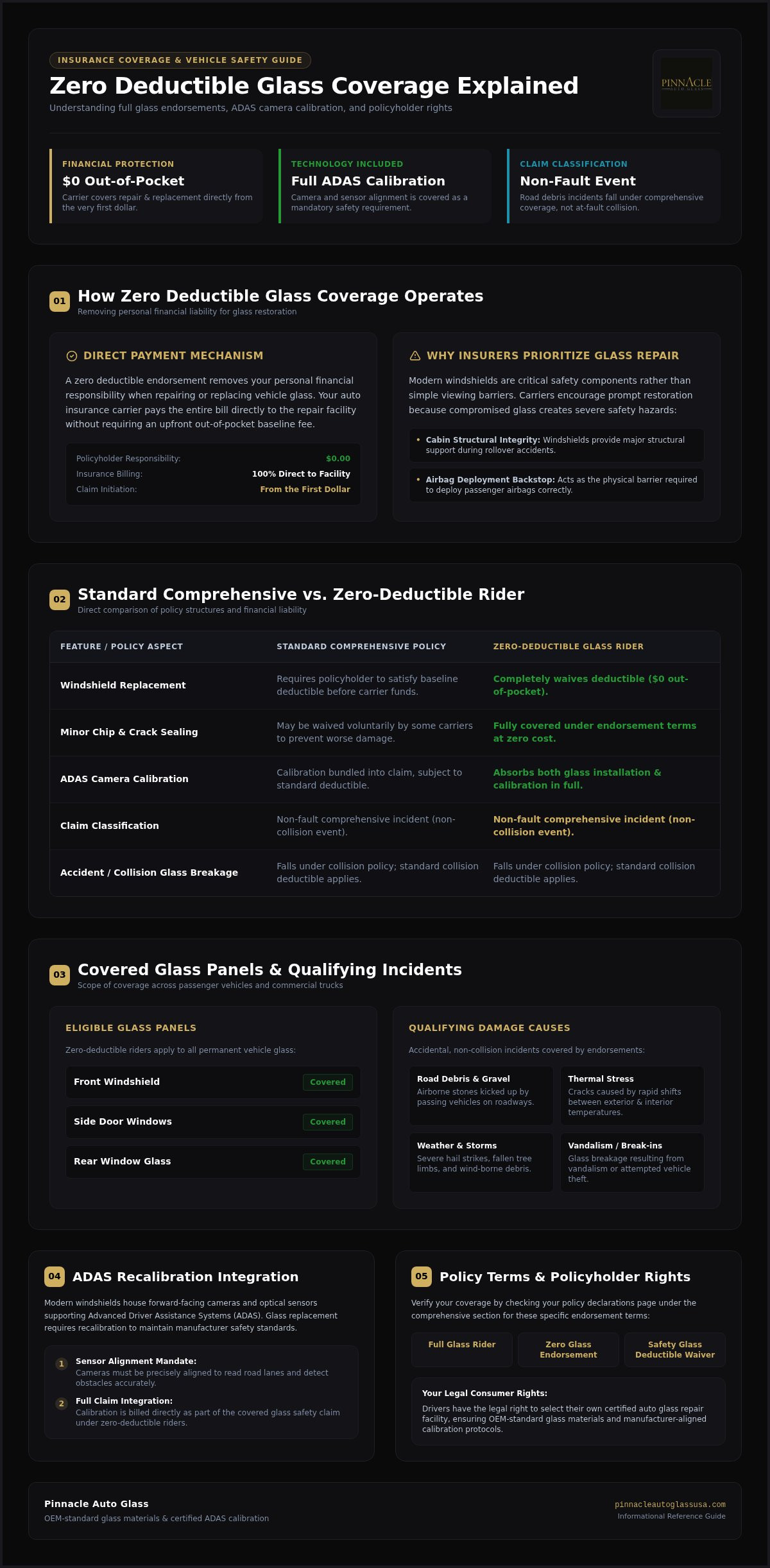
Zero deductible glass coverage is an insurance policy endorsement that removes your personal financial responsibility when repairing or replacing vehicle glass. Instead of paying an out-of-pocket fee before your benefits kick in, your auto insurance carrier pays the entire bill directly to the facility. Having zero deductible glass coverage explained simply means this: when unexpected roadway debris damages your vehicle, your insurance covers the restoration from the very first dollar.
Insurance providers encourage rapid glass restoration because modern automotive glass is an essential safety component. A vehicle windshield contributes significantly to cabin structural integrity during a rollover collision and provides the physical backstop for front passenger airbag deployment. Leaving a crack untreated compromises this safety shield. Comprehensive glass endorsements ensure drivers resolve visibility and structural issues promptly without worrying about upfront costs.
Comprehensive Auto Insurance vs. Full Glass Endorsements
Standard comprehensive auto policies protect your vehicle against non-collision hazards such as weather, animal impacts, and vandalism. However, these policies typically carry a standard comprehensive deductible that applies to all property claims. A dedicated glass endorsement acts as an amendment to your primary policy. It waives the baseline comprehensive deductible exclusively for approved safety glass services.
Collision policies operate under separate guidelines. If your windshield shatters during a vehicular accident with another car or a stationary barrier, that damage falls under collision coverage and incurs your standard collision deductible. To confirm whether you carry zero-deductible benefits, check your policy declarations page under the comprehensive section for terms like "Full Glass Rider," "Zero Glass Endorsement," or "Safety Glass Deductible Waiver."
Qualifying Types of Glass Damage Covered
Zero-deductible riders apply to all permanent glass panels on your passenger vehicle or commercial truck, including the windshield, rear window, and side door glass. Qualifying claims typically originate from accidental, non-collision incidents such as:
- Airborne gravel, stones, and road debris kicked up by passing vehicles.
- Thermal stress cracks caused by dramatic shifts between exterior temperatures and interior climate controls.
- Fallen tree limbs, storm debris, and severe hail strikes.
- Glass breakage resulting from vandalism or attempted vehicle theft.
Restoring these panels promptly also protects the onboard electronics attached to the glass. Modern windshields provide mounting points for optical hardware supporting Advanced driver-assistance systems (ADAS), which require proper structural alignment to read road lanes and detect obstacles accurately.
Zero Deductible vs. Standard Deductible: Comprehensive Comparison
Understanding the financial distinction between a standard comprehensive policy and a full glass rider prevents unpleasant surprises when filing a claim. Standard policies require you to pay a set out-of-pocket amount before insurance funds any repairs. In contrast, having zero deductible glass coverage explained reveals a structure where the insurer covers qualifying glass claims completely, leaving your personal funds untouched.
- Standard Comprehensive Policy: Requires policyholders to satisfy their baseline deductible for replacements; small repairs may be waived voluntarily by carriers to prevent severe glass damage.
- Zero-Deductible Glass Rider: Completely waives out-of-pocket requirements for chip repairs, crack sealing, and full windshield replacements.
- ADAS Sensor Integration: Standard policies apply deductibles to calibration work bundled with installations; zero-deductible riders absorb both calibration and glass installation in full.
- Claim Classification: Both options treat road debris as non-fault comprehensive events rather than at-fault collision incidents.
Consulting the Insurance Information Institute's guide to auto coverage confirms that standard deductibles primarily protect carriers against frequent micro-claims, while glass endorsements offer specialized financial relief for road hazards.
Evaluating Upfront Premium Cost Against Replacement Expenses
Adding a glass endorsement to an existing policy requires a modest ongoing premium adjustment, often just a few dollars each month. Drivers logging high highway miles face frequent exposure to gravel and debris, making that small recurring cost an economical safeguard. Paying a predictable premium addition protects against sudden, large out-of-pocket bills when a rock damages modern safety glass. Review our breakdown on how much does windshield replacement cost to evaluate standard industry expenses against your policy structure.
Windshield Repair vs. Windshield Replacement Rules
Over 80% of major auto insurance carriers voluntarily waive deductibles for minor chip repairs, even on standard policies without an endorsement. Insurers prefer filling a small quarter-sized chip with optical resin immediately rather than funding a full replacement once structural fissures expand across the panel.
Complete replacements become mandatory when damage exceeds two to three inches, penetrates inner laminate layers, or sits directly in the driver's primary line of sight. Learn more about damage thresholds in our guide to professional windshield repair. If you want seamless policy verification before scheduling work, contact the specialists at Pinnacle Auto Glass to review your coverage options.
Does Zero Deductible Coverage Include Modern ADAS Recalibration?
Modern vehicles feature forward-facing cameras and optical sensors mounted directly to the interior bracket of the windshield glass. These components feed real-time visual information into systems like Autonomous Emergency Braking (AEB), Lane Keep Assist (LKA), and Forward Collision Warning. When technicians detach the damaged glass, these optical arrays shift out of alignment. Restoring physical glass without resetting the camera creates safety risks for passengers.
Insurance carriers classify electronic recalibration as a mandatory procedural component of any windshield replacement claim. For vehicle owners with zero deductible glass coverage explained through their policy endorsements, this classification is critical. Because camera resetting is an indivisible step of an approved glass installation, insurers pay 100% of both the glass replacement and the sensor recalibration with zero out-of-pocket costs.
The Safety Role of Forward-Facing Safety Cameras
Replacing a windshield alters the physical angle of the forward-facing optical lens relative to the roadway. A misalignment of even a single millimeter throws off camera calculations by dozens of feet down the highway. This offset leads to delayed automatic braking or false steering corrections. Skipping recalibration leaves your advanced safety systems compromised or disabled by internal diagnostic faults.
Certified technicians follow strict Auto Glass Safety Council standards to ensure all safety equipment meets manufacturer specifications before releasing the vehicle back to the owner. Calibrations verify that every collision-avoidance feature functions precisely as engineered.
Static and Dynamic Calibration Under Insurance Claims
Depending on the vehicle make and model, insurance claims authorize one of two primary procedures, or sometimes a combination of both:
- Static Calibration: Performed inside a controlled service bay using vehicle-specific physical target boards, level flooring, and laser alignment tools to set focal geometry.
- Dynamic Calibration: Conducted by driving the vehicle at prescribed speeds on well-marked roadways while an electronic scan tool communicates with the onboard computer to map camera fields of view.
- Dual Calibration: Many late-model platforms mandate both static fixture alignment and on-road verification before clearing system error logs.
Insurers mandate electronic pre-scans and post-scans to document system health throughout this workflow. For a deeper breakdown of system requirements, read our reference guide on ADAS calibration auto glass.
How to File a Zero Deductible Auto Glass Insurance Claim
Filing an auto glass claim does not have to involve tedious paperwork or lengthy settlement delays. Having zero deductible glass coverage explained clearly reveals that the claims process is designed for speed and convenience. In most cases, a qualified auto glass specialist coordinates directly with your insurance carrier or third-party claims network, handling the authorization details so you pay nothing out of pocket.
Step-by-Step Claim Submission Workflow
Following a structured claim submission sequence ensures your claim gets approved swiftly without unexpected administrative holdups:
- Document the Damage: Take high-resolution photos of the chip or crack from multiple angles. Note your Vehicle Identification Number (VIN) and the date the damage occurred.
- Verify Policy Coverage: Check your digital insurance portal or policy declaration sheet to confirm active comprehensive coverage and any attached glass riders.
- Initiate Shop Coordination: Contact your preferred auto glass provider before contacting your claims line. Established providers routinely initiate the claim call with your insurer on a three-way line to prevent coverage confusion.
- Schedule Glass Service: Set up an appointment for repair or replacement along with necessary sensor recalibration. Review the technical steps in our guide to professional windshield replacement.
Understanding the Right to Choose Your Glass Repair Shop
When you contact your auto insurer to report broken glass, you are usually routed to a Third-Party Administrator (TPA) contracted to manage glass claims. These representatives often steer policyholders toward national corporate chains that belong to their preferred vendor networks.
Federal and state consumer protection regulations guarantee your absolute legal right to select any certified repair provider you choose. Insurance carriers cannot compel you to use a specific corporate chain. Selecting an independent facility allows you to demand certified technicians, OEM-equivalent glass, and strict compliance with vehicle safety guidelines. If you are dealing with broken safety glass, file your insurance claim with Pinnacle Auto Glass to let certified technicians manage the entire insurance claims workflow for you.
Selecting the Right Auto Glass Specialist for Insured Replacements
Zero deductible benefits cover your costs, but policy terms do not guarantee the quality of the workmanship. Having zero deductible glass coverage explained highlights your complete freedom to choose an installer that matches factory safety standards. Picking the right glass provider ensures your windshield installation maintains structural integrity and keeps your vehicle road-ready.
Certified nationwide technicians bring the tools and expertise required to handle both personal passenger vehicles and heavy commercial fleet glass. A high-performing auto glass specialist delivers three core requirements:
- Certified technicians trained to complete precision glass installations and ADAS recalibrations during the same service appointment.
- Strict compliance with federal motor vehicle safety standards and adhesive curing times.
- Direct insurance processing that removes administrative burdens from the policyholder.
Material Quality: OEM Standards vs. Budget Glass
Not all automotive glass delivers equal safety performance. Original Equipment Manufacturer (OEM) and Original Equipment Equivalent (OEE) glass adhere to exact factory specifications for thickness, optical clarity, and acoustic sound dampening. Budget aftermarket glass often suffers from visual distortions that strain your eyes. These imperfections also impair the optical cameras that guide automated safety systems.
Adhesive selection is equally vital. Professional installers utilize high-modulus, non-conductive polyurethane adhesives that secure the windshield to the vehicle frame. These commercial urethanes require strict adherence to minimum drive-away times, guaranteeing the glass remains bonded during an unexpected rollover or front-end collision.
The Advantage of Dedicated Insurance Billing Support
A full-service auto glass provider simplifies the insurance journey by verifying policy endorsements before any tools touch your car. Instead of leaving you to manage paperwork, phone authorizations, and reimbursement checks, the shop interfaces directly with your insurance claims department. Automated electronic billing ensures all work orders, glass invoices, and sensor recalibration reports are processed seamlessly.
When you demand certified technical expertise and streamlined billing coordination, turn to the professionals at Pinnacle Auto Glass. Their experienced team manages every detail of your windshield replacement, windshield repair, and ADAS recalibration from initial insurance verification to final roadway sign-off.
Restore Your Vehicle Safety Without Unexpected Out-of-Pocket Expenses
Navigating policy benefits becomes straightforward with zero deductible glass coverage explained from start to finish. Dedicated glass endorsements eliminate unexpected out-of-pocket bills, whether you need a quick chip fill or a complete installation. Remember that modern windshields protect more than outward visibility. They house critical safety cameras, making precision ADAS recalibration an essential component of every comprehensive replacement.
You also retain the full legal right to choose your repair facility. Never compromise on OEM-grade materials matching factory safety standards or certified technicians ensuring precision ADAS calibration on every install. When you partner with specialists offering direct insurance billing coordination across leading carriers, claim processing is completely effortless. Don't let road hazards compromise your vehicle's structural shield. Schedule your certified windshield replacement with Pinnacle Auto Glass today and return to the road with total confidence.
Frequently Asked Questions
What does zero deductible glass coverage mean on my auto policy?
Zero deductible glass coverage means your insurer covers 100% of approved glass repair or replacement costs without requiring you to pay an out-of-pocket fee. Having zero deductible glass coverage explained clearly reveals that it attaches as a specialized endorsement to your comprehensive auto insurance policy. It waives your standard comprehensive deductible, ensuring you don't face unexpected expenses when repairing damaged safety glass panels.
Will filing a zero deductible windshield claim increase my insurance rates?
Filing a single glass claim won't typically trigger a rate increase because insurers categorize glass damage from road debris or weather as a non-fault comprehensive loss. Unlike at-fault collision accidents, these claims rarely carry automatic rate surcharges. However, filing multiple claims within a three-year window can prompt your carrier to review your claim frequency, which might result in the loss of a claim-free discount.
Does zero deductible glass coverage cover side and rear windows or just windshields?
Full glass endorsements typically cover all permanent safety glass on your vehicle, including the front windshield, side door windows, quarter panels, and rear window. However, coverage parameters depend on your carrier's specific endorsement language. Some policies define the deductible waiver strictly for the front windshield, while others protect all structural vehicle glass panels across the body.
Is ADAS camera recalibration fully covered under my auto glass endorsement?
Yes, auto insurers cover ADAS camera recalibration under zero deductible endorsements because it's a mandatory procedural component of windshield replacement. Automotive safety standards require optical sensor arrays to be recalibrated whenever glass is disturbed. When you have zero deductible glass coverage explained by your carrier or repair shop, recalibration is billed directly to the claim alongside the glass installation, leaving you with zero out-of-pocket expenses.
Can my insurance company force me to use their preferred glass repair shop?
No, your insurer cannot legally force you to use their preferred network shop. Federal and state consumer protection rules grant vehicle owners the right to select any certified auto glass facility they trust. Third-party claims administrators often steer drivers toward large corporate chains during the initial phone intake, but you can simply direct them to coordinate with your preferred independent specialist instead.
How do I confirm if my current auto insurance includes a zero deductible rider?
You can confirm your coverage by reviewing your insurance policy's declarations page, accessible through your carrier's mobile app or digital portal. Look under the comprehensive physical damage section for endorsements labeled "Full Glass Rider," "Safety Glass Waiver," or a glass deductible listed as zero dollars. Alternatively, contact a certified auto glass shop to verify your policy benefits directly with your insurer before scheduling service.
What happens if my auto insurance policy does not include a glass deductible waiver?
If your policy lacks a dedicated glass endorsement, your standard comprehensive deductible applies to any glass replacement claim. When a comprehensive deductible is set at a standard threshold, you must pay that full amount before insurance funds the remainder of the invoice. For minor rock chips, however, most major insurers still voluntarily waive deductibles for quick resin repairs to prevent damage from spreading.


