
Is your windshield just a piece of glass, or is it the most critical optical lens in your vehicle's safety system? In 2026, a simple chip can lead to a complex technical dilemma. Most drivers feel overwhelmed when choosing between OEM and aftermarket glass, especially with the rise of sensitive safety technology. You want your car to perform exactly as the manufacturer intended, but confusing terminology like OEE and pressure from insurance companies can cloud your judgment. It's a common struggle to balance budget constraints with the fear that a non-factory part might cause your ADAS cameras to fail when you need them most.
This guide simplifies that decision by comparing the safety, technology, and cost implications of every glass type. You'll gain a clear decision framework to determine which option fits your specific needs, whether you manage a large commercial fleet or drive a personal sedan. We'll examine the nuances of glass manufacturing standards, the absolute necessity of professional ADAS recalibration, and how to navigate insurance coverage limits with confidence. You'll finish this guide with the technical knowledge required to ensure your vehicle remains safe and road-ready while understanding exactly what your policy covers.
Key Takeaways
- Understand the technical distinctions between factory-produced OEM glass and third-party aftermarket alternatives to ensure your replacement meets original safety standards.
- Learn why choosing between OEM and aftermarket glass is a critical decision for modern vehicles equipped with ADAS sensors and windshield-mounted cameras.
- Identify how glass thickness and optical clarity impact safety system performance and cabin noise levels for both personal and fleet vehicles.
- Navigate insurance claims and "Like Kind and Quality" clauses to determine when OEM is a necessity and when aftermarket offers a cost-effective solution.
- Discover a clear decision framework for selecting the right glass based on your vehicle's age, technology requirements, and budget.
Defining the Standards: What Are OEM and Aftermarket Glass?
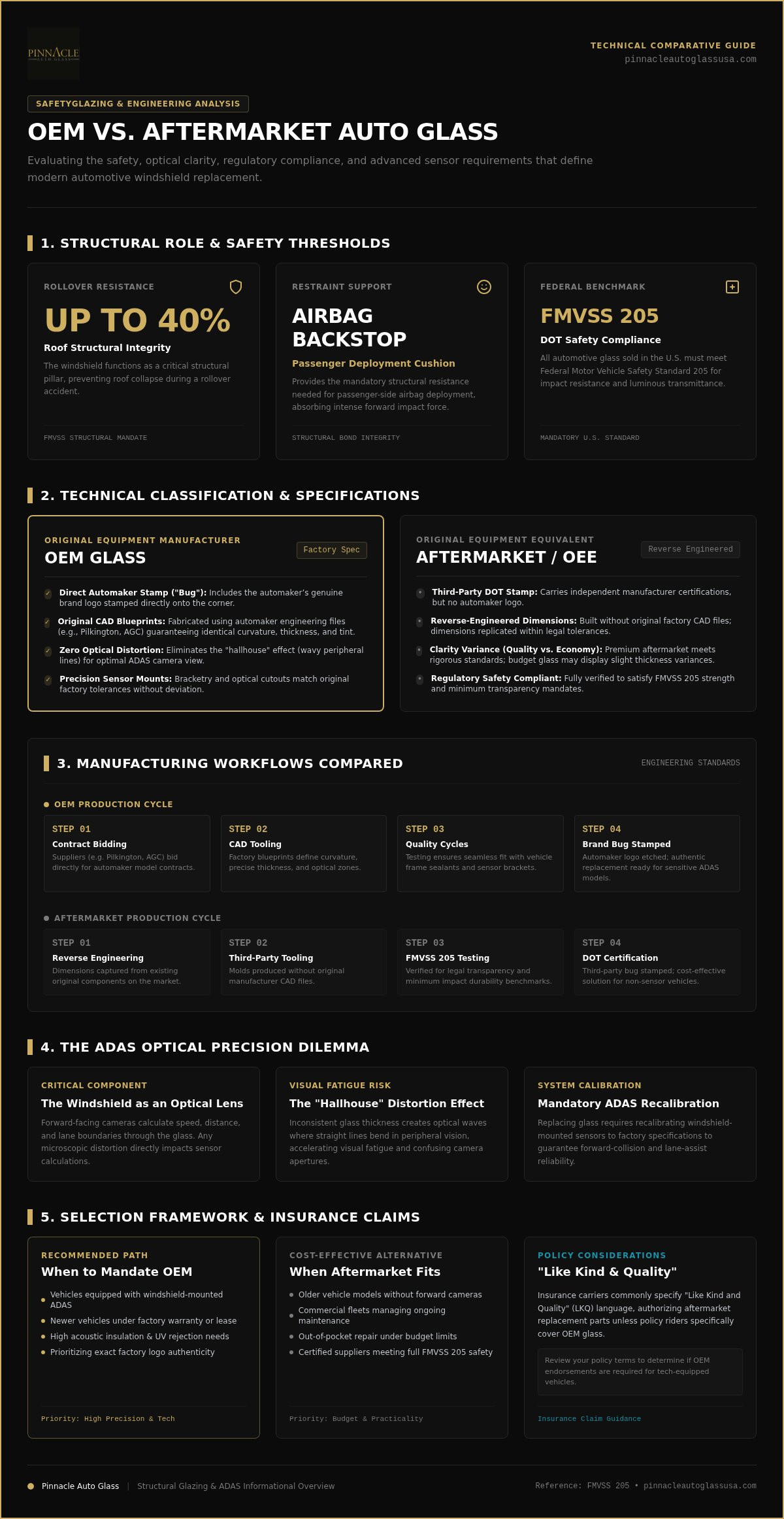
Understanding the terminology is the first step in choosing between OEM and aftermarket glass. Original Equipment Manufacturer (OEM) glass is produced by the same company that supplied the glass when the vehicle left the assembly line. It carries the automaker's brand logo, such as Ford or Toyota, stamped directly onto the corner. Original Equipment Equivalent (OEE) or aftermarket glass is produced by third-party companies that didn't hold the original contract for that specific model. While it lacks the automaker's logo, it must still comply with strict federal regulations.
Every piece of automotive glass sold in the United States must meet Department of Transportation (DOT) standards. Specifically, the Federal Motor Vehicle Safety Standard (FMVSS) 205 governs automotive windshield construction and safety glazing. These rules ensure that any glass installed in your vehicle provides a minimum level of transparency and impact resistance. The most visible difference between the two is the "bug," or the stamp, in the corner. If you want a perfect match for your original factory look, OEM is the only way to get that specific logo.
Consider these primary differences:
- OEM: Factory-stamped, exact specifications, carries the automaker logo.
- Aftermarket/OEE: Third-party production, reverse-engineered dimensions, no automaker logo.
- Regulatory Compliance: Both must meet FMVSS 205 safety benchmarks.
The Manufacturing Process of OEM Glass
OEM suppliers like Pilkington or AGC participate in a rigorous bidding process with automakers. Once selected, they receive the exact CAD files and engineering specifications for the vehicle. This ensures the thickness, curvature, and tint are identical to the original part. Quality control cycles for OEM parts are intense. The glass undergoes specific testing to ensure it integrates perfectly with the vehicle’s frame and sealants. This precision is why many professionals recommend OEM when choosing between OEM and aftermarket glass for newer vehicles with complex tech.
How Aftermarket Glass Meets Safety Requirements
Aftermarket manufacturers don't have access to the original factory blueprints. Instead, they use reverse-engineering to replicate the dimensions and shape of the glass. While they meet FMVSS 205 safety requirements for strength and clarity, there can be slight variances in fit or thickness. It's vital to distinguish between quality aftermarket glass, which comes from reputable global suppliers, and economy glass. Economy options may meet the bare minimum legal requirements but often fall short on optical clarity or long-term durability. Quality aftermarket glass remains a reliable, cost-effective choice for older vehicles without complex integrated sensors.
Performance and Safety: Comparing Fit, Clarity, and Durability
A windshield is a structural component, not just a clear barrier. It provides up to 40% of the roof's structural integrity during a rollover accident and acts as a backstop for the passenger side airbag. Every glass replacement must adhere to the Federal Motor Vehicle Safety Standard No. 205, which dictates specific benchmarks for strength and luminous transmittance. When choosing between OEM and aftermarket glass, you're evaluating how well a part maintains these critical safety margins over years of use. High-tier glass also offers superior UV protection and heat rejection, which preserves your vehicle's interior and reduces the load on your air conditioning system.
If you notice visual shifts or increased wind noise after a chip, consider a professional windshield replacement to restore your vehicle's factory standards. Quality installation ensures that the structural bond remains intact, protecting you and your passengers in the event of a collision.
Optical Distortion and Visual Clarity
Optical clarity is the measure of light transmission and distortion levels that determines how accurately a driver perceives the road, directly influencing the onset of visual fatigue during long trips. OEM glass is manufactured with precise curvatures that eliminate the "hallhouse" effect, where straight lines appear wavy in your peripheral vision. Aftermarket glass can sometimes vary in thickness or curvature slightly. These minor deviations change how light refracts through the pane. While it might seem negligible during a sunny day, these distortions become prominent during night driving or in heavy rain, where glare can quickly lead to eye strain and reduced reaction times.
Acoustic Performance and Cabin Comfort
Modern luxury vehicles and high-end trims rely on acoustic laminate layers to maintain a quiet cabin. This specialized Polyvinyl Butyral (PVB) interlayer is designed to dampen engine drone and wind noise. When choosing between OEM and aftermarket glass, acoustic performance is often where the differences are most audible. Many aftermarket options use standard laminate that doesn't provide the same sound-dampening properties. For high-mileage fleet vehicles, reducing cabin noise is essential for lowering driver stress and improving long-term focus. If your vehicle was originally equipped with "SoundScreen" or similar acoustic technology, opting for a lower-tier aftermarket part will likely result in a noticeably louder ride.
The ADAS Factor: Why Glass Choice Impacts Modern Safety Tech
Your windshield is no longer just a passive shield; it's an essential housing for your vehicle's Advanced Driver Assistance Systems (ADAS). Sensors and cameras mounted behind the glass manage critical tasks like lane-keeping assist and autonomous emergency braking. When choosing between OEM and aftermarket glass, you must consider how the clarity and thickness of the pane affect these optical components. Variations in glass tint or thickness can distort the camera’s "vision," potentially leading to delayed responses or system errors.
An IIHS study on crash avoidance system repairs highlights that even minor repair inaccuracies can compromise safety features. Because of these risks, many automakers now mandate the use of OEM glass for vehicles equipped with certain safety suites. The goal is to ensure the camera sees the road exactly as the software engineers intended. Following any replacement, a professional ADAS calibration auto glass procedure is mandatory to re-sync the sensors with the new glass properties.
Camera Focal Points and Glass Curvature
The cameras used for Lane Departure Warning and Forward Collision systems rely on specific focal points. If the glass curvature is off by even 1mm, the camera might "see" the road slightly to the left or right of its actual position. This deviation can cause the vehicle to steer unnecessarily or fail to brake in an emergency. The optical precision of the glass directly determines whether safety sensors can accurately measure the distance and speed of objects ahead. This level of accuracy is why many technicians prefer the guaranteed specifications of factory-stamped glass.
Recalibration Success Rates
Calibration success isn't always guaranteed when choosing between OEM and aftermarket glass. Low-quality aftermarket options often have subtle imperfections that prevent the calibration software from completing its cycle. Even if a system reports a "successful" calibration, slight optical distortions can lead to an inaccurate interpretation of road conditions. This creates a false sense of security for the driver. Pinnacle Auto Glass maintains national service standards to ensure every recalibration meets strict safety criteria. Our technicians handle the technical complexities of ADAS integration regardless of the glass type selected, ensuring your safety systems perform reliably on the road.
Financial and Insurance Considerations: Navigating the Cost Difference
The financial reality of vehicle repair often dictates the process of choosing between OEM and aftermarket glass. While aftermarket options offer upfront savings, the total cost involves more than just the initial invoice. Insurance carriers use the "Like Kind and Quality" (LKQ) standard to determine coverage limits. This standard allows them to approve third-party parts that function similarly to the original factory equipment. Before scheduling service, it's vital to evaluate how much does windshield replacement cost when factoring in your deductible and potential surcharges for factory parts.
Insurance Claims and Glass Type
Many policies automatically default to aftermarket glass once a vehicle is two or three years old. If you prefer factory glass, you might face an "out-of-pocket" difference between the insurer's approved rate and the OEM part cost. You can avoid this complication by adding an "OEM Rider" to your insurance policy. This rider is a specialized endorsement that guarantees the use of original manufacturer parts for all glass claims. In cases where a specific safety feature cannot be calibrated on aftermarket glass, your insurer may be obligated to cover the OEM part to return the vehicle to a safe, operable state. Always review your policy language before a chip turns into a crack.
Long-Term Value vs. Immediate Savings
Resale value is a major factor for owners of high-end or collector vehicles. A non-OEM windshield can be a red flag for prospective buyers; it suggests that the owner may have opted for the cheapest repair rather than the best one. For commercial operators, fleet vehicle glass maintenance is about maximizing uptime and safety. Using high-quality glass reduces the frequency of replacements and ensures that safety systems remain functional across the entire fleet. Balancing your budget doesn't mean you have to sacrifice safety; it means making an informed choice based on the vehicle's role, age, and technology.
Restoring your vehicle's glass requires a partner who understands the nuances of insurance claims and technical requirements. Reach out to our team for a comprehensive windshield replacement quote that prioritizes your safety and your budget.
Making the Expert Choice for Your Vehicle or Fleet
The decision-making process for choosing between OEM and aftermarket glass often follows a "Golden Rule." If your vehicle is less than three years old or features a complex suite of Advanced Driver Assistance Systems (ADAS), OEM glass is generally non-negotiable. The factory-stamped part ensures that every sensor and camera bracket is positioned with zero margin for error. Conversely, aftermarket glass is a smart, pragmatic choice for older vehicles where safety technology is minimal and budget constraints are a priority. Regardless of your choice, you should consult with auto glass professionals who provide integrated recalibration services to ensure the entire system functions as intended.
The quality of the technician is often more important than the brand of the glass. A premium OEM windshield will fail if the technician uses low-grade urethanes or fails to follow proper bonding protocols. Before the installation begins, ask your service provider about their experience with your specific vehicle make and their process for verifying ADAS alignment. Relying on a team that follows national service standards ensures consistent quality for both individual drivers and large-scale commercial operations.
A Decision Framework for Personal Vehicles
When evaluating glass for your personal car, consider the following variables:
- Vehicle Age: Newer models rely heavily on precise glass specifications for safety tech.
- Lease Agreements: Most leasing companies require OEM glass for returns; using aftermarket parts may result in penalties.
- Acoustic Preferences: If you value a silent cabin, verify that the replacement glass includes an acoustic laminate layer.
- Warranty: Ensure the installation includes a warranty on both the glass and the labor.
Strategic Choices for Commercial Fleets
For commercial operators, choosing between OEM and aftermarket glass is a matter of operational efficiency. Standardizing your glass types across a fleet simplifies maintenance schedules and creates predictable costs. High-volume fleets often benefit from quality aftermarket glass because it offers a balance between durability and price, especially for heavy-duty trucks that face frequent road debris. However, specialized commercial vehicles with integrated safety sensors still require the precision of OEM parts to avoid liability issues. Balancing downtime with glass availability is critical; choosing a provider with national reach ensures your trucks return to the road quickly without compromising on installation safety.
Prioritizing Your Vehicle's Safety and Performance
Your windshield is more than a window; it's a structural safety component. We've explored how glass choice affects everything from cabin acoustics to the precision of your ADAS cameras. While factory-stamped OEM glass offers guaranteed specifications for modern tech, quality aftermarket options provide a practical solution for budget-conscious owners of older vehicles. The most critical factor isn't just the logo on the glass, but the technical expertise behind the installation.
When choosing between OEM and aftermarket glass, you must prioritize accurate sensor alignment and structural integrity. Pinnacle Auto Glass acts as your dependable guide through this process. We provide national fleet and commercial support alongside safety-first installation standards. Our team includes certified ADAS recalibration specialists who ensure your safety systems are road-ready before you leave the shop. Don't compromise on the clarity or security of your vehicle.
Get a Professional Quote for Your Windshield Replacement today. We are ready to assist you in restoring your vehicle to its peak performance with the focused attention your safety deserves.
Frequently Asked Questions
Is aftermarket windshield glass as strong as OEM?
Yes, aftermarket glass must meet the same federal safety standards as OEM parts. Specifically, Federal Motor Vehicle Safety Standard No. 205 ensures that every windshield provides the necessary impact resistance and structural support for the vehicle. While the thickness or tint can vary slightly, the strength required to protect passengers during a rollover accident is a legal requirement for both types. Quality aftermarket brands provide the same level of structural protection as factory-installed units.
Will using aftermarket glass void my vehicle's warranty?
Using aftermarket glass will not void your entire vehicle warranty. The Magnuson-Moss Warranty Act protects you from such claims. A manufacturer cannot deny warranty coverage just because an aftermarket part was used unless they can prove that specific part caused a failure. When choosing between OEM and aftermarket glass, you can feel confident that your broader vehicle warranty remains intact as long as the installation is performed professionally and meets industry safety standards.
Why does my insurance company only want to pay for aftermarket glass?
Insurance companies prioritize aftermarket glass to control repair costs. Most policies include a "Like Kind and Quality" clause; this allows them to substitute original parts with functionally equivalent third-party options. They view aftermarket glass as a safe, cost-effective alternative that meets all regulatory requirements. If you want factory glass, you may need to pay the price difference out of pocket or have a specific OEM endorsement on your insurance policy before the damage occurs.
Can ADAS cameras be calibrated with an aftermarket windshield?
ADAS cameras can usually be calibrated with a high-quality aftermarket windshield. The success of the recalibration depends on the optical clarity and curvature of the glass in front of the camera lens. While most professional technicians can successfully sync sensors with aftermarket glass, some economy-grade options may have distortions that prevent the software from finishing the process. Quality installation and professional recalibration are essential for ensuring these safety systems function correctly regardless of the glass brand.
How can I tell if I have an OEM or aftermarket windshield currently?
You can identify your glass type by looking at the "bug" or stamp in the lower corner of the windshield. OEM glass features the vehicle manufacturer's logo, such as Ford, BMW, or Toyota, alongside the glass maker's name. Aftermarket glass will display the manufacturer's name, like Pilkington or AGC, and a DOT code, but it will lack the automaker's logo. This stamp is the most reliable way to verify the origin and type of your current glass.
Is there a difference in the warranty provided for the glass itself?
Warranty coverage varies significantly between manufacturers and installation companies rather than just the glass type. OEM parts are often backed by the automaker's limited parts warranty. Most reputable aftermarket glass manufacturers provide their own limited warranties against manufacturing defects like stress cracks or delamination. It's important to choose an installer that provides a comprehensive labor warranty to protect against leaks or wind noise; this ensures long-term protection regardless of the glass brand you select.
Does aftermarket glass affect the resale value of my car?
Aftermarket glass can impact the resale value of luxury, exotic, or very new vehicles. Buyers in these specific markets often look for original factory parts as a sign of meticulous maintenance. For standard daily drivers or older vehicles, the difference is usually negligible. However, if you are returning a leased vehicle, check your contract. Many leasing companies require OEM glass and may charge you a penalty if they find an aftermarket replacement during the turn-in inspection.
What happens if the ADAS calibration fails on aftermarket glass?
If an ADAS calibration fails on aftermarket glass, the safety systems may remain disabled or provide inaccurate warnings. This often happens when choosing between OEM and aftermarket glass if the third-party part has subtle optical distortions. In these rare cases, the only solution is to remove the aftermarket glass and install an OEM windshield. This ensures the camera has a clear, undistorted view that meets the manufacturer's exact software requirements for a successful and safe calibration cycle.


