
Would you pay $1,500 for a single piece of glass just because a small pebble hit your commute? Most drivers assume their standard insurance covers every chip and crack without a catch. However, modern vehicles are complex machines. A simple windshield replacement now requires precise ADAS recalibration to keep your safety systems functional. Many policyholders find themselves asking, what is full glass coverage on car insurance, only after they receive a massive bill for these technical requirements.
This 2026 guide clarifies how this specific endorsement eliminates out-of-pocket costs and ensures your vehicle remains safe to drive. You'll learn how to leverage $0-deductible repairs, understand the difference between comprehensive and full glass options, and confirm that technical recalibration is fully covered. We'll show you how to file a claim without the stress of rising rates or hidden fees. Protecting your windshield means protecting your safety sensors, and the right coverage makes that process seamless. Understanding your policy today prevents expensive surprises tomorrow.
Key Takeaways
- Understand exactly what is full glass coverage on car insurance and how it eliminates deductibles for windshield and window repairs.
- Identify the critical differences between general comprehensive policies and specialized glass endorsements to ensure maximum financial protection.
- Recognize why 2026 vehicle technology requires full glass coverage to account for expensive ADAS recalibration and integrated sensor components.
- Follow a clear path to verify your current policy benefits and determine if your damage requires a simple repair or a full replacement.
- Learn how professional technicians coordinate with insurance providers to handle technical claims and restore safety systems efficiently.
Defining Full Glass Coverage and Its Role in Auto Insurance
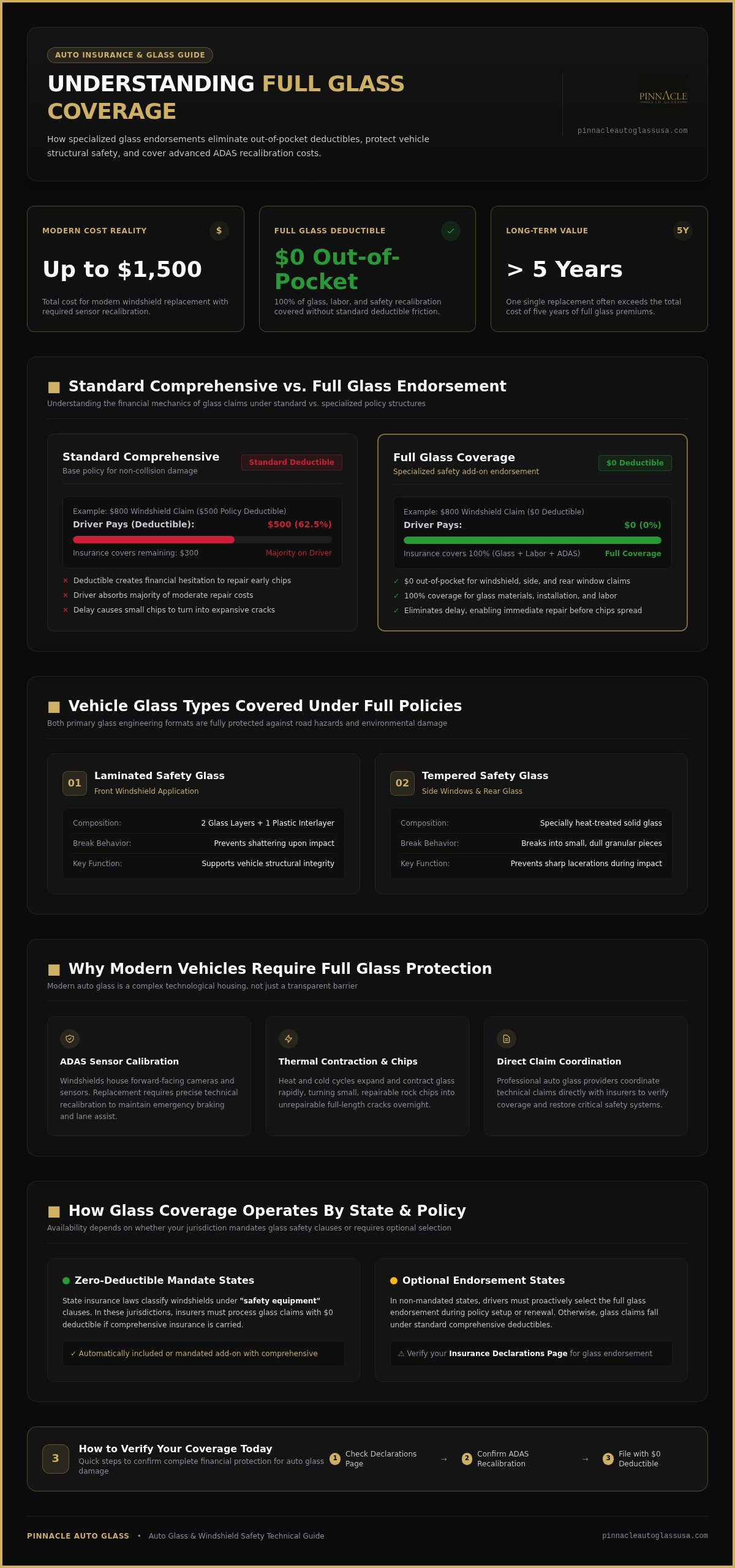
Full glass coverage is an optional insurance endorsement that pays for glass repair or replacement with no deductible. It functions as a specialized layer of protection, usually added to a comprehensive policy. When vehicle owners ask, what is full glass coverage on car insurance, they are usually looking for a way to avoid high out-of-pocket costs for a common problem. This coverage typically applies to all vehicle windows. This includes the windshield, side windows, and rear glass. Defined simply, full glass coverage is a $0-deductible safety protection for vehicle windows that ensures financial barriers don't prevent essential repairs.
It is helpful to understand the specific types of glass involved in a claim. Windshields are made of safety glass, which consists of two glass layers with a plastic interlayer. This design prevents shattering and supports the structural integrity of the vehicle. Side and rear windows often use tempered glass, which is designed to break into small, dull pieces upon impact. Full glass coverage handles both types, ensuring that every transparent surface on your vehicle is protected against road hazards and environmental damage.
How Full Glass Coverage Differs from Standard Policies
Standard comprehensive insurance is the parent policy for non-collision damage. However, it almost always includes a deductible. If your deductible is $500 and a new windshield costs $800, you are responsible for the majority of the bill. Full glass endorsements waive this deductible specifically for glass-only claims. This means the insurance company covers 100% of the cost for the glass and the labor involved in the installation.
This endorsement is a vital tool for drivers in areas with high road debris or extreme temperature fluctuations. Heat and cold cause glass to expand and contract; this can turn a tiny chip into a massive crack overnight. Without this coverage, you might delay a repair to avoid the deductible. This delay leads to a more dangerous situation on the road. Full glass protection removes that hesitation, allowing for immediate action when damage occurs.
Zero-Deductible States vs. Optional Endorsements
The availability of this coverage depends on your location and insurer. In several states, insurance law mandates that glass claims be processed with no deductible if you carry comprehensive insurance. These are often referred to as zero-deductible states. In these regions, insurers must provide full glass protection as part of the standard comprehensive package or offer it as a mandatory add-on. This is often codified under "safety equipment" clauses in insurance law, reflecting the windshield's role as a primary safety component.
To determine your coverage status, check your Insurance Declarations Page for specific glass endorsements or safety equipment language. If you live in a state where this isn't mandated, you must manually select the option during your policy renewal. It is a proactive step that ensures you aren't stuck with a technical bill when a rock hits your windshield. Understanding your state's specific requirements is the first step in maximizing your policy benefits.
Full Glass Coverage vs. Comprehensive Insurance: Key Differences
Understanding the hierarchy of your insurance policy is essential for financial planning. Comprehensive insurance serves as the base coverage for non-collision events like theft, fire, and vandalism. However, while comprehensive insurance covers glass damage, it typically requires you to pay a deductible first. To understand the basic auto insurance policy components, you must view comprehensive as the broad safety net and full glass as the targeted solution. When people ask, what is full glass coverage on car insurance, they are essentially looking for an upgrade that eliminates the financial friction of a standard comprehensive claim.
The financial math heavily favors the endorsement. A single windshield replacement on a modern vehicle often exceeds the cost of five years' worth of full glass premiums. You can learn more about these variables in our guide on how much does windshield replacement cost. By paying a small annual fee, you remove the risk of a sudden, large expense. It's a proactive way to manage the rising costs of automotive maintenance.
The Financial Breakdown: Deductibles vs. Endorsements
Consider a driver with a $500 deductible. When a rock chips the windshield, they might hesitate to file a claim because the repair cost is lower than their deductible. This delay often leads to the chip spreading into a crack that spans the entire glass. Under a full glass endorsement, that same driver pays $0. This encourages immediate action, which often allows for a simple repair rather than a total replacement. Long-term savings come from addressing these small issues before they become structural failures.
What Is (and Isn't) Covered Under Full Glass
While this coverage is extensive, it has specific limits you should know. Most policies focus strictly on the windshield, side windows, and rear glass. Other transparent or reflective surfaces might fall under different rules.
- Sunroofs and Moonroofs: These are frequently excluded from standard glass endorsements. They often require a separate rider or fall under the standard comprehensive deductible.
- Side-View Mirrors: The glass in your mirrors or light housings is usually not included in a full glass claim.
- Maintenance Issues: Insurance doesn't cover scratches from old wiper blades or general wear and tear.
Damage must be sudden and accidental to qualify for a claim. If you have a crack that needs professional attention, the team at Pinnacle Auto Glass can help you verify your coverage and navigate the claim process efficiently. This ensures your vehicle returns to a safe condition without unnecessary stress.
Why Modern Vehicles Need Full Glass Protection in 2026
In 2026, a windshield is no longer just a transparent barrier. It's a sophisticated housing for Advanced Driver Assistance Systems (ADAS). When drivers investigate what is full glass coverage on car insurance, they often discover that the technology behind the glass is the most expensive part of the claim. Modern vehicles use "smart" glass integrated with rain sensors and heads-up displays (HUD). These features significantly increase the cost of materials and specialized labor. Because of this complexity, hiring a certified auto glass technician is essential for a safe and functional installation. ADAS recalibration is a non-negotiable safety step after glass replacement to ensure your collision avoidance systems work correctly.
Smart glass features like rain sensors are often bonded directly to the glass surface. HUDs require a specific reflective layer within the glass laminate to project data clearly. If these components aren't perfectly matched to the vehicle's computer, safety features will fail. Full glass coverage protects you from the rising costs of these specific materials, which have doubled or tripled replacement costs compared to older vehicle models. This evolution in automotive design makes specialized coverage a financial necessity rather than a luxury.
The Hidden Cost of ADAS Recalibration
Recalibration ensures that cameras and sensors accurately "see" the road. After a windshield swap, these components must be digitally aligned to the vehicle's new structural state. Even a millimeter of variance can cause a safety system to malfunction. Fortunately, most full glass endorsements cover both the physical glass and the technical labor for recalibration. Without this coverage, you might face a bill for hundreds of dollars just for the software alignment. Check our ADAS calibration auto glass guide for technical details on how we perform this service to factory standards.
OEM vs. Aftermarket Glass Under Insurance
Policyholders often wonder if their coverage guarantees Original Equipment Manufacturer (OEM) parts. Many basic auto insurance policy components prioritize "like kind and quality" parts, which often means aftermarket glass. For vehicles with complex HUDs or sensitive cameras, aftermarket glass can occasionally cause visual distortion or sensor errors. You should advocate for OEM parts during your insurance claim by emphasizing the manufacturer's safety requirements for sensor compatibility. High-tech vehicles require high-tech glass to maintain factory safety standards and ensure your ADAS functions as intended.
How to Verify and Use Your Glass Coverage
Understanding what is full glass coverage on car insurance starts with verifying your specific policy documents. You don't need to wait for an agent to call you back to confirm your benefits. Follow these four steps to take control of your vehicle's safety and financial protection.
- Step 1: Locate your Insurance Declarations Page. This summary document lists every active coverage on your vehicle. Look for terms like "Full Glass" or "Safety Glass Endorsement."
- Step 2: Inspect the damage. A chip smaller than a quarter can usually be repaired. If the crack is longer than a credit card or located directly in the driver's line of sight, a full replacement is necessary.
- Step 3: Select a provider with specialized expertise. Ensure the shop understands insurance billing and has the equipment for ADAS recalibration to ensure your safety systems remain functional.
- Step 4: Contact the glass shop directly. Most professional providers can initiate the claim with your insurer on your behalf, saving you hours of phone time and administrative stress.
Reading Your Declarations Page Like a Pro
Your Declarations Page can be confusing at first glance. Look specifically for the "Deductibles" section. You might see a $500 deductible for Comprehensive coverage, but a separate line item for "Full Glass" should show a $0 or "N/A" value. This distinction is critical. If your policy doesn't explicitly mention glass as a separate endorsement, your repair will likely fall under your standard comprehensive deductible. If you are unsure about your specific limits, contact Pinnacle Auto Glass to help you interpret your coverage and verify your $0-deductible eligibility.
Will Filing a Glass Claim Raise Your Rates?
Many drivers fear that using their benefits will lead to a premium spike. In most cases, a glass claim is considered a "no-fault" comprehensive claim. Unlike collision claims, which involve moving accidents, glass damage from road debris is seen as an unavoidable hazard. Underwriters view these claims differently than they view accidents where a driver is at fault.
Insurance companies actually prefer that you file a claim for a small chip immediately. It is much more cost-effective for them to pay for a simple repair than to wait until the damage spreads and requires a full windshield replacement. Using your coverage for timely maintenance demonstrates responsible vehicle ownership. It maintains the safety of your car without the typical fear of massive rate increases associated with collision incidents.
Maximizing Your Coverage with Pinnacle Auto Glass
Pinnacle Auto Glass acts as a bridge between your insurance policy and the technical requirements of modern vehicle safety. When you understand exactly what is full glass coverage on car insurance, the next step is finding a provider who can execute the work to factory standards. Our team specializes in navigating the complexities of glass claims. We ensure that your $0-deductible benefit is applied accurately. We provide professional windshield replacement and integrated ADAS recalibration for both personal vehicles and large commercial fleets. By focusing on a national scale, we maintain the technical expertise required to handle high-tech glass for any make or model.
Efficiency is a priority for every vehicle owner. We work with all major national insurance carriers to minimize your downtime and remove the administrative burden from your plate. Whether you manage a fleet of commercial trucks or a single family SUV, our solutions are designed to be fast and reliable. We don't just swap the glass. Our certified technicians perform a comprehensive system check to ensure every sensor and camera functions exactly as the manufacturer intended. This technical focus ensures your vehicle remains a safe environment for you and your passengers.
Seamless Insurance Integration
We handle the paperwork so you don't have to. Our team manages the communication with your insurance provider, from the initial claim filing to the final billing. We utilize direct billing to insurance companies for a hassle-free experience. This process guarantees that you aren't stuck waiting for a reimbursement check. We also ensure all safety recalibrations are documented for your insurance records. This documentation is vital for maintaining your vehicle's history and verifying that all safety protocols were followed during the installation.
National Expertise, Professional Results
Our commitment to quality starts with the materials we use. We utilize high-quality glass and adhesives that meet or exceed federal safety standards. There is a distinct advantage to using a dedicated glass specialist over a general auto body shop. General shops often lack the specialized calibration equipment and technical training required for 2026 vehicle technology. We prioritize results and precision. Contact Pinnacle Auto Glass today to start your claim and restore your vehicle to its peak safety condition.
Secure Your Vehicle's Safety and Technology Today
Your windshield is a critical safety component that houses expensive sensors and cameras. Understanding what is full glass coverage on car insurance allows you to maintain these systems without the burden of high out-of-pocket costs. By choosing an endorsement that waives your deductible, you ensure that even small chips receive immediate professional attention before they become dangerous failures. This proactive approach preserves both your vehicle's structural integrity and its advanced safety features.
Pinnacle Auto Glass simplifies the entire restoration process. Our certified glass specialists provide expert ADAS recalibration with every installation to ensure your technology performs perfectly. We also handle direct insurance billing to save you time and administrative hassle. Don't let a cracked windshield compromise your safety or your wallet. Schedule your professional glass service with Pinnacle Auto Glass today. We are ready to assist you with reliable solutions and quality results.
Frequently Asked Questions
Is full glass coverage the same as comprehensive insurance?
No, full glass coverage is not the same as comprehensive insurance; it is a specialized endorsement added to it. While comprehensive insurance covers glass damage, it typically requires a deductible payment first. This endorsement specifically waives that deductible for glass-only claims. It ensures you don't pay out-of-pocket for common road hazards like flying rocks or debris. Think of it as a technical upgrade to your standard policy.
Does full glass coverage cover sunroofs and side mirrors?
Most standard full glass endorsements do not cover sunroofs, moonroofs, or side-view mirrors. These components are usually classified as body parts or specialized equipment rather than safety glass. If these items are damaged, they typically fall under your standard comprehensive deductible. You should review your policy's specific safety equipment clause to see if any exceptions apply to your vehicle's glass roof panels or mirrors.
How do I know if I have a $0 deductible for glass?
You can determine your status by reviewing your Insurance Declarations Page. This document provides a summary of your policy limits and deductibles. Look for a specific line item labeled Full Glass or Safety Glass Endorsement. If the deductible listed next to this item is $0 or N/A, you have the protection. Understanding what is full glass coverage on car insurance helps you identify these specific benefits before you need a repair.
Will my insurance cover ADAS recalibration after a windshield replacement?
Yes, most insurance policies cover ADAS recalibration as part of a windshield replacement claim. Because recalibration is essential for your safety systems to function, insurers view it as a mandatory part of the repair process. Professional providers like Pinnacle Auto Glass include this service to ensure your vehicle meets factory safety standards. Always confirm that your chosen glass shop can document this technical work for your insurance records.
Can I choose my own glass shop if I have full glass coverage?
Yes, you generally have the right to choose any certified glass shop for your repairs. While some insurers might suggest a preferred vendor, you aren't legally required to use them. It's often better to choose a specialist that prioritizes ADAS recalibration and high-quality materials. Selecting a shop that understands insurance billing ensures your claim is handled correctly while maintaining the high safety standards your modern vehicle requires.
What happens if I don't have full glass coverage and my windshield cracks?
If you lack this coverage, you must pay your standard comprehensive deductible before the insurance company pays the remaining balance. For example, if a replacement costs $900 and your deductible is $500, you are responsible for the first $500. For smaller repairs, the cost of a chip fix might be lower than your deductible. In that case, you would pay the entire bill out-of-pocket without any assistance from your insurer.
Does full glass coverage apply to commercial fleet vehicles?
Full glass coverage is available for commercial fleet vehicles and is highly recommended for high-mileage operations. Fleet managers often use these endorsements to avoid the administrative burden of paying individual deductibles for every cracked windshield. Pinnacle Auto Glass provides specialized fleet glass services that integrate with commercial insurance platforms. This coverage helps maintain the safety of your drivers and keeps your commercial trucks on the road with minimal financial disruption.
How many glass claims can I file in one year without affecting my premium?
Insurance companies typically don't raise rates for a single no-fault glass claim. However, filing multiple claims within a twelve-month period can sometimes lead to a policy review. While there is no hard limit, three or more claims in one year might cause an insurer to reconsider your premium or your eligibility for the endorsement. It's best to address chips early through repair to avoid the need for multiple full replacements.


