

Many drivers worry about the impact a glass claim can have on their auto insurance premiums, despite a more favorable market reality. You likely feel overwhelmed by the complex windshield replacement insurance laws or concerned that your car's safety cameras won't function correctly after a repair. This is a common worry for modern vehicle owners who rely on advanced driver assistance systems (ADAS) every day.
This article promises to show you how to secure a no-cost replacement without the stress. You'll discover how many comprehensive policies include provisions for zero-deductible glass claims. This ensures your vehicle's safety technology is fully restored at no cost to you. We will preview the specific steps to confirm your eligibility, the importance of professional ADAS recalibration, and how to choose a provider that handles the entire insurance process. Understanding these 2026 updates ensures your car remains safe and your wallet stays closed.
Key Takeaways
- Understand how Florida Statute §627.7288 allows you to replace your windshield with zero out-of-pocket costs if you carry comprehensive insurance.
- Navigate the latest 2026 updates to Florida windshield replacement insurance laws to ensure your claim is processed efficiently and correctly.
- Learn why ADAS recalibration is a mandatory safety requirement that must be performed alongside your windshield replacement to restore vehicle sensors.
- Follow a professional step-by-step guide to filing your claim, starting with damage documentation and choosing a specialist who manages the insurance process.
- Identify why high-grade adhesives and professional installation standards are critical for maintaining your vehicle's structural integrity after a glass replacement.
Understanding Florida Statute §627.7288 and Windshield Safety
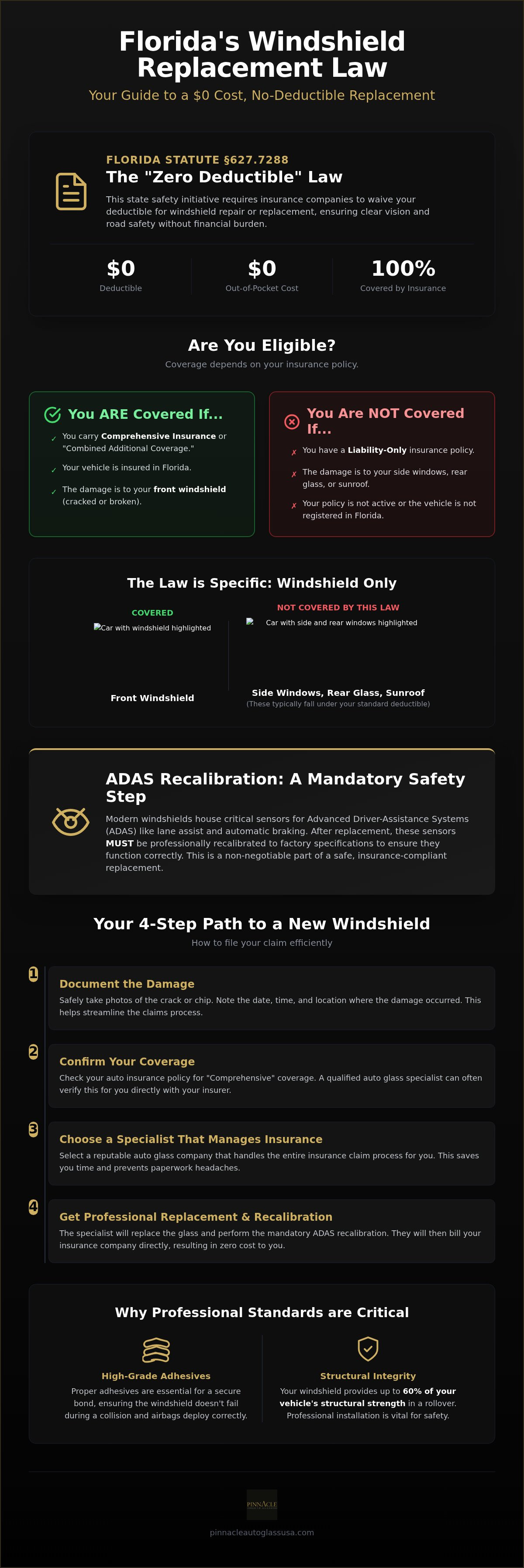
Florida Statute §627.7288 is commonly known as the "Zero Deductible" law for automotive glass. It is a specific regulation that protects drivers from high repair costs when their vision is compromised. Under this law, insurance companies must waive the deductible for windshield replacement or repair. This applies to any motor vehicle insured in Florida that carries comprehensive coverage. When you file a claim, "zero deductible" means exactly what it sounds like: you face no out-of-pocket costs for the service.
This regulation isn't just a financial perk. It's a formal safety initiative designed to keep vehicles with impaired glass off the roads. By eliminating the cost barrier, the state ensures that Florida windshield replacement insurance laws prioritize public safety over insurance company profits. It encourages drivers to address damage before it leads to an accident or a failed inspection.
The Purpose of the Zero Deductible Mandate
Florida's roads are busy and fast. Clear vision is non-negotiable for every driver. A small chip can quickly spread into a large crack, obstructing your view of traffic and pedestrians. Beyond visibility, your windshield is a primary structural component of the vehicle. It provides up to 60% of the structural integrity in a rollover accident. It also ensures that the passenger-side airbag deploys at the correct angle during a collision.
The state knows drivers often delay repairs when faced with a $500 deductible. Removing this barrier encourages timely windshield repair. Addressing chips early maintains the factory seal and upholds rigorous windshield safety standards. This proactive approach saves lives and keeps Florida's highways safer for everyone.
What the Law Covers vs. What It Doesn't
It's vital to understand the scope of this legal protection. The zero-deductible mandate is highly specific. It only applies to the windshield. If your side window is shattered or your rear glass is damaged, you will likely still have to pay your standard comprehensive deductible. The law covers the windshield because of its unique role in driver visibility and structural support.
The statute covers glass that is either "cracked" or "broken." There is no requirement for the crack to be a certain length before the law applies. Additionally, this protection extends to various types of owners. It covers:
- Personal passenger vehicles used for daily commuting.
- Commercial fleet vehicles.
- Large commercial trucks and transport vehicles.
Whether you own one car or manage a fleet of fifty, the Florida windshield replacement insurance laws provide the same level of protection. As long as the vehicle carries comprehensive insurance or "Combined Additional Coverage," you are eligible for a no-cost windshield solution.
Eligibility Requirements for No-Deductible Glass Replacement
Eligibility starts with your insurance policy. The Florida windshield replacement insurance laws are clear: you must have comprehensive coverage to skip the deductible. This benefit is also available through "Combined Additional Coverage," a common feature in specific specialized policy types. One of the most reassuring aspects of the law is its no-fault application. It doesn't matter if the damage came from a road debris strike or a falling object. As long as your policy is active and the damage requires professional attention, you qualify for a no-cost solution.
Comprehensive vs. Liability-Only Policies
Liability-only insurance covers damage you do to others. It doesn't provide glass protection for your own car. If you're unsure about your coverage, check your policy declarations page. Look for terms like "Comprehensive" or "Other than Collision." These sections confirm that your insurer will handle the bill for your windshield. If you find you only have liability, you'll be responsible for the service costs. Even then, don't cut corners. Investing in professional windshield replacement is vital for your safety. High-quality glass and proper installation prevent the windshield from failing during an accident.
Commercial and Fleet Vehicle Eligibility
The law isn't just for individual commuters. Business-owned vehicles and commercial trucks are fully covered under the same statutes. Fleet managers often face high maintenance costs, so the zero-deductible provision is a major advantage for operational budgets. It helps maintain vehicle uptime by allowing for immediate repairs without the delay of deductible approvals. This ensures that your business stays on the move without unexpected financial hurdles.
Commercial vehicles must adhere to strict federal safety standards. When a windshield is replaced, it must meet or exceed Original Equipment Manufacturer (OEM) specifications. This includes the integration of safety sensors. Modern trucks rely on ADAS recalibration in legal safety standards to operate safely. If your fleet uses advanced driver assistance systems, the recalibration is a required part of the insurance claim. This ensures your drivers stay protected on the road and your equipment remains compliant. You can contact a glass expert to review your fleet's specific needs and ensure every vehicle is safe for the road.
The Role of ADAS Recalibration in Legal Safety Standards
Modern vehicles are much more than steel and glass; they're sophisticated computers on wheels. Your windshield serves as a mounting point for critical sensors that power Advanced Driver Assistance Systems (ADAS). These systems include lane-keep assist, adaptive cruise control, and autonomous emergency braking. When a windshield is replaced, these cameras are moved and must be perfectly realigned. Under Florida windshield replacement insurance laws, a vehicle is not fully restored until these safety systems are functioning at factory specifications. ADAS recalibration is a vital safety step after glass installation that ensures your car's technology reacts correctly to road hazards.
Insurance providers are legally required to cover the cost of this recalibration as part of the total glass claim. Because the technology is an integral part of the windshield assembly, the "zero deductible" benefit extends to the labor and software required for the tech restoration. A replacement is technically incomplete if the cameras are left uncalibrated, as this leaves the driver with a false sense of security while the safety features are offline or inaccurate.
Why Recalibration is Non-Negotiable
Precision is the foundation of modern vehicle safety. Even a millimeter of variance in glass thickness or a slight tilt during installation can drastically change a camera's field of vision. This misalignment can cause your vehicle to provide late warnings or steer into an adjacent lane unexpectedly. For all 2026 vehicle models, ADAS calibration auto glass services are mandatory for a safe return to the road. You shouldn't trust a shop that ignores the digital side of your vehicle's structural glass. A misaligned sensor is often worse than a disabled one because it provides incorrect data to the car's braking and steering systems.
Insurance Coverage for Technology Restoration
Standard Florida insurance policies include a clause for "restoration to pre-accident condition." Since your car had functional safety technology before the glass was damaged, the insurer must pay to return it to that state. This process often requires two distinct types of recalibration. Static recalibration uses specialized targets in a controlled shop environment to set the base parameters. Dynamic recalibration involves a technician driving the vehicle on the road so the sensors can learn to identify real-world markers like lane lines and traffic signs.
It's essential to work with a glass specialist who manages the technology as well as the physical glass. This prevents the inconvenience of visiting a dealership after the glass is installed. By handling the entire process in one appointment, you ensure that your vehicle meets all safety standards before you pull out of the shop. This comprehensive approach is the only way to satisfy the requirements of Florida windshield replacement insurance laws while protecting your family on the highway.
Step-by-Step Guide to Filing an Auto Glass Insurance Claim
Filing a claim for a damaged windshield shouldn't be a stressful experience. When you understand how Florida windshield replacement insurance laws work, the process becomes a series of simple steps. Your first action should always be to document the damage. Take clear photos of the impact point and any spreading cracks. Record the date and time of the incident while the details are fresh. This evidence supports your claim and helps the technician determine the best repair path.
Next, contact a professional auto glass specialist before you call your insurance company. Many drivers make the mistake of calling their agent first. A specialized provider can verify your coverage details and handle the communication with the insurer on your behalf. This ensures the claim is filed correctly as a zero-deductible service. Once coverage is confirmed, you can schedule an appointment. Choose between a mobile service for convenience or an in-shop visit for static recalibration. After the installation and tech calibration are finished, your provider will finalize the paperwork directly with the insurance company.
Your Right to Choose a Repair Provider
You may encounter a practice known as "steering." This happens when an insurance representative strongly suggests or requires you to use their preferred network shop. Under Florida windshield replacement insurance laws, you have the absolute right to choose your repair provider. You aren't obligated to use the shop they recommend. Independent experts often provide more personalized service and better attention to detail. Prioritize specialists who offer comprehensive ADAS services. This ensures your vehicle's safety technology is handled by experts rather than a generalist shop.
What Information You Need for the Claim
Having your information ready speeds up the approval process. You will need your insurance policy number and your vehicle identification number (VIN). The VIN is usually found on your dashboard or driver-side door jamb. Be prepared to describe the specific cause of damage, such as a rock flying off a construction truck. While the state mandate covers the cost, insurers still review how much does windshield replacement cost based on glass type and labor requirements. Providing accurate details helps the specialist secure approval quickly. If you are ready to restore your vehicle's safety, you can start your claim with an expert glass specialist today.
Why Professional Standards Matter for Insurance-Backed Repairs
While Florida windshield replacement insurance laws ensure you don't pay out of pocket, the law cannot dictate the quality of the glass installed in your car. That responsibility rests with you and your chosen specialist. Professional shops prioritize Original Equipment Manufacturer (OEM) equivalent glass. This material matches the exact thickness, curvature, and clarity of your factory windshield. Using low-quality alternatives can lead to optical distortion or poor fitment, which compromises both your vision and the vehicle's structural integrity.
Installation quality is equally dependent on the adhesives used. High-grade urethane adhesives are required for proper structural bonding. These chemicals must be applied in a controlled environment to ensure they cure correctly. A professional service is the only way to guarantee the law's safety intent is met. Certified technicians follow strict protocols to maintain your vehicle's factory warranty. If a windshield is installed incorrectly, it can lead to leaks, wind noise, or even structural failure during an accident.
Structural Integrity and Airbag Deployment
Your windshield is a critical safety component that does more than block the wind. During a rollover accident, the glass provides essential support to prevent the roof from caving in. If the bond between the glass and the frame is weak, the roof can collapse, leading to severe injuries. Additionally, the windshield acts as a backstop for the passenger-side airbag. When the airbag deploys, it strikes the glass first to position itself correctly for the passenger. An improperly installed windshield can be blown out by the force of the airbag, rendering the safety system useless. Uncertified individuals often skip the rigorous cleaning and priming steps required to create a permanent, safe bond.
Quality Assurance in 2026 Auto Glass
The evolution of automotive technology has changed the requirements for glass replacement. In 2026, electric and autonomous vehicles use specialized glass designed for acoustic insulation and weight reduction. These modern materials require specialized tools and handling to prevent damage during installation. Professional shops invest in the latest equipment to handle these technical demands. You should trust an auto glass specialist for long-term peace of mind. This ensures your vehicle's safety standards are upheld and your insurance claim results in a high-quality restoration. Choosing an expert ensures that your car remains as safe as the day it left the factory.
Restore Your Safety and Visibility
Florida's unique legal landscape provides a significant advantage for drivers facing glass damage. By leveraging Florida windshield replacement insurance laws, you can ensure your vehicle is restored to factory standards without the burden of a deductible. It's vital to remember that a modern windshield is a complex assembly of glass and technology. A simple installation is no longer enough. Expert ADAS recalibration is required to maintain the accuracy of your lane-keep assist and emergency braking systems.
Whether you manage a commercial fleet or drive a personal passenger car, maintaining professional standards ensures your vehicle remains structurally sound. You don't have to navigate the insurance paperwork alone. Contact Pinnacle Auto Glass for professional windshield replacement and ADAS recalibration today. Our team specializes in hassle-free insurance claim processing and provides high-quality glass solutions for all modern vehicle safety standards. Take the first step toward a clearer view and a safer drive. Your safety is our priority, and we're ready to assist you in getting back on the road with total peace of mind.
Frequently Asked Questions
Is windshield replacement really free in Florida?
Yes, if you have comprehensive insurance or combined additional coverage. Florida Statute § 627.7288 requires insurers to waive the deductible for windshield repair or replacement. This means you won't pay anything out of pocket at the time of service. It's a consumer protection designed to ensure that damaged glass doesn't remain on the road. The Florida windshield replacement insurance laws prioritize your safety by removing financial barriers to essential repairs.
Does the zero-deductible law cover ADAS recalibration?
Absolutely. A windshield replacement isn't complete until the safety systems are fully functional. Because ADAS cameras and sensors are mounted to the glass, recalibration is a necessary part of the repair process. Insurance companies are legally obligated to cover these costs as part of the restoration to pre-accident condition. Professional specialists handle both the glass installation and the technical calibration in a single service to ensure your vehicle meets all safety standards.
Will filing a windshield claim increase my insurance premiums?
Typically, filing a single no-fault glass claim doesn't result in a premium increase. Florida law protects drivers from rate hikes for claims where they weren't at fault, such as damage from flying road debris. The broader insurance market is currently stabilizing due to recent legislative reforms. This environment allows you to address safety concerns promptly without worrying about a sudden spike in your monthly costs. Your safety is more important than a minor claim record.
What if I only have liability insurance in Florida?
Liability insurance only covers damage you cause to others; it doesn't cover your own vehicle. If you carry liability-only coverage, the zero-deductible mandate won't apply to your claim. You'll be responsible for the full cost of the glass and any necessary recalibration. In these cases, it's still critical to choose a professional specialist. High-quality materials and certified installation are essential for maintaining your car's structural integrity and your long-term safety.
Can my insurance company force me to use a specific glass shop?
No, your insurance provider cannot mandate which shop you use. While they might suggest a preferred provider, Florida law grants you the absolute right to choose any licensed repair facility. This prevents steering and allows you to select a specialist who prioritizes high-grade adhesives and OEM-equivalent glass. Choosing an independent professional often ensures a more thorough service, especially when dealing with complex tasks like ADAS recalibration for modern vehicles.
How many times per year can I use the Florida windshield law?
There is no specific limit on how many times you can use the zero-deductible provision each year. As long as each instance of damage is a separate, legitimate incident covered by your comprehensive policy, the law remains in effect. However, frequent claims may lead to increased scrutiny from your insurer. It's always best to have a professional evaluate the damage immediately to determine if a full replacement is required or if a simple repair is sufficient.
Does the law apply to commercial trucks and fleet vehicles?
Yes, the statute applies to personal vehicles, commercial trucks, and fleet operations alike. Any motor vehicle insured in the state with the appropriate coverage qualifies for no-cost windshield services. This is beneficial for:
- Owner-operators of semi-trucks.
- Logistics companies managing large fleets.
- Small businesses with delivery vans.
What happens if I drive with a cracked windshield in Florida?
Driving with a cracked windshield is both dangerous and potentially illegal. If a crack obstructs your clear view of the road, law enforcement can issue a citation for an equipment violation. Beyond the legal risk, damaged glass is a major safety concern. It weakens the structural integrity of the roof and can interfere with proper airbag deployment. Using Florida windshield replacement insurance laws allows you to fix these issues immediately at no out-of-pocket cost.


