
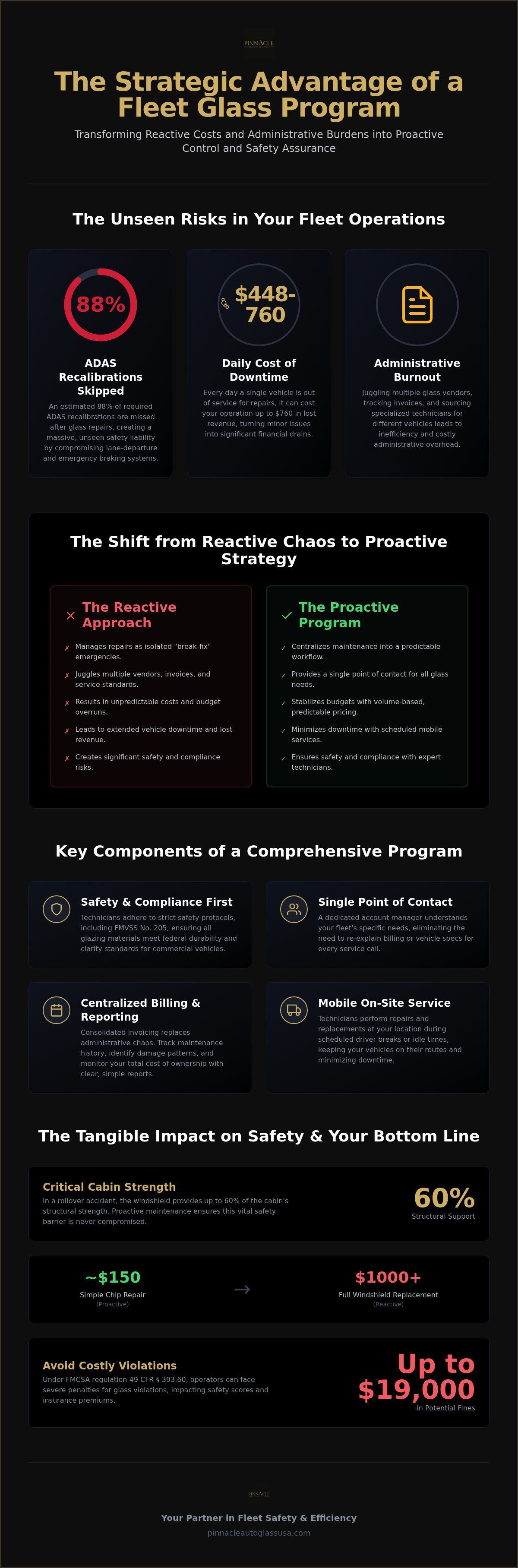
Did you know that an estimated 88% of required ADAS recalibrations are skipped after glass repairs? For a commercial fleet, this isn't just a maintenance oversight; it's a massive safety liability. Managing multiple glass vendors and tracking down specialized technicians often leads to administrative burnout and costly vehicle downtime. You need your trucks on the road, not sitting in a shop waiting for a part. Every day a vehicle is out of service can cost your operation between $448 and $760 in lost revenue.
We understand that your priority is keeping your drivers safe and your deliveries on time. Implementing a structured fleet glass repair program simplifies this process by providing a single point of contact for all your glass needs. This guide will show you how a professional program reduces downtime through mobile services, ensures compliance with FMCSA regulations, and stabilizes your maintenance budget. We'll break down the transition from reactive repairs to a proactive strategy that includes expert ADAS recalibration and predictable, volume-based pricing. Learn how to streamline your operations and protect your bottom line in 2026.
Key Takeaways
- A structured fleet glass repair program reduces administrative burdens and minimizes the high daily costs associated with vehicle downtime.
- Mobile glass services keep your vehicles on their routes by performing repairs and replacements during scheduled driver breaks or idle times.
- ADAS recalibration is a critical safety step that maintains the accuracy of cameras and sensors after a windshield replacement.
- Centralizing your maintenance allows for predictable billing and volume-based pricing that stabilizes your annual operational budget.
- You can implement a program by first assessing your current fleet size and defining specific mobile or geographical service needs.
Why Fleet Glass Maintenance is a Strategic Business Priority
A fleet glass repair program is more than a list of local vendors. It's a centralized maintenance partnership designed to protect your assets and your bottom line. Many companies treat glass as a minor "break-fix" issue. This reactive approach creates hidden costs that drain resources. A single cracked windshield triggers a chain reaction of negative outcomes. It compromises driver safety, leads to failed inspections, and damages your professional image on the road. When your vehicles look neglected, it reflects poorly on your operational standards.
Your vehicle's windshield is a critical structural component. In a rollover accident, the glass provides up to 60% of the cabin's structural strength. Proactive management ensures this safety barrier remains intact. Shifting from reactive repairs to a proactive fleet-wide strategy allows you to catch damage before it escalates. It moves your team away from emergency scrambles and toward a controlled, predictable workflow.
The Real Cost of Vehicle Downtime
Research shows that a single day of vehicle downtime can cost a fleet operation between $448 and $760. Waiting for a "convenient" time to address a chip often backfires. Small chips quickly expand into large cracks due to road vibration and temperature changes. What could've been a simple $150 mobile repair often turns into an expensive full replacement. Furthermore, glass violations are a magnet for roadside inspectors. Under FMCSA regulation 49 CFR § 393.60, operators can face fines of up to $19,000 for safety violations. These penalties directly impact your safety scores and insurance premiums.
Program Benefits for Logistics Managers
Managing repairs across a large territory is an administrative burden. A structured fleet glass repair program integrates into broader fleet management functions by centralizing communication. You gain a single point of contact instead of managing dozens of separate invoices. This consistency ensures that every vehicle in your organization receives the same high standard of care.
- Administrative Efficiency: Streamline tasks with centralized invoicing and electronic billing.
- Quality Control: Standardize repair and recalibration quality across your entire fleet.
- Budget Stability: Leverage volume-based pricing to make your annual maintenance costs predictable.
By prioritizing glass integrity, you reduce the chaos of unscheduled repairs. You'll keep your drivers on their routes and your vehicles in peak condition without the administrative headache of traditional maintenance models.
Key Components of a Comprehensive Fleet Glass Repair Program
A successful fleet glass repair program functions as a managed logistics system rather than a series of isolated service calls. It requires a dedicated account manager who understands your specific operational tempo and scheduling constraints. This single point of contact ensures that whether you need a windshield replacement for a delivery van or specialized commercial truck glass for a heavy-duty semi, the response is immediate and consistent. You shouldn't have to explain your billing preferences or vehicle specs every time a chip occurs.
Safety is the foundation of these programs. Technicians must adhere to strict protocols, including the Federal Motor Vehicle Safety Standard (FMVSS) No. 205. This standard dictates the durability and clarity requirements for all glazing materials used in commercial vehicles. Additionally, a comprehensive program integrates ADAS recalibration directly into the replacement workflow. Modern safety sensors are non-negotiable. If they aren't calibrated correctly after a glass change, your lane-departure and emergency braking systems fail. We ensure every technician is certified to handle these complex technical requirements.
Centralized Billing and Reporting
Managing dozens of individual vendors is an administrative nightmare for accounts payable. A centralized program replaces this chaos with consolidated reporting. You receive one clear invoice that covers all services across your entire organization. This data is valuable. It helps you identify high-frequency damage patterns on specific routes or vehicle models. Tracking this maintenance history also supports higher vehicle resale values by proving a consistent record of professional care. It's a transparent way to monitor your total cost of ownership.
Priority Scheduling and Mobile Dispatch
Downtime kills profitability. A mobile-first service model is essential for modern logistics. Technicians arrive at your fleet hubs or distribution centers to perform repairs while vehicles are already idle. This prevents drivers from wasting hours at a shop or missing delivery windows. Priority status is particularly vital during peak seasons or after major storms when glass demand spikes nationwide. Your fleet stays at the front of the line.
Consistent service levels are mandatory. Your drivers shouldn't receive different quality levels based on their current city. A national-scale provider ensures that every repair meets the same rigorous standards regardless of location. If you're looking to simplify your maintenance workflow, exploring fleet glass services can provide the logistical support your operation needs.
Minimizing Downtime: The Logistics of Mobile Fleet Glass Services
Mobile service is the engine of an effective fleet glass repair program. It eliminates the logistical headache of transporting heavy-duty vehicles to a centralized shop. Instead of pulling a driver off a route, technicians meet the vehicle at a hub or distribution center. This approach is central to reducing fleet downtime with mobile glass repair. It allows your operation to maintain its delivery schedule without interruption. High-quality field work requires specialized mobile units equipped with industrial-grade tools and climate-controlled adhesive storage.
Coordination is key to maximizing efficiency. A professional program schedules repairs during natural idle times, such as mandatory driver breaks or overnight loading windows. This synchronization ensures the vehicle is ready to move the moment the driver returns to the cab. By integrating these services into your existing workflow, you treat glass maintenance as a seamless part of your logistics strategy rather than an emergency disruption.
Specialized Equipment for Heavy-Duty Vehicles
Replacing commercial truck glass requires more than a standard toolkit. Semi-truck and box truck windshields are significantly larger and heavier than passenger glass, often requiring specialized lifting equipment and two-man teams. Technicians must also account for weather conditions that affect adhesive curing times. Using high-modulus adhesives ensures the glass bonds correctly even in fluctuating temperatures. Adhering to strict DOT/FMCSA regulations is mandatory during these field installs. Proper installation protects the driver and maintains the vehicle's structural integrity during high-speed transit.
On-Site ADAS Recalibration Logistics
Modern fleet vehicles rely on Advanced Driver Assistance Systems (ADAS) to prevent collisions. When a windshield is replaced, these cameras and sensors must be recalibrated to function correctly. Mobile recalibration units bring this technical capability directly to your yard. This process requires specific environmental conditions, including a level surface and controlled lighting, to ensure the sensors align with factory specifications.
Technicians perform a series of tests to verify that safety features like lane-departure warnings and emergency braking are fully operational. We provide digital documentation for every recalibration. This creates a verifiable paper trail that confirms the vehicle is safe for service. Having this technical expertise on-site prevents the need for a secondary trip to a dealership, further protecting your uptime.
Liability, Safety, and the Role of ADAS Recalibration
A modern windshield is far more than a transparent barrier; it's a critical housing for Advanced Driver Assistance Systems (ADAS). When you replace the glass, you're also moving the cameras and sensors that govern emergency braking and lane-keeping assistance. Even a millimeter of misalignment can cause these systems to fail or provide inaccurate warnings. This is why a professional fleet glass repair program prioritizes technical precision over speed. Statistics show that an estimated 88% of required ADAS recalibrations are skipped after glass repairs. This oversight creates a massive safety gap that endangers your drivers and the public.
The legal implications of neglecting calibration are severe. If a fleet vehicle is involved in an accident and the safety systems were found to be uncalibrated, your organization faces significant liability. It's not just about compliance; it's about protecting your assets. Utilizing ADAS calibration auto glass services ensures that every vehicle returns to the road in factory-perfect condition. Depending on the vehicle make and model, your fleet may require static recalibration, which uses physical targets in a controlled environment, or dynamic recalibration, which involves a specific driving protocol on the road.
Maintaining Safety System Standards
Every replacement must meet or exceed original equipment manufacturer (OEM) specifications. This ensures the glass interacts correctly with the vehicle's sensors and maintains structural integrity. We rely on certified auto glass technicians who understand the specific requirements for different commercial platforms. Documentation is the final piece of the safety puzzle. Providing a digital certificate of recalibration for every vehicle creates a verifiable record for insurance compliance and potential accident investigations. It proves that you've fulfilled your duty of care as a fleet operator.
Reducing Long-Term Liability
A formal program provides a clear audit trail of all safety maintenance. This transparency is invaluable during insurance renewals or legal disputes. Beyond liability, professional glass care directly impacts driver safety and employee retention. Drivers feel more confident in vehicles where safety systems work as intended. Additionally, expert installation prevents secondary damage, such as water leaks or frame rust, which can compromise the vehicle's structural strength over time. If you want to secure your fleet's safety standards, contact us to schedule your fleet glass services today.
Implementing Your Fleet Glass Program with Pinnacle Auto Glass
Transitioning to a structured fleet glass repair program begins with a thorough assessment of your current operations. You must evaluate your total fleet size and review your glass maintenance history from the past twelve months. This data reveals your most common failure points and helps define your specific service requirements. Whether your operation relies on mobile dispatch at regional hubs or requires in-shop support for complex repairs, your strategy should align with your geographical footprint. You shouldn't have to manage different vendors for every city your trucks pass through.
Establishing a clear communication protocol is the next step. You need a streamlined authorization process that prevents delays while maintaining oversight. As a national glass partner, Pinnacle Auto Glass provides the infrastructure to manage these logistics at scale. We focus on removing the friction between identifying a crack and completing the recalibration. Our goal is to act as a dependable guide through the technical complexities of modern commercial vehicle maintenance.
The Onboarding Process
Successful onboarding focuses on administrative integration. We work with your team to set up centralized billing and account management preferences that match your existing financial workflows. This eliminates the need for drivers to handle payments or paperwork on the road. If you use fleet management software, we can often integrate our service data to provide real-time updates on repair status. Training is equally important for long-term success. We provide clear guidelines for your drivers and dispatchers on how to initiate a request. When everyone knows the protocol, the transition from reactive maintenance to a managed program is seamless and efficient.
Evaluating Program Success
A partnership should deliver measurable results that impact your bottom line. You can track the effectiveness of your fleet glass repair program using specific key performance indicators (KPIs). Monitor your vehicle uptime and track the total glass spend per vehicle over time. A critical metric is your repair-to-replacement ratio. Catching chips early through a proactive program significantly lowers your total costs compared to emergency replacements. Conduct regular reviews with your account manager to analyze this data. These sessions allow you to optimize service delivery and adjust your strategy based on fleet-wide trends. Continuous improvement ensures your maintenance budget remains stable while your safety standards stay high.
Secure Your Fleet's Future with Professional Glass Care
A structured fleet glass repair program is a necessity for modern logistics operations. By centralizing your maintenance, you eliminate administrative chaos and protect your bottom line from the high costs of vehicle downtime. Safety systems like ADAS require expert recalibration to remain effective; skipping this step creates safety risks and legal liabilities that your business cannot afford to ignore. Mobile service ensures your drivers stay on schedule without the need for time-consuming shop visits.
Pinnacle Auto Glass offers national-scale mobile service for all commercial vehicle types, from delivery vans to heavy-duty semi-trucks. Our certified experts specialize in ADAS recalibration and fleet safety, providing comprehensive windshield replacement and repair solutions. We focus on quality and efficiency so you can focus on your core business goals. Contact Pinnacle Auto Glass to start your fleet program today and experience the benefits of a professional partnership. We're ready to help you keep your fleet safe and your operations moving forward.
Frequently Asked Questions
What is a fleet glass repair program and how does it differ from standard service?
A fleet program is a centralized maintenance partnership designed specifically for commercial operations. Unlike standard service where you manage individual repairs as they happen, this program provides a single point of contact, volume-based pricing, and consolidated billing. It prioritizes fleet uptime by coordinating repairs around your routing schedule. This management layer removes the administrative burden from your team while ensuring consistent quality across all your vehicles.
Can all types of fleet vehicles, including semi-trucks, be serviced on-site?
Yes, professional mobile units are equipped to handle a wide range of commercial vehicles on-site. This includes semi-trucks, box trucks, delivery vans, and passenger sedans. Specialized teams use heavy-duty lifting equipment and industrial adhesives to perform windshield replacements at your distribution centers or hubs. Performing these services on-site eliminates the need for vehicle transport, which is a major factor in reducing overall operational downtime.
How does a fleet program help reduce the overall cost of windshield replacement?
A managed fleet glass repair program reduces costs through proactive maintenance and volume-based pricing structures. By implementing a standard reporting procedure for drivers, you can catch small chips and perform repairs before they escalate into expensive replacements. Centralized billing also reduces administrative overhead in your accounts payable department. These combined efficiencies help stabilize your annual maintenance budget and lower the total cost of vehicle ownership.
Why is ADAS recalibration mandatory for fleet vehicles after glass replacement?
Recalibration is mandatory because modern windshields house cameras and sensors that control critical safety features like emergency braking and lane-keeping assistance. A glass replacement physically moves these sensors, and even a minor misalignment can cause system failure. Proper recalibration ensures your fleet remains compliant with safety standards and reduces your legal liability in the event of an accident. It's a non-negotiable step for maintaining driver safety and vehicle integrity.
How long does a typical mobile fleet glass repair take to complete?
A standard windshield repair usually takes about 30 to 45 minutes. For a full windshield replacement, the process typically requires one to two hours, depending on the vehicle type and whether ADAS recalibration is necessary. You must also account for the adhesive's safe drive-away time, which varies based on weather conditions. We coordinate these windows during your vehicles' scheduled idle times to ensure they're ready for their next route without delay.
What insurance documentation is provided through a managed fleet glass program?
We provide comprehensive digital documentation for every service performed, including detailed invoices and certificates of ADAS recalibration. This creates a clear audit trail that is essential for insurance compliance and accident investigations. Our centralized reporting system allows you to access maintenance histories for your entire fleet in one location. This level of transparency simplifies the claims process and helps you maintain accurate records for your insurance providers.
Does a fleet glass program include proactive chip repair to prevent cracks?
Yes, proactive chip repair is a core component of a strategic fleet glass repair program. We encourage drivers to report minor damage immediately so it can be fixed before road vibrations or temperature changes cause the glass to crack. Repairing a chip is significantly faster and more cost-effective than a full replacement. This preventative approach is the most effective way to maintain the structural strength of your vehicle cabs while minimizing expenses.
How do I transition my current fleet maintenance to a centralized glass program?
The transition begins with a consultation to assess your fleet size and service history. We help you define your specific logistical needs, such as mobile dispatch requirements and geographical coverage. From there, we set up your centralized billing preferences and integrate our reporting with your fleet management software. Finally, we provide training materials for your drivers and dispatchers to ensure everyone understands the new request process. This methodical approach ensures a smooth implementation.


