
Did you know that the windshield of a heavy-duty truck contributes up to 60% of the cabin's structural strength in the event of a rollover? It isn't just a piece of glass; it's a critical safety component that keeps your drivers protected. You already know that vehicle downtime is the enemy of your bottom line. When a stone chip turns into a spiderweb crack, the pressure to get that vehicle back into service is immense. Navigating the logistics of heavy duty truck windshield replacement while managing ADAS recalibration and insurance claims can feel like a full-time job on its own.
We understand that your priority is keeping your fleet moving safely and efficiently. This guide provides the technical knowledge and logistical strategies you need to master the replacement process. You'll learn how to maintain full compliance with FMCSA 49 CFR 393.60 standards and ensure your safety systems are perfectly calibrated. We'll walk you through the latest 2026 requirements for sensor alignment, the importance of Safe Drive-Away Time, and how to streamline your insurance processing. This article provides a clear roadmap to minimize operational disruptions and maximize fleet safety.
Key Takeaways
- Understand the windshield's critical role in maintaining up to 60% of cab structural integrity during a rollover event.
- Learn why modern ADAS sensors require professional recalibration following a heavy duty truck windshield replacement to ensure driver safety.
- Identify FMCSA criteria for glass damage to determine if a repair is possible or if a full replacement is required for compliance.
- Use a preparation checklist for mobile glass services to minimize vehicle downtime and streamline your fleet's maintenance schedule.
- Gain insights into managing commercial insurance claims and documentation for seamless glass service processing.
Why Heavy Duty Truck Windshield Replacement is a Safety Priority
Heavy-duty trucks carry immense weight and face extreme road conditions. A windshield in these vehicles is far more than a clear viewing port. It's a structural necessity that maintains the cab's geometry. When you schedule a heavy duty truck windshield replacement, you're restoring a primary safety shield. Damaged glass compromises the vehicle's ability to withstand external pressure, especially during high-speed travel or sudden maneuvers. Safety isn't just about visibility; it's about the physical integrity of the entire cab.
The Structural Role of Glass in Heavy-Duty Cabs
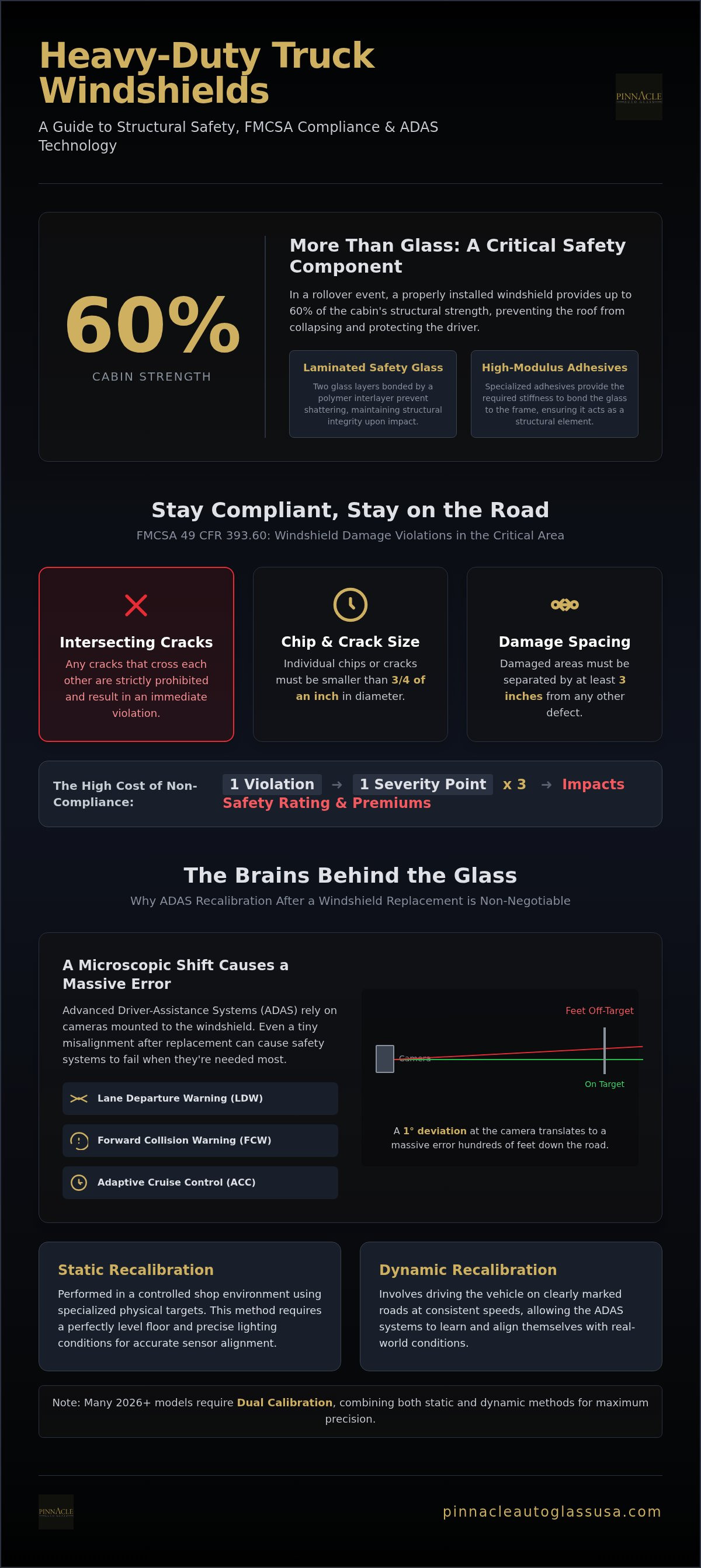
In a rollover accident, the windshield provides up to 60% of the cabin's structural strength. Without this support, the roof is significantly more likely to collapse under the truck's weight. This structural role is why the choice of adhesive is so critical. Technicians must use high-modulus adhesives to provide the stiffness required for heavy-duty cabs. While side windows typically use tempered glass that shatters into small cubes, windshields utilize laminated safety glass to keep the pane intact during an impact. Under 2026 safety specifications, laminated safety glass is defined as a composite of two glass layers bonded by a polymer interlayer that prevents shattering and maintains structural cab integrity during high-impact events.
FMCSA Compliance and Inspection Standards
The Federal Motor Carrier Safety Administration (FMCSA) enforces strict rules under 49 CFR 393.60. Any damage in the "critical area", which is the section swept by the windshield wipers, can result in an immediate citation. Regulations are clear about what constitutes a violation during a roadside inspection.
- Cracks that intersect with each other are strictly prohibited.
- Individual chips or cracks must be smaller than 3/4 of an inch in diameter.
- Damaged areas must be at least 3 inches apart from any other defect.
Failing an inspection due to glass damage does more than just delay a shipment. A single violation adds a severity point to your Vehicle Maintenance BASIC score, which is then multiplied by three. This significantly impacts your carrier safety rating and can lead to increased insurance premiums. A professional heavy duty truck windshield replacement ensures your fleet meets these standards before the vehicle even leaves the yard.
Beyond structural and legal concerns, damaged glass is a major contributor to driver fatigue. Pitting and minor scratches cause light to scatter, creating glare during night driving or in direct sunlight. This constant visual strain forces the driver's eyes to work harder, leading to exhaustion and slower reaction times. Professional replacement eliminates these optical distortions, ensuring your drivers stay alert and focused on the road. Maintaining clear glass is a simple but effective way to improve overall fleet safety and driver retention.
Navigating ADAS Recalibration in Modern Commercial Trucks
Modern trucks are essentially computers on wheels. By 2026, most Class 8 vehicles come equipped with complex safety suites designed to prevent accidents before they happen. When a technician performs a heavy duty truck windshield replacement, they're physically detaching the "eyes" of the vehicle. Cameras and sensors are often mounted directly to the glass or in brackets attached to it. Even a tiny deviation in the new installation can throw off these sensors. Because the camera is looking hundreds of feet down the road, a microscopic shift at the mounting point translates to a massive error at distance.
Critical Systems Requiring Alignment
Several systems rely on the windshield's optical clarity and the camera's precise positioning. Lane Departure Warning (LDW) uses high-resolution cameras to track lane markers. If the camera is tilted slightly, the system may fail to warn a drifting driver or provide a false alert. Forward Collision Warning (FCW) and Adaptive Cruise Control (ACC) use a combination of radar and camera data to monitor the gap between vehicles. These systems must be perfectly synchronized to function correctly.
Recalibration methods are categorized as static or dynamic. Static recalibration occurs in a specialized facility where the truck is positioned in front of physical targets. This process requires a perfectly level floor and specific lighting conditions. Dynamic recalibration involves driving the vehicle on clearly marked roads at consistent speeds. Many 2026 models require a "dual calibration," which combines both methods to ensure maximum precision for heavy-duty applications.
The Consequences of Skipping Recalibration
Ignoring this critical step creates significant legal and safety liabilities. If a truck's safety system fails to engage during a collision because of a misaligned camera, the fleet manager and carrier face intense scrutiny. Phantom braking is a frequent result of poor calibration. This happens when the sensor detects a nonexistent obstacle, like an overhead sign or a shadow, and slams on the brakes at highway speeds. This poses a severe risk for jackknifing or being rear-ended by trailing traffic.
The Federal Motor Carrier Safety Regulations outline strict requirements for windshield-mounted devices to ensure they don't obstruct the driver's view. Proper recalibration ensures these devices work within those legal parameters. For more technical details on how these systems interact with your glass, read our guide on ADAS calibration auto glass. Ensuring your heavy duty truck windshield replacement includes these services is the only way to maintain fleet safety. You can partner with professional fleet glass experts to keep your technology and your drivers protected.
Evaluating Repair vs. Replacement for Heavy-Duty Glass
Deciding between a quick fix and a full overhaul is a daily challenge for fleet managers. While a minor chip might seem like a candidate for windshield repair, heavy-duty vehicles face unique stressors that make traditional rules of thumb dangerous. Long-haul trucks frequently suffer from pitting. This occurs when thousands of microscopic craters from road debris scatter light across the pane. Pitting creates a haze that isn't fixable with resin. If your drivers report excessive glare during sunrise or sunset, a full heavy duty truck windshield replacement is often the only way to restore safe visibility.
High-vibration environments are another critical factor. A semi-truck's diesel engine and stiff suspension transmit constant energy through the frame. Edge cracks are particularly volatile in these conditions. Because the glass is a structural member, a small crack near the gasket can quickly run across the entire pane during a single shift. Proactively replacing glass before a crack spreads helps you avoid emergency downtime. It's often more cost-effective to schedule a replacement during a planned service interval than to deal with a grounded vehicle and lost revenue on the road.
When a Repair is No Longer an Option
Professional auto glass specialists look for specific indicators that a repair will fail. For commercial vehicles, if a chip is larger than 3/4 of an inch or located directly in the driver's line of sight, federal law mandates a replacement. Technicians also evaluate the stability of the damage. If the impact has reached the inner layer of the laminate or shows signs of legs extending from the center, the structural bond is gone. Attempting a resin fix on a compromised frame is a temporary solution that risks a failed roadside inspection and potential safety failures.
OEM vs. Aftermarket Glass for Semi-Trucks
Choosing the right glass impacts both safety and driver comfort. Original Equipment Manufacturer (OEM) glass is produced to the exact specifications of the truck's builder. This ensures perfect fitment and optical clarity, which is crucial for the sensor arrays used in modern trucks. Aftermarket glass, or Original Equipment Equivalent (OEE), can be a viable cost-saving measure for older fleet models without complex ADAS features. However, you must verify the glass thickness. Thicker OEM-spec glass provides superior noise reduction. This is vital for reducing driver fatigue during long hauls. Investing in a high-quality heavy duty truck windshield replacement pays dividends in driver retention and long-term vehicle health.
Minimizing Fleet Downtime with Professional Logistics
Every hour a Class 8 vehicle sits idle is an hour of lost revenue. In the logistics industry, reducing fleet downtime with mobile glass repair is the most effective way to maintain your schedule. A mobile heavy duty truck windshield replacement allows your drivers to stay at the terminal or a designated rest stop while the work is completed. This eliminates the need for out-of-route miles to a repair facility. To ensure the process is as fast as possible, proper preparation is essential.
Use this checklist to prepare your truck for a mobile technician:
- Provide the exact VIN and DOT number to ensure the correct glass part and ADAS brackets are ordered.
- Select a level, paved surface with enough clearance for the technician to work around the cab.
- Clear the dashboard of all personal items, logs, and electronic devices.
- Ensure the vehicle is accessible and keys are available at the scheduled time.
The Mobile Replacement Workflow
A structured workflow prevents errors and keeps the installation on track. First, the provider identifies the specific glass requirements based on the vehicle's year and model. This includes verifying if the truck needs a split or one-piece windshield. Next, the service is scheduled during a driver's mandatory rest period or at a terminal during loading. Finally, certified technicians perform the on-site installation and recalibration. This synchronized approach means the truck is ready for the road as soon as the adhesive cures.
Insurance and Claims Management for Commercial Vehicles
Navigating commercial insurance policies shouldn't be the fleet manager's burden. Professional glass providers offer centralized billing and direct insurance processing to streamline the paperwork. Keeping detailed documentation of every heavy duty truck windshield replacement is vital for your maintenance records and FMCSA compliance audits. When you partner with an expert, they handle the claim submittal and verify coverage details before the technician arrives. This reduces the administrative load on your office staff and prevents billing surprises.
Safety continues even after the technician leaves. You must respect the Safe Drive-Away Time (SDAT), which is typically between 30 and 60 minutes for modern high-modulus adhesives. Moving the truck too early can cause the glass to shift, breaking the structural seal or misaligning the ADAS sensors you just calibrated. If you need to restore your fleet's safety and get back to work, contact Pinnacle Auto Glass for professional fleet glass services today. Our team coordinates every detail to ensure your trucks stay on the road where they belong.
Pinnacle Auto Glass: Expert Solutions for Heavy-Duty Fleets
Pinnacle Auto Glass stands as the premier partner for commercial truck glass. We don't just install panes; we manage your fleet's safety infrastructure with a focus on reliability and quality. Our team understands that a heavy duty truck windshield replacement is a high-stakes technical task that requires more than just adhesive and glass. We prioritize high-modulus materials and certified technician expertise to ensure your drivers remain protected. Every installation we perform adheres to strict FMCSA safety standards. Our nationwide service model is built for the demands of long-haul logistics. We provide consistent, professional results across state lines, ensuring your maintenance standards never waver.
Comprehensive Fleet Glass Management
Managing a large fleet requires a partner who can handle scale without losing sight of the details. Pinnacle handles multi-vehicle accounts with specialized care and highly organized logistics. We maintain an extensive inventory of heavy-duty glass for all major truck brands, including:
- Freightliner and Western Star
- Peterbilt and Kenworth
- Volvo and Mack
- International (Navistar)
This deep inventory ensures that when you need a heavy duty truck windshield replacement, we have the correct part ready to go. Our approach is purely solution-oriented. We address complex recalibration needs for 2026 models with precision tools and certified training. Whether your trucks utilize static or dynamic ADAS systems, our technicians ensure every sensor is perfectly synchronized before the vehicle returns to service. We act as a stable, nationwide entity that maintains the focused attention of a localized service provider. This means you get the resources of a large company with the personalized communication your fleet deserves.
Ready to Secure Your Fleet?
Starting a professional partnership with Pinnacle Auto Glass is a straightforward process. We are ready to assist you with immediate service needs or a long-term fleet consultation. Our team is no-nonsense and focused on results. We provide the expertise needed to navigate the complexities of modern vehicle safety systems. You can trust our industry-leading standards to protect your drivers and your bottom line. Contact us today to learn how we can streamline your glass maintenance and maximize your fleet's uptime. We are your dependable guide in the evolving world of commercial vehicle safety.
Securing Your Fleet’s Safety and Future
Maintaining a modern fleet requires a proactive approach to safety and compliance. We have explored how the windshield serves as a vital structural component, contributing significantly to cabin strength during high-impact events. The complexity of 2026 ADAS systems makes professional recalibration non-negotiable for any vehicle returning to the road. By prioritizing high-quality materials and mobile logistics, you protect your drivers and your operational uptime.
A professional heavy duty truck windshield replacement is an investment in long-term fleet health. It ensures you meet FMCSA standards while avoiding the hidden costs of vehicle downtime and failed inspections. Our solution-oriented approach simplifies these technical tasks. We provide the stability of a nationwide entity with the focused attention of a specialized service provider.
When you're ready to upgrade your glass maintenance strategy, our team is prepared to assist. We offer certified ADAS recalibration, nationwide commercial fleet support, and a full range of high-quality glass options tailored to your specific needs. Get Professional Heavy Duty Truck Windshield Replacement from Pinnacle Auto Glass to secure your vehicles today. We look forward to keeping your fleet safe and moving forward.
Frequently Asked Questions
How long does a heavy-duty truck windshield replacement take?
A standard heavy duty truck windshield replacement typically takes between 2 and 4 hours to complete. This timeframe covers the physical installation and the mandatory period for the specialized adhesive to bond properly. If your vehicle requires ADAS recalibration, you'll need to account for additional time depending on the system alignment needs. Scheduling these services during a driver’s mandatory rest period is an effective way to manage your fleet's operational schedule.
Is mobile windshield replacement safe for semi-trucks?
Mobile replacement is entirely safe and often preferred for minimizing fleet downtime. Professional technicians use specialized equipment to handle large glass panes in the field. It's key to perform the work on a level, paved surface. This ensures the glass sets correctly and the ADAS sensors are aligned on a flat plane. Mobile services allow your trucks to stay at the terminal while receiving expert care from certified specialists.
Do I really need ADAS recalibration after a truck windshield replacement?
Recalibration is mandatory whenever the windshield is removed or replaced. Because safety cameras are mounted to the glass, even a microscopic shift can cause system errors. Skipping this step risks the failure of Lane Departure Warning and Collision Mitigation systems. Professional providers use specialized software to reset these sensors to factory specifications. Ensuring your technology is synchronized is the only way to maintain the safety standards required for modern commercial operations.
Does insurance cover the cost of heavy-duty windshield replacement?
Most commercial insurance policies cover glass replacement under comprehensive coverage. Many fleet managers find that their policies include full glass coverage with little to no deductible. Professional glass providers often handle the insurance claims process directly with your carrier to save you administrative time. Always verify your specific policy details to understand how recalibration costs are handled. Direct billing options help streamline the payment process and get your vehicles back in service faster.
What is the "safe drive-away time" for a commercial truck?
The safe drive-away time for a commercial truck is typically between 30 and 60 minutes after the installation is finished. This period allows the high-modulus adhesive to reach the necessary strength to hold the glass in place during operation. Driving the vehicle too early can cause the windshield to shift or leak. It also risks throwing off the calibration of sensitive ADAS cameras. Always follow the specific technician’s instructions regarding the cure time used.
Can a cracked semi-truck windshield be repaired instead of replaced?
Repair is possible if the damage is smaller than 3/4 of an inch and located outside the driver's critical viewing area. However, the high vibration levels in heavy-duty trucks often cause small chips to spread rapidly into large cracks. If the damage is near the edge of the frame or intersects with another crack, a full heavy duty truck windshield replacement is required for safety. Technicians evaluate the structural stability of the glass before recommending a resin repair.
What happens if I ignore a small chip in my truck windshield?
Ignoring a small chip leads to expensive full replacements and failed roadside inspections. Temperature changes and road vibrations cause minor damage to expand into unrepairable cracks. A single visible crack in the wiper path can result in an FMCSA violation and points on your safety score. Proactive maintenance prevents these issues and keeps your fleet compliant. It's the most cost-effective way to manage your glass maintenance budget and avoid unexpected downtime.
Are all heavy-duty windshields the same quality?
Glass quality varies significantly between OEM, OEE, and aftermarket options. Original Equipment Manufacturer glass is identical to the factory install and offers the best fit for complex sensor arrays. Original Equipment Equivalent glass meets the same standards but is produced by different manufacturers. Aftermarket glass is a budget-friendly option but may lack the thickness needed for superior noise reduction. Choosing high-quality glass ensures better optical clarity and reduces driver fatigue during long-haul trips.


