
Did you know your windshield provides up to 60% of your vehicle's structural integrity during a rollover accident? This glass is a critical safety component, not just a window. Because it's so vital, the most common question we hear is how long for windshield adhesive to cure before the car is safe to drive.
It's frustrating to wait for hours when you have a busy schedule. You might hear different timelines from every shop you call, which only adds to the confusion. We know you want to get back on the road without worrying if your windshield will pop out during a crash. This guide clears up the mystery by explaining the vital difference between a surface dry and a full chemical cure.
You'll learn about Safe Drive-Away Time (SDAT) standards for 2026, how humidity impacts your seal, and the specific steps to take during the first 48 hours to protect your vehicle. We provide the clear timeline you need for total peace of mind regarding your car's structural safety.
Key Takeaways
- Identify the critical difference between Safe Drive-Away Time (SDAT) and a full chemical cure to ensure your vehicle is structurally sound.
- Understand how local temperature and humidity levels directly influence how long for windshield adhesive to cure in your specific environment.
- Learn why a properly bonded windshield is essential for supporting passenger-side airbags and maintaining cabin integrity during a rollover.
- Follow non-negotiable care rules for the first 48 hours, including specific techniques to avoid damaging the seal with internal pressure spikes.
- See why professional technicians must calculate drive-away times based on specific adhesive brands and integrated ADAS recalibration requirements.
Understanding Windshield Adhesive: Drying vs. Curing
Many drivers assume that once the glue is no longer tacky to the touch, the car is ready for the road. This is a dangerous misconception. Understanding how long for windshield adhesive to cure requires a clear distinction between drying and curing. Drying is a surface-level event where solvents evaporate from the outer layer. Curing is a deep chemical transformation that turns the liquid adhesive into a high-strength structural solid.
Urethane is the industry-standard adhesive used to bond laminated safety glass to your vehicle's metal frame. It's not just a sealant; it's a vital structural component. While the edges might appear dry within minutes, the internal bonding process takes much longer. You can safely operate the vehicle once it reaches a specific safety milestone, but a full cure often takes several days to complete.
What is Safe Drive-Away Time (SDAT)?
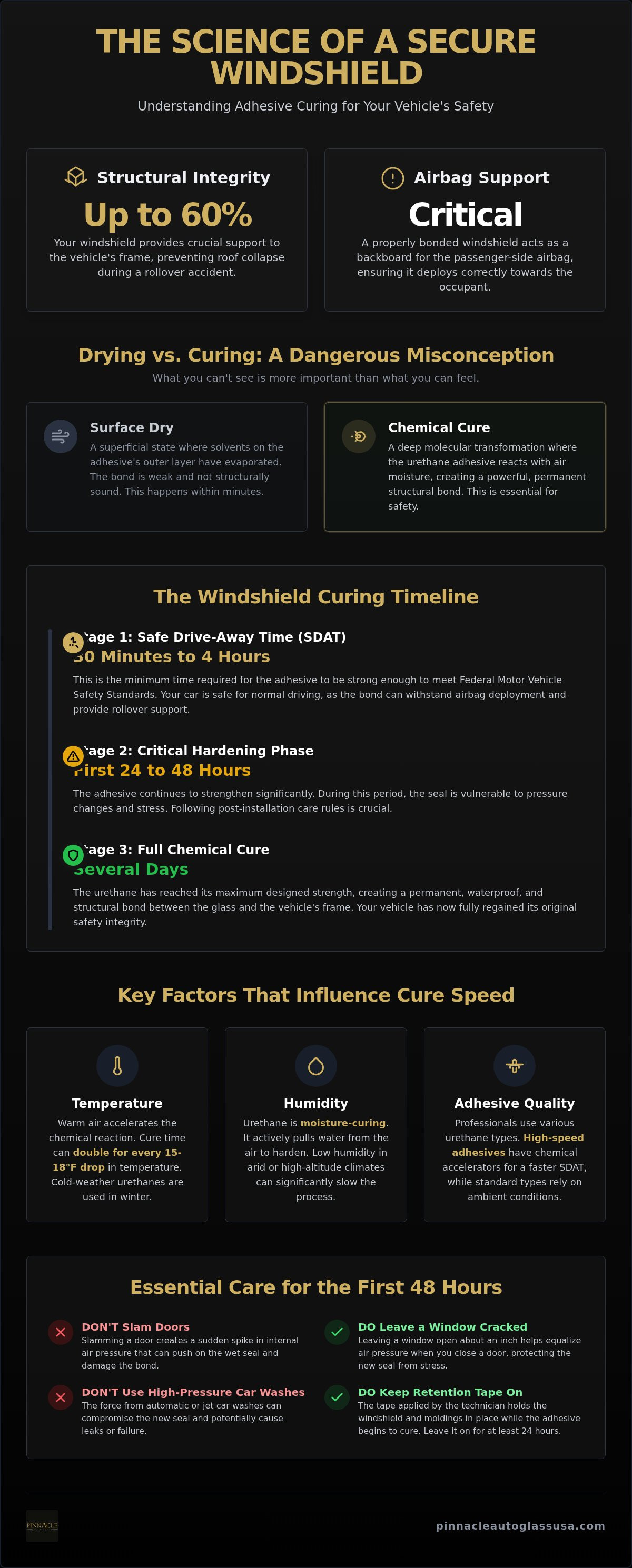
Safe Drive-Away Time, or SDAT, is the minimum amount of time the adhesive needs to reach the strength required by Federal Motor Vehicle Safety Standards (FMVSS). These regulations, specifically FMVSS 212 and 216, ensure the glass remains in place during a collision. The adhesive must be strong enough to support the force of a deploying passenger-side airbag and maintain the roof's structural integrity during a rollover. Depending on the specific adhesive brand and the weather, SDAT typically ranges from 30 minutes to 4 hours.
The Chemical Process of Urethane Curing
Most professional-grade auto glass urethanes are moisture-curing polymers. They don't simply dry out; they actually pull moisture from the surrounding air to trigger a chemical reaction. This process, known as molecular cross-linking, creates an incredibly strong bond between the glass and the vehicle frame. The speed of this reaction depends on the specific product used by the technician.
- Standard Urethanes: These rely entirely on ambient humidity and often require longer wait times.
- High-Speed Adhesives: These use advanced chemical accelerators to reach SDAT in as little as 30 to 60 minutes.
- Full Cure: Regardless of the SDAT, the adhesive continues to harden for 24 to 48 hours.
When asking how long for windshield adhesive to cure, remember that the environment plays a huge role. Cold, dry air can double the time needed for the chemical bond to stabilize. Professional shops calculate the safe window based on the specific adhesive and the day's weather conditions to ensure your safety.
Key Factors that Influence Adhesive Cure Speed
The environment around your car is the single biggest variable in determining how long for windshield adhesive to cure. While a technician might give you a standard window, the actual chemical reaction is highly sensitive to the air you breathe. It isn't a fixed countdown; it's a dynamic process that reacts to your local climate in real time.
Temperature and Humidity: The Perfect Environment
Most professional-grade urethanes are moisture-curing polymers. This means they don't just dry out; they actually pull water molecules from the atmosphere to trigger their hardening process. Warm, moist air acts as a catalyst. In tropical or high-humidity climates, the adhesive cross-links quickly. Conversely, in arid or high-altitude regions, the lack of moisture can significantly stall the cure.
Temperature is equally critical for viscosity and reaction speed. As a general rule, for every 15 to 18 degree Fahrenheit drop in temperature, the time required for the adhesive to reach full strength can roughly double. This is why winter installations often require specialized "cold-weather" urethanes. These products are engineered to remain pliable and reactive even when temperatures dip below freezing.
Adhesive Quality and Type
One-part urethane systems are the most common choice for both mobile and shop-based repairs. They are reliable and easy to apply, but they rely entirely on ambient conditions. Some heavy-duty or commercial applications use two-part systems that carry their own chemical hardener. These systems cure at a more predictable rate regardless of the weather. Following Professional Installation Standards ensures that the adhesive type and bead size meet federal requirements for structural integrity.
Adhesive volume also plays a role in your timeline. A thicker bead of urethane takes longer for moisture to penetrate to the very center. If a technician uses an oversized bead to compensate for a poorly fitting windshield, the cure might be slower than expected. High-quality windshield replacement services prioritize glass that matches OEM specifications to ensure a perfect fit with a standard, efficient bead size.
The type of glass matters too. Original Equipment Manufacturer (OEM) glass features a specific ceramic frit, the black band around the edge, that's designed to bond perfectly with modern primers. Lower-quality aftermarket glass may have a different frit composition, sometimes requiring longer primer flash times or specific adhesive formulations to achieve a safe bond. Professional shops monitor current humidity and temperature data to select the exact adhesive that will get you back on the road safely. This methodical approach ensures the glass provides the necessary structural support as mandated by 2026 safety regulations.
The Safety Risks of Driving Too Early
Ignoring the timeline for how long for windshield adhesive to cure isn't just a matter of convenience. It's a gamble with your life. While you can't see the adhesive working, it performs a massive job every second you're on the road. Driving before the Safe Drive-Away Time (SDAT) can lead to immediate mechanical failures like glass shifting. This often results in annoying wind whistles or water leaks that can damage your car's interior electronics and upholstery.
Airbag Deployment and Glass Displacement
The most terrifying risk of an uncured windshield happens during a collision. In many modern vehicles, the passenger-side airbag is designed to deploy upward. It hits the windshield first, using the glass as a "backstop" to redirect the cushion toward the passenger. This happens with incredible force in a fraction of a second. If the adhesive is still soft, the internal pressure of the airbag can launch the glass right out of the frame. When the glass fails, the airbag has nothing to push against, leaving the passenger completely unprotected. Following established windshield replacement safety standards is the only way to ensure this system functions as intended.
Structural Integrity in Rollover Accidents
Your windshield is a primary structural pillar. In a rollover accident, the glass provides up to 60% of the cabin's strength. It prevents the roof from caving in on the occupants. A weak bond compromises the entire safety cell of the vehicle. If the urethane hasn't reached its structural milestone, the roof can collapse under the weight of the car. We don't accept "good enough" when it comes to structural bonding. The adhesive must be fully capable of holding the weight of the vehicle to keep you safe during an emergency.
High-speed wind pressure is another factor drivers often overlook. At highway speeds, the air pushing against the front of your car exerts hundreds of pounds of force. If you haven't waited the proper amount of time for how long for windshield adhesive to cure, this pressure can create microscopic gaps in the seal. These gaps eventually grow into major leaks or cause the glass to vibrate, which can lead to stress cracks. Total patience during the first few hours is a small price to pay for long-term safety and vehicle durability.
Essential Care Rules for the First 24–48 Hours
Reaching the safe drive-away time doesn't mean the installation is complete. While the adhesive is strong enough to hold the glass during your trip home, it hasn't reached its final structural state. You must protect the seal during the initial 24 to 48 hours to prevent leaks or shifts. Following these non-negotiable rules ensures the longevity of your repair and maintains the safety standards established during installation.
Managing Internal Air Pressure
One of the most common causes of seal failure is the "pressure spike." When you close a car door with all the windows up, the air inside the cabin is suddenly compressed. This force looks for the weakest point to escape, which is often the fresh, soft adhesive around your new windshield. This can cause a "seal pop," creating a microscopic hole that leads to future water leaks and annoying wind noise. It's a simple physical reaction that can ruin a perfect installation.
- Leave at least one window cracked about an inch for the first 24 hours.
- Avoid slamming doors or the trunk with excessive force.
- Don't use the "recirculate" air setting on high immediately after installation.
Washing and Cleaning Restrictions
High-pressure car washes are the primary enemy of a new windshield. The concentrated jets of water can easily displace the urethane before it hardens. Additionally, many commercial car wash detergents contain harsh chemicals that can interfere with how long for windshield adhesive to cure by disrupting the moisture-curing process. Wait at least 24 hours before hand-washing your vehicle and a full 72 hours before using an automated high-pressure wash. For a secure and professional result, trust the experts at Pinnacle Auto Glass to use the highest quality materials available.
Retention Tape and Debris
Technicians often apply retention tape to the top of the glass. This isn't just a marker; it holds the windshield in the exact correct position while the glue sets. Don't remove this tape for at least 24 hours. You should also keep your dashboard clear of heavy items like sunshades, dash cams, or radar detectors. These objects can press against the glass from the inside, potentially causing the glass to shift out of its ideal alignment. Understanding how long for windshield adhesive to cure means respecting these physical barriers until the bond is permanent and structural.
The Importance of Professional Installation Standards
Attempting a DIY replacement is a significant safety risk. It isn't just about fitting the glass; it's about the complex chemistry of structural bonding. Professional technicians undergo rigorous training to understand exactly how long for windshield adhesive to cure in any environment. They don't rely on guesswork. Instead, they use precise equipment to measure relative humidity and ambient temperature before selecting the correct urethane for the job. This methodical approach ensures the bond meets or exceeds federal safety requirements, providing the necessary support for airbags and roof integrity.
ADAS Recalibration and the Cure Cycle
Modern safety systems add a critical layer of technical requirements. Most 2026 vehicles rely on cameras and sensors mounted directly to the windshield. These ADAS calibration auto glass systems cannot function if the glass isn't perfectly stable. If the windshield shifts even a millimeter during the initial cure cycle, the safety sensors will provide inaccurate data to the vehicle's computer. This can lead to lane-departure failures or emergency braking errors. Professionals follow a strict, multi-step workflow. They install the glass, allow it to reach the Safe Drive-Away Time, and only then perform the necessary recalibration. This ensures the safety technology is as secure as the glass itself. Hiring certified auto glass technicians is the only way to guarantee this level of precision.
Why Quality Materials Matter
Bargain shops often use low-cost, generic urethanes to cut corners. These products typically have unpredictable cure times and may not provide the same level of structural strength as professional-grade options. In contrast, premium shops invest in high-performance, fast-cure urethanes. These advanced adhesives are engineered to reach SDAT in as little as 30 to 60 minutes, even in challenging weather conditions. These materials are more expensive, but they significantly reduce your downtime while maximizing your safety. Understanding how long for windshield adhesive to cure requires more than just reading a label; it requires the right tools and premium chemicals. We use only the highest quality primers and urethanes to ensure a reliable seal that stands up to 2026 safety standards. Contact Pinnacle Auto Glass today for a safe, professional replacement that prioritizes your vehicle's structural integrity.
Prioritize Your Road Safety Today
Safety starts with understanding that your windshield is more than just glass; it's a structural shield. We've explored how environmental factors like humidity and temperature dictate how long for windshield adhesive to cure before you can safely drive away. Remember that reaching the Safe Drive-Away Time is only the first step. You must strictly follow post-installation care rules for the first 48 hours to protect the seal from pressure spikes and chemical damage.
Choosing a professional installer ensures your vehicle meets all federal safety standards. We use high-performance, FMVSS-certified adhesives and provide expert ADAS recalibration to keep your safety systems functioning perfectly. Our mobile service brings this expertise directly to you for maximum convenience. Don't compromise on your vehicle's structural integrity or your family's safety.
Get a Professional Windshield Replacement Quote and drive with confidence knowing your car is secure. We're ready to assist you with quality service and reliable results.
Frequently Asked Questions
Can I drive my car immediately after a windshield replacement?
No, you cannot drive immediately. You must wait for the Safe Drive-Away Time (SDAT) to expire. Depending on the specific adhesive used and the weather, this window typically lasts between 30 minutes and 4 hours. Driving too early compromises the structural integrity of your vehicle. The adhesive needs this time to bond firmly enough to support the roof during a rollover or withstand the force of an inflating passenger airbag.
What happens if it rains right after my windshield is replaced?
Light rain is actually beneficial because most professional urethanes are moisture-curing products. The water molecules in the air trigger the chemical reaction that hardens the glue. However, you should avoid driving in heavy storms or downpours immediately after installation. The physical force of high-speed rain hitting the glass can displace the fresh adhesive before it reaches its initial set point. Always check with your technician if the weather is severe.
How long should I wait before going to a car wash?
Wait at least 24 hours before performing a gentle hand wash and a full 72 hours before visiting an automatic car wash. High-pressure jets and mechanical brushes can easily shift the glass or create microscopic holes in the seal. The harsh detergents used in commercial washes can also interfere with the chemical bond. Stick to a bucket and sponge for the first few days to keep the seal and your vehicle safe.
Why do I need to leave my windows cracked after glass installation?
Leaving a window cracked about an inch prevents a sudden air pressure spike when you close your car doors. Modern vehicles are well-sealed; closing a door with all windows up forces air to look for an escape route. This often results in a seal pop where the air pushes through the fresh, soft urethane. This creates a permanent leak point. Maintain this gap for the first 24 hours to protect the bond's integrity.
How long does it take for windshield glue to stop smelling?
The distinctive chemical odor of auto glass urethane typically fades within 24 to 48 hours as the product finishes off-gassing. This scent is a natural byproduct of the moisture-curing process. Keeping your windows cracked slightly not only protects the seal from pressure but also helps ventilate the cabin. If the smell persists beyond three days, it might indicate a lack of airflow or an unusual amount of adhesive used for a deep-set frame.
Is it safe to remove the yellow tape from my new windshield after 12 hours?
No, you should leave the retention tape in place for a full 24 hours. While the glue may feel dry on the surface after 12 hours, the internal bond is still reaching its structural capacity. The tape prevents the heavy glass from sliding or shifting due to gravity or road vibrations. Removing it too early can result in a misaligned windshield, which can lead to leaks, wind noise, or issues with your ADAS sensor alignment.
Does the type of car I drive affect the adhesive cure time?
The vehicle model influences the amount of adhesive required and the weight the bond must support. Larger SUVs and trucks have heavier glass that puts more stress on the urethane during the initial set. Vehicles with Advanced Driver Assistance Systems (ADAS) also require the glass to be perfectly stationary for recalibration. Understanding how long for windshield adhesive to cure is essential for these high-tech vehicles, as any movement can throw off camera and sensor accuracy.
What are the signs that my windshield adhesive didn’t cure properly?
You should look for water dripping inside the cabin, unusual wind whistling at highway speeds, or any visible movement of the glass. If the seal is compromised, you might notice a vibrating sensation or a rattle when driving over bumps. These issues often stem from not allowing enough time for how long for windshield adhesive to cure or failing to follow post-care rules. If you spot these signs, contact a professional technician immediately for an inspection.


