
In 2026, your windshield is no longer just a piece of glass. It is a sophisticated structural component and a digital sensor hub for your entire safety system. You're likely aware that a crack is a safety hazard, making professional automobile glass replacement a technical necessity rather than a simple cosmetic fix. It's common to feel overwhelmed by technical jargon or worried about hidden costs related to camera systems. You deserve a clear, professional path to restoring your vehicle's integrity without the guesswork.
This guide provides everything you need to know about modern vehicle glass services. We cover the critical balance between structural safety standards and the precision required for ADAS recalibration. You'll learn the facts about OEM versus aftermarket glass and see exactly how a high-quality installation protects your vehicle's safety features. We break down the process from the initial assessment to the final system check. This ensures your safety tech works perfectly and your vehicle remains as reliable as the day it was built. Our goal is to move you quickly from a damaged windshield to a fully restored, safe driving experience.
Key Takeaways
- Understand how your windshield serves as a critical structural component that prevents roof collapse during a rollover accident.
- Even a minor camera misalignment can cause safety system failure, requiring expert ADAS recalibration following an automobile glass replacement.
- Identify the specific types of damage and sensor locations that mandate a full replacement over a simple chip repair.
- Explore the professional workflow for modern glass installation, including pre-inspection protocols and specialized requirements for commercial fleet vehicles.
Understanding the Role of Modern Automobile Glass Replacement
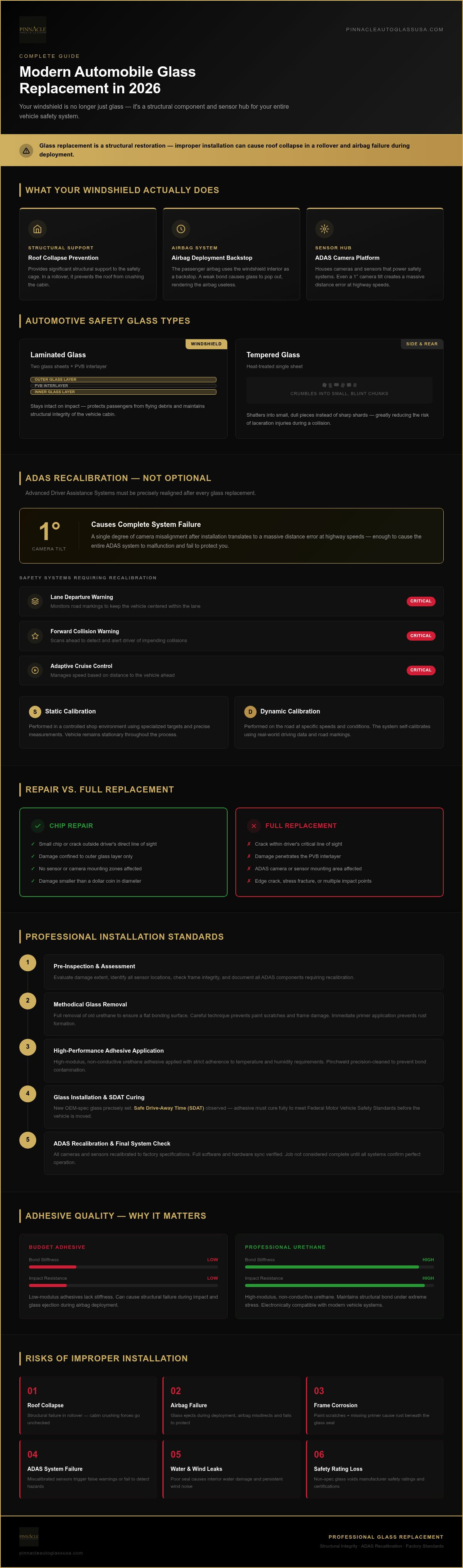
Professional automobile glass replacement is a structural restoration process. It isn't just a cosmetic fix or a way to improve visibility. Your windshield is a load-bearing component of the vehicle safety cage. In a rollover accident, the glass provides a significant portion of the structural support needed to keep the roof from collapsing. If the glass isn't installed correctly, the vehicle cabin becomes vulnerable to crushing forces. This structural integrity is a fundamental part of the vehicle's original engineering.
The windshield also plays a vital role in airbag deployment. When the passenger-side airbag activates, it uses the interior surface of the windshield as a backstop to position itself correctly. A weak bond can cause the glass to pop out during deployment, rendering the airbag useless. High-quality automobile glass replacement requires professional-grade urethanes. Budget shops often use low-modulus adhesives that lack the stiffness required for modern frames. These inferior products can lead to structural failure during an impact, whereas high-performance adhesives maintain the bond under extreme stress.
The Science of Automotive Safety Glass
Windshields are made of laminated glass. This design features a thin layer of polyvinyl butyral (PVB) sandwiched between two sheets of glass. It stays intact during an impact, protecting passengers from flying debris. Side and rear windows usually consist of tempered glass, which is heat-treated to crumble into small chunks instead of sharp slivers. Professional installation preserves the vehicle's original safety rating by using glass that meets precise manufacturer specifications. Safe Drive-Away Time (SDAT) is the critical period required for the adhesive to cure enough to meet Federal Motor Vehicle Safety Standards before the car is moved.
Why Professional Standards Matter
Improper bonding causes more than just wind noise or water leaks. It can lead to severe frame corrosion. If a technician uses metal tools carelessly, they can scratch the vehicle's paint. Without the immediate application of a specialized primer, rust will form beneath the glass seal. This hidden damage compromises the integrity of the vehicle frame and makes future repairs difficult. Certified auto glass technicians use methodical removal processes and corrosion-inhibiting primers to ensure long-term durability. They prioritize the following standards:
- Full removal of old urethane to ensure a flat bonding surface.
- Use of high-modulus, non-conductive adhesives for electronic compatibility.
- Strict adherence to temperature and humidity requirements during the curing process.
- Precision cleaning of the pinchweld to prevent contamination of the bond.
By following these rigorous steps, technicians ensure that the replacement glass performs exactly like the factory original. This attention to detail protects both the vehicle's value and the occupants' safety.
The Critical Link Between Glass Replacement and ADAS Recalibration
Modern vehicles rely on Advanced Driver Assistance Systems (ADAS) to help prevent accidents and simplify the driving experience. These sensors and cameras are typically mounted directly behind the windshield. Think of ADAS as the brain behind the glass. When you schedule an automobile glass replacement, you aren't just changing a transparent panel. You are moving sensitive safety equipment that requires perfect alignment. Even a one-degree tilt in a camera mount can cause the entire system to fail. A camera that is slightly off-center might "see" a car in the wrong lane, which translates to a massive distance error when you're traveling at highway speeds.
Several key safety features rely on this precise sensor alignment:
- Lane Departure Warning: Keeps your vehicle centered within road markings.
- Forward Collision Warning: Scans the road ahead to alert you of impending impacts.
- Adaptive Cruise Control: Manages your speed based on the distance to the vehicle in front of you.
We treat recalibration as a mandatory safety protocol rather than an optional add-on. Our team integrates technical system testing with every high-tech glass install to ensure your car leaves our shop in factory-perfect condition. We don't consider the job finished until the software and the hardware are in total sync.
Static vs. Dynamic Recalibration
Calibration methods vary by manufacturer and vehicle model. Static calibration happens in a controlled shop environment. Technicians use specialized targets, lasers, and level floors to align the camera. Dynamic calibration occurs during a specific driving sequence where the vehicle's computer learns to recognize road markings while in motion. Many 2026 models require both methods to achieve total system accuracy. This dual-process approach ensures that your sensors respond correctly to complex real-world environments.
Ensuring Your Safety Systems Work Post-Replacement
Skipping recalibration is a major safety risk. It can lead to annoying false alerts or a total failure to brake in an emergency. ADAS calibration and auto glass standards have evolved significantly for 2026 vehicles. Systems are now more integrated and sensitive than ever before. After your automobile glass replacement, we verify that every sensor is correctly aligned. We provide a digital report confirming the successful handshake between the new glass and your vehicle's computer. If you have questions about your specific model's requirements, speak with our technical team for a detailed consultation.
Deciding Between Automobile Glass Repair and Full Replacement
Deciding between a quick fix and a full automobile glass replacement depends on several technical factors. In 2026, the standard for safety is higher than ever. A chip is no longer just a blemish. It's a potential weak point in your vehicle's structural integrity. The cost-benefit analysis usually favors immediate action. A repair is significantly less expensive than a full replacement. However, ignoring a chip leads to inevitable cracking. This eventually forces a full automobile glass replacement anyway, often at a higher cost when you factor in the required ADAS recalibration.
Location is the primary driver for replacement. If damage sits in the "critical vision area" directly in front of the driver, repair isn't an option. Distortions from resin can compromise your view. More importantly, damage over ADAS sensors or cameras mandates a full replacement. These systems require perfectly clear glass to function. Temperature also plays a role. Rapid shifts from a hot car to cold air conditioning cause glass to expand and contract. This thermal stress turns a small chip into a sprawling crack in minutes.
When Repair is a Viable Option
A professional windshield repair is often possible for damage smaller than a quarter. The process involves injecting a high-grade resin into the chip. This material restores optical clarity and bonds the glass layers back together. Repairing glass is also the greener choice. It keeps damaged windshields out of landfills and reduces the energy needed to manufacture new units. If the damage is shallow and away from the edges, a repair can save you time and preserve the factory seal. By 2026, the "Rule of Thumb" focuses on sensor interference. If a chip sits within two inches of a camera mount, the refractive index of the resin might still trigger an ADAS fault. In these cases, replacement is the only way to ensure your safety systems remain active.
Red Flags That Require Immediate Replacement
Some damage simply cannot be safely patched. You must prioritize a full replacement if you notice any of the following red flags:
- Cracks longer than six inches.
- Cracks that reach the outer edge of the glass, as these compromise structural tension.
- Damage that penetrates both the inner and outer layers of the laminated glass.
- Heavy pitting or "sandblasting" that scatters light and confuses ADAS camera vision.
Pitting is particularly dangerous for modern light sensors and rain detectors. It causes erratic system behavior and increases driver fatigue at night. If you aren't sure, a quick assessment by a professional can determine if your glass still meets 2026 safety standards.
What to Expect During a Professional Glass Replacement Service
A professional automobile glass replacement follows a methodical, multi-step workflow. It begins with a comprehensive pre-inspection. Technicians identify existing ADAS fault codes and document any pre-existing trim damage. This ensures a clear baseline before work starts. Next, the team prepares the vehicle by protecting the interior upholstery and dashboard with specialized covers. Wipers and cowls are carefully removed to access the full perimeter of the glass without damaging delicate plastic components.
The extraction phase requires extreme precision. Professionals use specialized tools like fiber lines or reciprocating blades to cut the old seal. They prioritize the pinchweld area, which is the metal track where the glass sits. Any nick in the paint here can lead to rapid oxidation and rust. Professional extraction methods glide through the adhesive without touching the metal. After removal, the old urethane is trimmed down to a thin, uniform base. The installation involves applying an OEM-spec urethane bead with consistent height and width. This ensures a watertight, structural bond. Finally, the new glass is set into place with vacuum-suction handles for perfect alignment.
The Installation Timeline
The physical automobile glass replacement process typically takes about 60 minutes. While the swap is fast, the vehicle must remain stationary to allow the adhesive to bond. High-quality windshield replacement costs reflect the level of expertise required to manage these tight tolerances. A seasoned technician works efficiently to prevent air gaps while ensuring all sensor brackets are positioned correctly. Total service time increases when ADAS recalibration is performed on-site, as the software initialization requires its own dedicated window. We prioritize accuracy over speed to ensure your vehicle meets all safety standards before it leaves the shop.
Post-Installation Care and Safety
Your responsibility begins once the installation is complete. Adhering to the 24-hour rule is vital for a permanent seal. Avoid high-pressure car washes or slamming doors with all windows closed. The sudden change in air pressure can push the fresh urethane out of alignment. Leave one window cracked slightly for the first day to vent this pressure. Avoid removing the retention tape used to hold the molding in place for at least 24 hours. This tape prevents the glass from shifting while the urethane reaches its initial cure strength. Technicians perform a final electronics check to ensure rain sensors and cameras are reconnected and functioning. For a service that prioritizes these safety protocols, book your glass replacement with our expert team today.
Specialized Solutions for Commercial and Fleet Glass Management
Fleet managers understand that a cracked windshield is more than a nuisance. It is a logistics bottleneck that threatens delivery schedules and driver safety. Proactive management reduces the high cost of downtime by identifying damage before it requires an emergency stop. Professional automobile glass replacement for fleets requires a strategy that balances speed with technical precision. We focus on standardizing glass quality across your entire multi-vehicle operation. This consistency protects your business from liability and ensures every vehicle in your inventory meets the same high safety standards.
Logistics-first scheduling is the core of our commercial service. We perform replacements during your vehicles' scheduled rest periods or loading windows. This approach ensures that your assets remain productive during peak hours. Our team understands the specific requirements of delivery vans, utility trucks, and service vehicles. We use high-performance materials that cure quickly, allowing your drivers to return to the road without compromising the structural bond of the glass. By treating automobile glass replacement as a planned maintenance item, you avoid the chaos of unscheduled repairs.
Heavy-Duty and Semi-Truck Glass
Large-scale glass presents unique engineering challenges. The sheer weight and surface area of semi-truck windshields demand superior seal integrity to withstand constant road vibration and wind resistance. We use specialized high-viscosity urethanes that prevent the glass from sagging or shifting during the installation process. Compliance with DOT safety regulations is mandatory for every commercial job we perform. Reducing fleet downtime with mobile glass repair is a strategic advantage for long-haul operators who cannot afford to deviate from their routes. Our technicians are trained to handle the complex gasket and glue-in systems found on heavy-duty equipment.
Streamlining Fleet Maintenance
We simplify the administrative side of glass management for multi-vehicle operations. Centralized billing and direct insurance claims handling save your office staff hours of tedious paperwork. You receive clear, itemized reports for every service performed on your fleet. Mobile service is typically the superior choice for commercial logistics. It eliminates the need to transport heavy equipment to a shop, which reduces fuel costs and driver hours. We also offer customized service plans for box trucks and high-roof delivery vans. These plans include regular glass inspections to catch small chips before they spread into full-length cracks. This methodical approach keeps your fleet safe, compliant, and on the move.
Securing Your Vehicle's Future and Safety
Modern driving demands more than just a clear view of the road. In 2026, your windshield is both a critical safety shield and a digital sensor hub. Choosing a professional automobile glass replacement means you're prioritizing structural integrity and the precise function of your vehicle's safety systems. You now understand that even a minor misalignment can disable essential features like emergency braking or lane assistance. Professional standards ensure that every installation uses high-quality materials and follows strict curing protocols.
Pinnacle Auto Glass bridges the gap between traditional mechanical skill and advanced digital recalibration. Whether you manage a national fleet or drive a personal vehicle, our approach ensures your glass and sensors work in perfect harmony. Don't settle for budget fixes that compromise your safety. Our team is ready to help you restore your vehicle to factory specifications with confidence and speed.
Get a Professional Quote from Pinnacle Auto Glass Today. We provide expert ADAS recalibration and quality-first professional installation from fleet and commercial specialists. We look forward to getting you back on the road safely.
Frequently Asked Questions
How long does a standard automobile glass replacement take?
A standard automobile glass replacement takes about 60 minutes for the physical installation. You must also factor in the Safe Drive-Away Time (SDAT). This is the period required for the adhesive to cure enough to meet federal safety standards. Most professional-grade urethanes require at least one hour of curing before the vehicle is safe to drive. If your vehicle needs ADAS recalibration, the total service time usually extends to two or three hours.
Is ADAS recalibration really necessary after a windshield replacement?
Yes, recalibration is a mandatory safety requirement for vehicles with Advanced Driver Assistance Systems. These cameras are precision-mounted directly behind the windshield. Removing the glass shifts their alignment by microscopic margins. Without proper recalibration, features like lane-keeping assist and automatic emergency braking can fail or respond incorrectly. We integrate this technical process into our safety protocols to ensure your technology remains reliable and accurate after every installation.
Can I drive my car immediately after the glass is installed?
You shouldn't drive your car immediately after the glass is set. The specialized urethane adhesive needs time to bond with the vehicle frame to ensure structural support. Driving too soon can cause the glass to shift, which leads to air leaks or compromised safety in a rollover accident. Technicians will provide a specific Safe Drive-Away Time based on current humidity and temperature. This wait usually lasts at least one hour after the installation is finished.
Does my auto insurance typically cover the full cost of glass replacement?
Most comprehensive insurance policies cover the cost of automobile glass replacement, often with a low or waived deductible. Coverage depends on your specific provider and policy details. We recommend contacting your insurance agent to verify your benefits before scheduling service. Many providers encourage repair over replacement and will cover chip repairs at no cost to the policyholder. Our team can assist with the insurance claims process to make the entire transition as smooth as possible.
What is the difference between OEM and aftermarket glass?
Original Equipment Manufacturer (OEM) glass is produced by the same company that made your vehicle's factory glass. It matches original specifications for thickness, tint, and sensor brackets exactly. Aftermarket glass is produced by third-party manufacturers. While it must meet federal safety standards, it can have slight variations in fit or clarity. We prioritize high-quality glass that ensures your ADAS cameras have a clear, undistorted view of the road for maximum safety and system accuracy.
Will a mobile glass replacement be as high-quality as an in-shop service?
Mobile services offer the same level of quality as in-shop repairs when performed by expert technicians. Our mobile teams use the same professional-grade tools and OEM-spec adhesives as our shop locations. The primary requirement for a successful mobile install is a controlled environment, free from heavy rain or extreme heat. While some complex ADAS recalibrations require a perfectly level shop floor, most standard replacements are completely safe to perform at your home or office.
What happens if my ADAS camera isn't recalibrated correctly?
An incorrectly calibrated camera can lead to dangerous system errors. Your car might provide false lane departure warnings or fail to detect an obstacle in time for automatic braking. Even a misalignment of one degree can result in a significant distance error on the road. This puts you and your passengers at risk. Correct recalibration ensures that the "brain" of your car sees the road accurately, maintaining the effectiveness of your vehicle's safety cage.
How do I know if my windshield chip can be repaired instead of replaced?
A chip can usually be repaired if it is smaller than a quarter and not located in the driver's direct line of sight. If the damage is near the edge of the glass or directly over an ADAS sensor, a full replacement is required. Deep cracks that penetrate both layers of laminated glass also mandate a new windshield. Acting quickly is vital. Temperature changes can cause a minor chip to spread into a large, unrepairable crack.


