
A minor windshield replacement or a routine wheel alignment can silently compromise your car's most critical safety features. Lane keep assist recalibration isn't just a simple software update. It is a precise mechanical realignment required to restore your vehicle's safety geometry after any structural or sensor change. Without this adjustment, your safety systems may fail to protect you when you need them most.
You likely depend on your vehicle's cameras to stay centered and safe on the road. It's frustrating when these systems feel "off" or trigger confusing dashboard warnings. We understand the anxiety that comes with potential safety system failures and the confusion surrounding technical terms like static versus dynamic calibration. You deserve a clear, professional path to restoring your vehicle's reliable performance.
This guide provides the clarity you need to maintain your vehicle's integrity. You'll learn exactly how the recalibration process works, when your vehicle requires professional service, and how insurance typically handles these costs. We will outline the specific steps to ensure your lane-keeping features are functional, accurate, and fully compliant with 2026 safety standards.
Key Takeaways
- Understand why lane keep assist recalibration is a mandatory step after windshield replacement to maintain sensor alignment.
- Learn the difference between static recalibration in a shop environment and dynamic recalibration performed during a specialized road test.
- Identify common triggers for service, including wheel alignments and suspension work, that require a system reset.
- Discover how pre- and post-repair diagnostic scans provide proof of compliance for insurance and safety records.
- Recognize how professional ADAS services reduce liability and driver fatigue by ensuring safety features function correctly.
What is Lane Keep Assist Recalibration and Why Does It Matter?
Modern vehicles rely on a complex network of Advanced Driver Assistance Systems (ADAS) to keep occupants safe. Lane Keeping Assist systems (LKA) are a vital subset of this technology. These systems use a forward-facing camera, usually mounted behind the rearview mirror, to monitor road markings and provide steering corrections. However, this camera isn't a standalone unit; it's physically bonded to your windshield. If the glass is replaced or the camera is disturbed, the system loses its reference point.
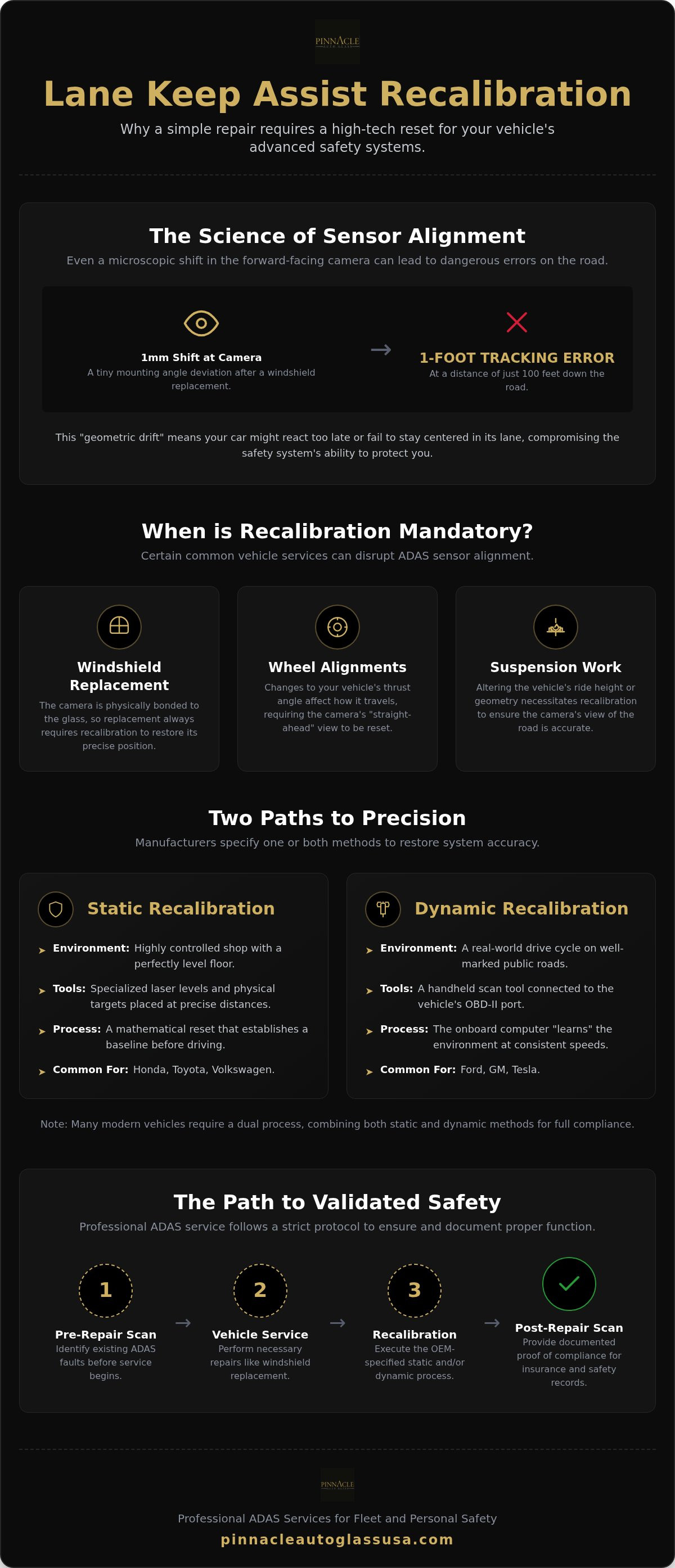
Precision is everything in automotive safety. Even a microscopic shift in the camera's mounting angle can lead to dangerous errors on the road. For example, a shift of just one millimeter at the camera lens can result in a tracking error of one foot or more at a distance of 100 feet. This misalignment causes the vehicle to "hunt" for the lane or react too late to a departure. The Image Processing Module A (IPMA) relies on perfect alignment to interpret road data correctly. Without lane keep assist recalibration, the IPMA processes flawed information, which compromises your safety.
The Science of Sensor Alignment
Every camera has a specific Field of View (FOV) that must remain perfectly centered. If the camera's path is obstructed by low-quality glass or if it sits at an incorrect angle, the FOV becomes distorted. Geometric drift is the measurable deviation of a sensor's physical orientation from its factory-specified mounting angle, often caused by structural changes or component wear. Maintaining OEM standards is the only way to ensure the system functions as the manufacturer intended. Professional technicians use specialized tools to correct this drift and align the camera's digital "eyes" with the physical reality of the road.
How Recalibration Restores Your Safety Baseline
Recalibration moves your safety system from an "estimated" state to a "validated" one. After a windshield replacement, the camera might be operational, but its positioning is only an estimate based on the new glass installation. Lane keep assist recalibration involves a series of tests that confirm the camera sees the road exactly as it should. This process validates the sensor's accuracy and ensures that steering interventions occur at the correct moment. For a deeper look at how these sensors interact with your vehicle's glass, see our ADAS Calibration and Auto Glass: The Complete 2026 Reference Guide. By restoring this baseline, you eliminate the guesswork and ensure your vehicle remains a reliable partner in road safety.
Static vs. Dynamic Recalibration: Understanding the Methods
Every vehicle manufacturer dictates a specific method to restore safety systems. These procedures are not interchangeable. Failing to follow the OEM-specified path can leave sensors blind or inaccurate. Most vehicles require either a static or dynamic approach, but modern models often demand a dual process. This ensures the camera is physically aligned and then validated under real-world driving conditions. Properly performing a lane keep assist recalibration is the only way to guarantee the system reacts correctly to road markings.
Static Recalibration: Precision in the Shop
Static recalibration occurs in a highly controlled service environment. The vehicle must sit on a perfectly level floor to ensure the camera’s pitch and yaw are accurate. Technicians use laser levels and physical targets placed at precise distances from the front bumper. Lighting is critical; shadows or excessive glare can prevent the camera from "re-zeroing" correctly. Brands like Honda, Toyota, and Volkswagen typically require this method. It is a mathematical reset that establishes a baseline before the car ever moves. Specialized targets and mounting jigs are used to mimic road conditions within the bay.
Dynamic Recalibration: Real-World Validation
Dynamic recalibration involves a specialized drive cycle on public roads. The technician connects a handheld scan tool to the OBD-II port and drives the vehicle on well-marked roads at consistent speeds. During this time, the onboard computer "learns" the environment by tracking lane lines and stationary objects. Ford, GM, and Tesla often utilize this method. It requires clear weather and visible markings to succeed. If you've recently had a windshield replaced, you may need professional ADAS recalibration to ensure these systems function correctly.
Sophisticated equipment is mandatory for both processes. Technicians use manufacturer-specific software and diagnostic tools to communicate with the vehicle's computer. Some brands, including Subaru with its EyeSight system and certain Mercedes-Benz models, require a dual process. This means the car undergoes a static setup in the shop followed by a dynamic validation drive. This comprehensive approach ensures the lane keep assist recalibration is perfectly executed. It maintains the safety standards you expect and ensures your technology remains a reliable safety net.
Critical Triggers: When Does Your Vehicle Need Recalibration?
Safety systems rely on perfect physical alignment to function correctly. While many drivers associate lane keep assist recalibration exclusively with glass work, several common maintenance tasks can disrupt sensor accuracy. Any change to the vehicle's height, pitch, or steering geometry requires a system reset. Ignoring these triggers can lead to erratic steering interventions or a complete failure of safety features during a departure event. You must be proactive about scheduling service after any of the following events:
- Windshield replacement or removal
- Wheel alignments or suspension component replacement
- Significant changes in tire size or pressure
- Post-collision repairs, including minor fender benders
- Front airbag deployment
Why Windshield Replacement is the Primary Catalyst
The forward-facing camera is physically attached to the glass. During a professional windshield replacement, technicians must unmount this sensitive sensor and move it to the new pane. Even if the technician uses an identical OEM windshield, minute variations in the glass curvature or thickness can distort the camera's view. A shift of just a few millimeters is enough to throw the system out of its factory-specified tolerance. Recalibration ensures the camera's digital orientation matches its new physical environment perfectly and functions without error.
Secondary Triggers Often Overlooked
Suspension work and wheel alignments are the most common overlooked triggers. A wheel alignment changes the relationship between the steering wheel and the road. If the steering angle sensor is not synchronized with the camera's perspective, the vehicle may struggle to stay centered in the lane. Similarly, replacing struts or shocks can alter the vehicle's "pitch," which is the forward or backward tilt of the chassis. This tilt changes where the camera "looks" on the horizon, potentially causing it to miss lane markings entirely.
Tire changes also play a role in system accuracy. Moving to a different tire size or running on significantly under-inflated tires changes the ride height. This creates a perspective shift for the ADAS camera. It's a common misconception that the vehicle will always display a dashboard warning light if calibration is needed. In reality, a system can be misaligned enough to be dangerous without triggering a fault code. This "silent failure" is why performing a lane keep assist recalibration after any major mechanical service is a critical safety requirement for every modern vehicle owner.
The Recalibration Process: Steps, Costs, and Insurance
Professional recalibration is a methodical process that begins before any tools touch your windshield. Every service starts with a pre-repair diagnostic scan. This step identifies existing fault codes or sensor issues that might interfere with the calibration. Skipping this baseline makes it impossible to verify if the system was functioning correctly before the glass work began. Once the physical repair or replacement is finished, the lane keep assist recalibration is performed to align the camera with the vehicle's new geometry.
The final step is the post-repair scan. This provides a digital certificate of successful calibration. It serves as your proof that the safety system is active and operating within factory specifications. Most professional services take between one and two hours to complete, depending on whether the vehicle requires a static or dynamic setup. This timeframe ensures that every sensor is checked and validated for accuracy before you return to the road.
Professional Service Standards
Restoring a safety system requires specialized knowledge and high-end diagnostic equipment. Working with a certified auto glass technician ensures that the recalibration meets strict OEM requirements. Many drivers attempt to rely on "self-healing" features or DIY software, but these often fail to address the physical alignment of the camera. A failed calibration can lead to the system deactivating itself or providing false steering inputs. Proper documentation, including the pre- and post-scan reports, is essential for maintaining your vehicle's safety records and resale value.
Navigating Insurance and Costs
Insurance carriers recognize that safety technology is inseparable from the vehicle's structural integrity. If you have comprehensive coverage, your policy typically covers the cost of recalibration as part of a glass claim. Professional shops work directly with insurance adjusters to verify coverage and provide the necessary documentation for the "Safety System" line item on your estimate. This ensures that your out-of-pocket expenses are minimized while your safety is prioritized. If you need assistance with a glass claim or sensor reset, you can schedule ADAS recalibration services with a professional provider to ensure the job is done right.
Understanding the breakdown of your repair estimate is vital. You will often see specific charges for the diagnostic scans and the labor for the calibration itself. These are not optional add-ons. They are mandatory procedures required by 2026 safety standards to ensure the lane keep assist recalibration is effective. By choosing a shop that handles both the glass replacement and the recalibration, you streamline the insurance process and ensure a seamless transition from the service bay to the highway.
Choosing Professional ADAS Services for Fleet and Personal Safety
Fleet managers face unique challenges when maintaining modern safety technology. Beyond simple glass maintenance, they must ensure every vehicle in the fleet meets strict safety standards. Prioritizing lane keep assist recalibration is a strategic move to reduce corporate liability. A single sensor error in a commercial vehicle can lead to catastrophic accidents and significant legal exposure. Pinnacle Auto Glass offers nationwide expertise in ADAS and heavy-duty glass, providing the specialized care required for large-scale operations.
Commercial and Fleet Considerations
ADAS in semi-trucks and commercial delivery vans differs significantly from passenger car systems. These sensors are calibrated for different heights, angles, and vehicle lengths. Maintaining these systems is a cost-effective way to preserve the longevity of your fleet and protect your bottom line. You can learn more about optimizing your fleet in our guide: Reducing Fleet Downtime with Mobile Glass Repair: A Strategic Guide for 2026. Integrated glass replacement and recalibration services minimize the time your vehicles spend off the road, keeping your operations moving efficiently.
The impact of LKA on long-haul safety is profound. Professional drivers often face high levels of fatigue during extended shifts. Functional lane-keeping systems act as a second set of eyes, providing subtle steering corrections that reduce the physical and mental strain on the driver. This technology doesn't replace the driver; it supports them. Ensuring these systems are perfectly aligned is essential for maintaining driver alertness and preventing lane-departure accidents on long routes. It's a critical safety net that pays for itself through improved driver retention and reduced incident rates.
The Final Verdict on Recalibration
Skipping the lane keep assist recalibration step is a risk that modern vehicle owners cannot afford. It compromises the vehicle’s safety rating and can lead to unpredictable behavior from the onboard computer. A professionally validated system provides the confidence you need to drive safely in all conditions. Pinnacle Auto Glass specializes in integrated solutions, including windshield replacement, commercial truck glass, and fleet glass services. We ensure your technology is accurate, reliable, and ready for the road. Reach out to a professional today to schedule your assessment and ensure your vehicle's safety features are fully operational.
Secure Your Vehicle’s Safety Performance
Maintaining your vehicle's advanced safety technology is a non-negotiable part of modern car ownership. You now understand that lane keep assist recalibration is a mandatory technical requirement rather than an optional service. Whether you've just completed a windshield replacement or a routine wheel alignment, restoring your sensor's physical geometry is the only way to ensure your safety features respond accurately on the road. These precision adjustments provide a critical safety net that reduces driver fatigue and prevents lane-departure incidents.
Pinnacle Auto Glass provides nationwide ADAS expertise to handle your recalibration needs with total precision. Our certified technicians specialize in both personal vehicles and heavy-duty commercial fleets, ensuring every camera meets strict manufacturer standards. We prioritize your convenience by offering seamless insurance claim processing for a hassle-free experience. Don't compromise your vehicle's integrity or your safety by skipping this essential step. Take action to ensure your technology remains a reliable partner during every journey.
Schedule Your Professional ADAS Recalibration with Pinnacle Auto Glass today and drive with the confidence that your safety systems are professionally validated.
Frequently Asked Questions
Is Lane Keep Assist recalibration mandatory after a windshield replacement?
Yes, lane keep assist recalibration is mandatory after a windshield replacement because the camera is physically bonded to the glass. Any change in the camera's position, even by a single millimeter, can cause significant tracking errors on the road. Manufacturers require this process to validate that the safety system sees the road markings correctly. Skipping this step leaves your vehicle's safety features in an unverified state, which can lead to unpredictable steering interventions.
How long does a typical ADAS recalibration take?
A typical ADAS recalibration takes between one and two hours to complete. This timeframe includes the pre-scan to identify existing faults, the physical calibration process, and the post-scan for final validation. Static recalibrations performed in a shop may take longer due to the precise setup of targets and lighting. Dynamic recalibrations require a specific drive cycle on marked roads. Your technician will provide a time estimate based on your vehicle's specific requirements.
Can I drive my car if the Lane Keep Assist is not calibrated?
You can physically drive the vehicle, but your safety systems may be compromised or completely inactive. Driving without a calibrated camera means the vehicle may not provide accurate lane-keeping assistance or emergency braking. This increases the risk of an accident and shifts liability to the owner. It's best to have the system professionally serviced immediately after a windshield replacement or major suspension work to ensure all safety nets are fully operational.
Does auto insurance cover the cost of Lane Keep Assist recalibration?
Most comprehensive auto insurance policies cover the cost of recalibration when it is part of a necessary repair. Since lane keep assist recalibration is a safety-essential requirement, insurance carriers typically include it as a standard line item in glass claims. Professional service providers work directly with insurance companies to verify coverage and handle the documentation. You should check your specific policy details, but most drivers only pay their standard glass deductible.
What happens if I skip the recalibration process?
Skipping the recalibration process can result in silent failures where the system remains active but provides incorrect steering inputs. The camera may misinterpret road markings, causing the car to drift out of its lane or react too late to hazards. In some cases, the vehicle's computer will detect the misalignment and disable the safety features entirely. This leaves you without the protection you expect and can lead to higher liability in the event of a collision.
Will my car tell me if the camera needs recalibration?
Your car won't always alert you if the camera is misaligned. While some modern vehicles display a dashboard warning light or a system unavailable message, others continue to operate with inaccurate data. This is why professional diagnostic scans are critical. A technician uses specialized software to check for fault codes that aren't visible to the driver. Relying solely on your dashboard can give you a false sense of security regarding your vehicle's safety status.
Is there a difference between Lane Departure Warning and Lane Keep Assist calibration?
Both systems typically rely on the same forward-facing camera, so calibrating one usually covers the other. Lane Departure Warning alerts you when you drift, while Lane Keep Assist provides active steering to keep you centered. Because they share the same hardware and data processing module, a single recalibration session ensures that both systems are synchronized with the road. This integrated approach maintains the overall safety integrity of your vehicle's advanced driver assistance features.
Can recalibration be done through a mobile service?
Recalibration can be done through a mobile service depending on the vehicle's requirements. Dynamic recalibration, which involves a specific drive cycle, is often well-suited for mobile technicians. However, static recalibration requires a perfectly level shop floor and specialized targets in a controlled environment. Many providers offer a combination of shop-based and mobile solutions to accommodate different vehicle makes and fleet needs. Always confirm which method your specific car requires before scheduling your appointment.


