
That tiny chip in your line of sight is more than a nuisance. It is a structural vulnerability that can compromise up to 60% of your vehicle's cabin strength during a rollover. Deciding between windshield repair vs replacement often feels like a gamble, especially when you're worried about rising costs or how a new glass installation might affect your car's safety cameras. You want a solution that ensures your safety without unnecessary downtime or technical glitches.
We'll help you navigate this decision with confidence. You'll learn exactly when a chip can be saved and when a full replacement is the only way to maintain your vehicle's structural integrity. This guide covers the critical "yes/no" rules for glass damage, the essential role of ADAS recalibration in 2026, and how to handle insurance requirements for a seamless service experience. Our goal is to get your vehicle back on the road quickly and safely.
Key Takeaways
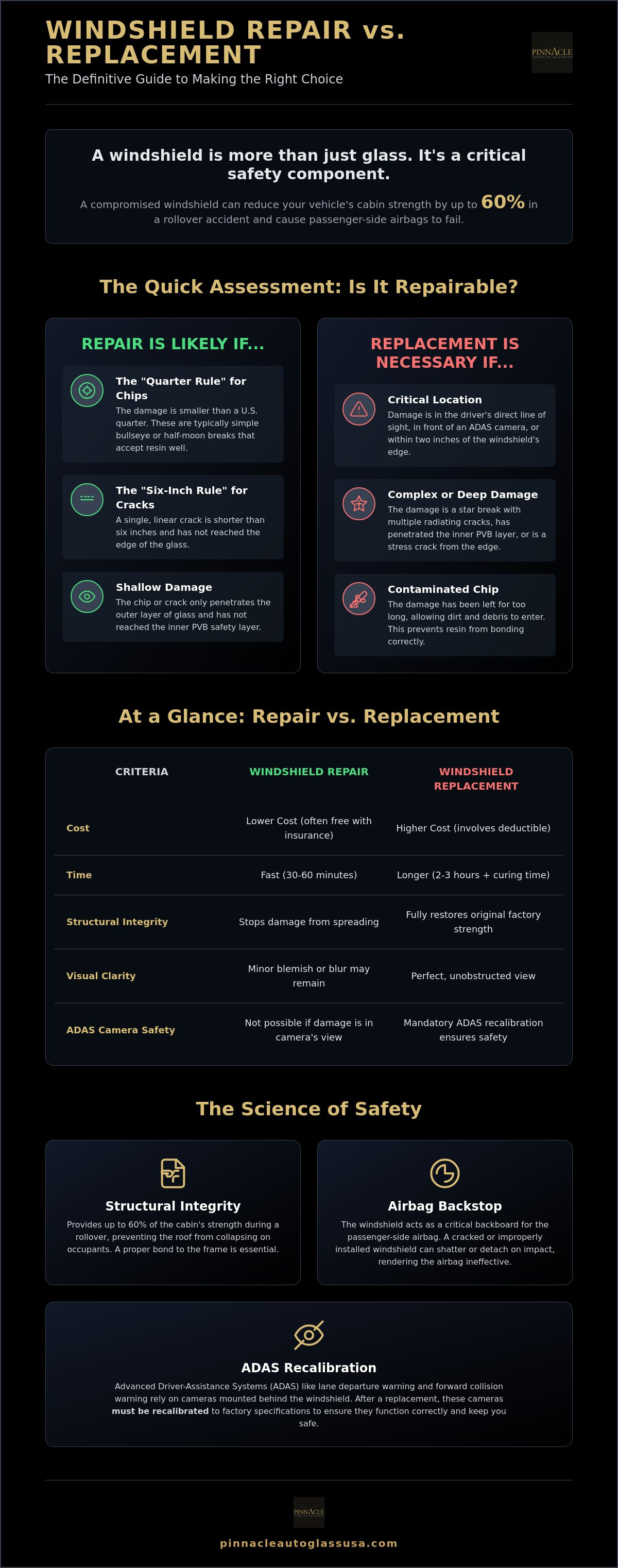
- Apply the "Quarter Rule" and "Six-Inch Rule" to determine if your glass damage is repairable or requires full service.
- Learn why a windshield provides up to 60% of cabin strength and how it supports critical passenger-side airbag deployment.
- Evaluate the cost and time requirements of windshield repair vs replacement to choose the most efficient path forward.
- Navigate insurance coverage and avoid common industry scams to secure professional service with minimal out-of-pocket costs.
- See how integrated ADAS recalibration ensures your vehicle’s safety technology remains factory-accurate after a glass installation.
The Quick Assessment: Size, Location, and Severity Rules
Determining the right course of action for glass damage starts with a simple physical assessment. While modern technology has improved the success rate of professional resin injections, the choice between windshield repair vs replacement still follows strict physical limits. You can't simply patch every crack and expect the glass to perform its job during a collision. Technicians use three primary metrics to evaluate damage: size, depth, and location.
The "Quarter Rule" is the industry standard for chips. If the point of impact is smaller than a silver quarter, a repair is typically possible. For linear cracks, we use the "Six-Inch Rule." Cracks shorter than six inches are often eligible for repair, provided they haven't started to spiderweb into complex patterns. However, depth is the ultimate dealbreaker. Most vehicle windshields are constructed from laminated safety glass, which consists of two glass sheets bonded by a clear plastic interlayer. If a rock chip or crack penetrates through to that inner layer, the structural bond is compromised. In these cases, a full replacement is the only safe solution.
Safety also dictates that the driver's line of sight remains perfectly clear. Any damage located directly in the driver's primary field of vision usually mandates a replacement. Even the best repairs can leave a slight blur or "ghost" image in the glass. At night or in heavy rain, these minor distortions can catch glare and create dangerous blind spots. Replacing the glass ensures your view remains unobstructed and your ADAS cameras have a clear path for monitoring the road.
Common Types of Windshield Damage
Not all chips are created equal. Bullseye and half-moon breaks are the easiest to fix because they have a clear, circular impact point that accepts resin easily. Star breaks are more volatile. They feature fine cracks radiating from the center that can spread rapidly due to temperature changes or road vibrations. Stress cracks are the most difficult. These often occur without a clear impact point, usually caused by extreme temperature shifts or structural twisting. Because stress cracks often start at the edge and move inward, they almost always require a full replacement.
Damage Location and Legal Compliance
Location is just as critical as size. Edge cracks, or damage within two inches of the glass perimeter, are particularly dangerous. This area is where the glass is bonded to the vehicle frame. Damage here compromises that structural seal and increases the risk of the windshield detaching during an accident. Federal DOT standards also regulate visibility; driving with a significantly damaged windshield can result in citations if the damage interferes with safe operation. Finally, consider the "pit" factor. If you leave a chip exposed for weeks, dirt and washer fluid accumulate in the crevice. This contamination prevents the resin from bonding properly, often turning a simple repair into a mandatory replacement.
The Science of Safety: Structural Integrity and ADAS
A windshield is much more than a transparent shield against the wind. It is a critical safety component designed to maintain the vehicle's structural frame. In the event of a rollover accident, the windshield provides up to 60% of the cabin's strength. This structural rigidity prevents the roof from crushing the occupants. If the glass is compromised by deep cracks or is incorrectly installed, this vital support fails. This safety factor is a primary consideration when weighing windshield repair vs replacement for modern vehicles.
Beyond roof support, your windshield acts as the essential backstop for the passenger-side airbag. When an airbag deploys, it strikes the glass with immense force before expanding toward the passenger. If the glass bond is weak or the glass is cracked, the airbag could push the windshield out of the frame. This renders the safety system useless. High-quality laminated glass technology relies on a Polyvinyl Butyral (PVB) inner layer to absorb energy and prevent occupant ejection during high-impact collisions. ADAS recalibration is the software alignment of vehicle safety cameras.
Why Modern Tech Changes the Repair Equation
The presence of sensors and cameras behind the glass significantly influences the windshield repair vs replacement decision. Even a minor resin repair located directly in front of a camera lens can cause light refraction or distortion. This interference often leads to system failures in Forward Collision Warning or Lane Departure systems. Because of these risks, ADAS recalibration is mandatory after a new installation. If your vehicle features these technologies, you must prioritize ADAS calibration auto glass services to ensure the safety software remains factory-perfect.
Structural Bonding and Adhesive Standards
The strength of a windshield is only as good as the adhesive holding it in place. Professional installers use high-performance urethane to bond the glass to the vehicle frame. This process requires a specific "Drive-Away Time," which is the period the car must remain stationary while the adhesive cures. Skipping this step or using low-grade materials compromises the structural fit. Choosing a professional windshield replacement with OEM-equivalent glass ensures the sensors line up correctly and the glass meets original safety ratings. For the best results, it is wise to work with a provider that follows certified glass safety protocols to protect your vehicle's occupants.
Comparing the Options: Repair vs. Replacement Logistics
Logistics and practical results often dictate the final decision for most vehicle owners. While a repair is a reliable way to stop a crack from spreading, it remains a structural patch rather than a total cure. In contrast, a full replacement resets the safety clock of your vehicle and restores the glass to its original manufactured state. The primary difference in windshield repair vs replacement logistics comes down to time, cost, and long-term aesthetic expectations.
- Time Investment: A professional repair takes approximately 30 minutes. A replacement requires up to two hours to allow for proper adhesive curing and camera alignment.
- Aesthetic Results: Even the highest quality resin leaves a faint "scar" or watermark. If you require absolute optical clarity, replacement is the only option.
- Durability: A replacement guarantees a factory-sealed environment and a fresh start for the glass surface. Repairs are durable but can occasionally fail if the glass is subjected to extreme temperature stress later.
When a Repair is the Smartest Choice
Choosing windshield repair is often the most strategic move for specialized, high-cost glass. High-value components like Head-Up Displays (HUD) or internal heating elements can make a full replacement significantly more complex and expensive. Repairing these units saves the original technology and prevents unnecessary glass waste from entering landfills. For commercial operations, mobile on-site repairs maximize fleet efficiency by fixing rock chips during scheduled downtime. This prevents a small issue from grounding a vehicle or turning into a mandatory replacement. Crucially, minor repairs located away from the sensor array typically do not require the time or expense of ADAS recalibration, making it the fastest way to get back on the road.
The Tipping Point for Full Replacement
Safety standards eventually mandate a full replacement. If your glass has three or more distinct chips, the overall structural integrity is too compromised for resin to fix safely. Pitting is another major factor that many owners overlook. Over time, tiny road debris creates a "sandblasted" effect across the surface. This causes dangerous glare and light scattering during night driving, which cannot be cured with resin. Contamination also plays a critical role in the success of a fix. If you have applied heavy rain-repellent chemicals or if dirt has settled deep into an old crack, the repair resin cannot form a permanent bond. In these scenarios, a full replacement is the only way to ensure your safety systems and visibility are restored to factory standards.
Navigating Insurance and Avoiding Industry Scams
Professional glass services often involve complex insurance interactions. Most vehicle owners are surprised to learn that comprehensive insurance usually covers repair costs with a $0 deductible. This is distinct from your collision deductible, which applies to accidents involving other vehicles. Insurers prefer paying for a small fix rather than a full installation. This financial incentive simplifies the decision of windshield repair vs replacement for those on a budget. As of July 2026, states like Florida, Kentucky, and South Carolina legally require insurers to waive the deductible for windshield replacement for policyholders with comprehensive coverage. Residents in South Carolina should track bill HB 4817. If passed, it would end mandatory zero-deductibles on January 1, 2027.
A common concern is the "No-Fault" myth. Many drivers worry that a glass claim will spike their monthly premiums. In most jurisdictions, glass damage is treated as a "no-fault" comprehensive claim. It typically does not impact your rates. To ensure your claim is processed without a hitch, always work with a certified auto glass technician. Certified professionals follow industry-standard billing practices that insurance adjusters trust. This prevents billing disputes that could leave you responsible for the balance.
How to File a Successful Glass Claim
Start by documenting the damage immediately. Take clear, high-resolution photos of the chip or crack and your vehicle's VIN. Professional shops often offer direct billing. They handle all the communication and electronic filing with your insurance provider for you. Remember that you have the "Right to Choose." You are not legally obligated to use the "preferred provider" your insurance agent suggests. You can select any shop that meets your standards for quality and safety. This ensures you get the specific glass and ADAS recalibration your vehicle requires.
Red Flags in Auto Glass Services
Predatory scams are a growing issue in the industry. Be wary of "parking lot" solicitors who approach you at gas stations or grocery stores. These individuals often claim your windshield is "illegal" or "dangerous" to push for an immediate replacement. They are usually looking to collect insurance payouts for substandard work. In Illinois, bill HB 4373 now requires auto glass shops to provide a "good faith estimate" and disclose ADAS recalibration needs before starting work. Use these indicators to stay safe:
- Unsolicited offers: Legitimate businesses do not solicit work in random public spaces.
- "Free" windshields: Be cautious of "rebate" or "cash-back" offers. These are often signs of insurance fraud.
- Verification: Always check for a physical business address and professional certifications.
If you have questions about your coverage or the safety of your glass, you can contact us for a professional glass assessment to ensure your vehicle is road-ready.
Professional Solutions: The Pinnacle Auto Glass Approach
Pinnacle Auto Glass operates with a focus on technical precision and customer reliability. We provide nationwide service for individual drivers and large-scale commercial operations. Deciding on windshield repair vs replacement requires a partner who understands both structural safety and modern sensor technology. We offer the diagnostic expertise to identify the most efficient path forward for your vehicle. Our teams deliver consistent professional standards whether you are at home or managing a depot.
Modern vehicles require more than just a physical glass swap. Every replacement we perform includes integrated ADAS recalibration. We ensure your lane-keep assist, adaptive cruise control, and emergency braking systems function exactly as the manufacturer intended. You don't need to visit a separate dealership for software alignment. We handle the entire process in a single appointment. This integrated approach saves you time and ensures your safety systems are factory-perfect before you drive away.
Flexibility is a core part of our service model. We offer both mobile and in-shop options to fit your schedule. Mobile repairs are ideal for busy professionals and families who need immediate solutions. For complex replacements that require a controlled environment for recalibration, our shops provide the necessary technical infrastructure. We also specialize in reducing fleet downtime with mobile glass repair. This strategic focus helps commercial clients maintain their schedules without compromising on safety compliance.
Commercial and Heavy-Duty Glass Expertise
Fleet operators face unique challenges with semi-truck and box truck windshields. These vehicles have massive glass surfaces and specific mounting requirements that standard passenger car shops often cannot handle. We provide specialized solutions for diverse commercial vehicle configurations. Our fleet partners benefit from priority scheduling and a streamlined billing process. This keeps your logistics moving and your drivers protected on long-haul routes.
The Pinnacle Quality Guarantee
The quality of a glass installation depends heavily on the materials used. We utilize only premium urethanes and adhesives to achieve the fastest safe drive-away times in the industry. Our technicians undergo continuous training to master the latest automotive glass materials and sensor technology. We prioritize results and efficiency in every job we take. If you have a chip that needs mending or a shattered windshield that requires a full reset, we are ready to assist. Schedule your professional glass assessment with Pinnacle Auto Glass today and get back on the road with confidence.
Secure Your Vehicle's Safety and Technology
Your windshield is a primary safety shield that supports your vehicle's frame and advanced driver assistance systems. Understanding the nuances of windshield repair vs replacement ensures you make the best choice for your safety and your budget. Whether you are dealing with a minor chip that needs professional resin or a complex replacement requiring full camera alignment, expert intervention is essential. We provide nationwide professional service with a focus on technical accuracy and speed. Our certified ADAS recalibration specialists ensure your vehicle's technology remains reliable, while our expert fleet and commercial solutions keep logistics operations moving efficiently. Don't let a small crack compromise your vehicle's structural integrity or safety sensors. Take the next step to restore your optical clarity and cabin strength with a team that prioritizes quality. We are ready to help you navigate insurance claims and technical requirements with ease. You can drive with confidence knowing your glass meets factory safety standards.
For drivers who are also looking for a vehicle that has been carefully maintained to these high safety standards, you can check out Stone Road Auto to explore a wide selection of quality pre-owned cars in the Greater Rochester area.
Get a Free Quote for Windshield Repair or Replacement
Frequently Asked Questions
Can a cracked windshield be repaired or does it always need replacement?
A cracked windshield can often be repaired if the damage is less than six inches long and hasn't reached the edge of the glass. If the crack is longer, penetrates the inner laminate layer, or obstructs the driver's direct line of sight, a full replacement is necessary. Professionals use these size and location rules to determine the best path for windshield repair vs replacement to ensure your vehicle remains safe.
Is it safe to drive with a small chip in my windshield?
It isn't safe to drive with an unrepaired chip because even small damage can spread instantly during temperature shifts or when hitting a pothole. Beyond visibility issues, a chip weakens the windshield's structural role. The glass provides vital support for the roof in a rollover and serves as a backstop for the passenger-side airbag; any compromise increases your risk during an accident.
How long does a professional windshield replacement take to complete?
A professional replacement typically takes about two hours from start to finish. This duration accounts for the physical removal of the old glass, the application of high-strength urethane, and the mandatory curing time. If your vehicle has advanced safety features, this timeframe also includes the precise recalibration of your ADAS cameras to ensure all systems are functioning at factory specifications before you drive away.
Will my insurance company pay for a full windshield replacement?
Most comprehensive insurance policies cover windshield replacement, though your specific out-of-pocket cost depends on your deductible. In states like Florida, Kentucky, and South Carolina, current laws require insurers to provide $0 deductible glass replacement for policyholders with comprehensive coverage. We recommend checking your local regulations, especially with pending legislative changes in South Carolina that could affect these requirements in 2027.
What happens if I don’t recalibrate my ADAS camera after a replacement?
Failing to recalibrate your ADAS camera can lead to dangerous malfunctions in your vehicle's safety technology. Systems like lane departure warnings and automatic emergency braking rely on the camera's exact alignment through the glass. Without recalibration, the software may miscalculate distances or fail to detect obstacles, which compromises the safety of everyone on the road. Professional shops integrate this service to maintain factory-level protection.
How much does it typically cost to replace a windshield without insurance?
For vehicles without advanced safety systems, typical industry replacement costs range from $250 to $600. If your car features ADAS technology, the cost increases to between $600 and $1,600 or more. This higher price accounts for specialized glass and the necessary recalibration services. The final decision between windshield repair vs replacement for out-of-pocket customers often depends on these technology factors and the need for recalibration.
Can mobile glass repair be done in the rain or cold weather?
Mobile repairs can be performed in various conditions, but the glass must be dry for the resin to bond effectively. If it's raining, the work should be done in a garage or under a shelter. In cold weather, technicians use specialized tools to gently warm the glass to a specific temperature. This ensures the resin flows correctly into the chip for a durable, professional-grade fix.
Will a repair make the chip completely invisible?
A professional repair significantly improves the appearance of a chip, but it won't make the damage completely invisible. You should expect a small, faint mark where the impact occurred. The primary goal of a repair is to restore the structural integrity of the glass and prevent the damage from spreading. If you require absolute optical perfection, a full replacement is the better choice for your vehicle.


