Your windshield is no longer just a piece of glass. In a rollover accident, it provides up to 60 percent of your cabin's structural integrity and acts as the essential backstop for your passenger-side airbag. When you seek professional windshield services, you aren't just buying a replacement part; you're investing in a complex safety recalibration. It's natural to feel concerned about potential leaks, malfunctioning sensors, or the headache of filing an insurance claim.
You deserve a solution that restores your vehicle to its original factory standards without the stress. We understand that the shift toward mandatory ADAS recalibration and new state laws, like those recently enacted in New York, makes selecting a provider feel more complicated than ever. This guide provides a comprehensive checklist to help you evaluate quality and safety. You'll learn how to verify technician expertise, understand recalibration requirements, and ensure your safety systems function exactly as intended. We've simplified the technical details so you can secure a leak-free, crystal-clear result with total confidence.
Key Takeaways
- Understand why modern auto glass care is a comprehensive safety restoration process rather than a simple hardware swap.
- Learn the technical benchmarks of professional windshield services, including adherence to AGRSS standards and the use of structural bonding materials.
- Identify the professional "rule of thumb" to determine if your glass damage requires a quick repair or a full replacement based on size and location.
- Discover how to vet providers by evaluating their insurance processing capabilities and the scope of their workmanship warranties.
- Gain clarity on how integrated safety technology and ADAS requirements have redefined the quality standards for vehicle maintenance in 2026.
What Defines Professional Windshield Services in 2026?
The definition of auto glass care has fundamentally changed over the last decade. Professional windshield services are now categorized as a comprehensive safety restoration rather than a simple hardware replacement. This shift is driven by the integration of complex electronics and structural requirements that didn't exist in older vehicle generations. Professional windshield services are the intersection of structural integrity and sensor precision.
Choosing "budget" glass solutions often results in immediate failure during modern safety inspections. These low-cost alternatives frequently lack the precise curvature or thickness needed to bond correctly with the vehicle frame. A professional approach prioritizes OEM-equivalent glass and high-quality adhesives to ensure the vehicle remains as safe as the day it left the factory. Reliability depends on the quality of the materials used during the installation process.
The Structural Role of Your Windshield
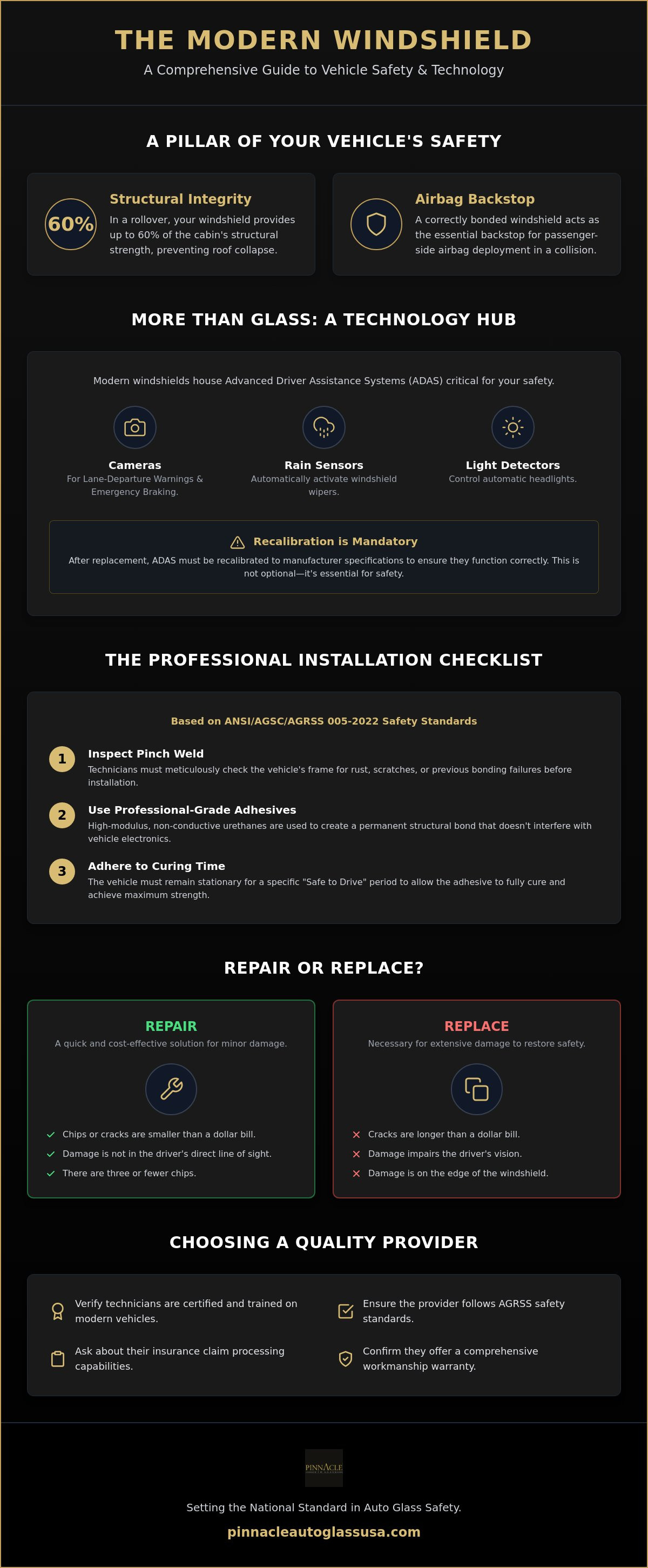
Your windshield provides up to 60 percent of the cabin's structural strength during a rollover accident. It acts as a pillar that prevents the roof from collapsing on the occupants. Additionally, the glass serves as the essential backstop for the passenger-side airbag. If the bond between the glass and the frame is weak, the force of the airbag deployment can pop the windshield out, rendering the safety system useless.
Professional technicians use high-modulus, non-conductive urethanes to create a permanent structural bond. Most modern vehicles utilize laminated safety glass, which consists of two layers of glass with a vinyl interlayer. This construction prevents the glass from shattering into dangerous shards. Without professional-grade adhesives and proper preparation, this safety feature cannot perform its job during a collision.
Beyond the Glass: The Technology Factor
Modern windshields are hubs for Advanced Driver Assistance Systems (ADAS). These systems include cameras, rain sensors, and light detectors mounted directly to the interior surface. A professional service manages the delicate balance between glass clarity and sensor performance. Even a slight imperfection in the glass can cause your lane-departure warning or automatic emergency braking to malfunction. Accuracy is the difference between a safe drive and a system failure.
This is why hiring a certified auto glass technician is essential. These professionals understand how to handle sensitive electronics without causing damage. They ensure that the camera's field of vision is unobstructed and that the glass meets the exact specifications required by the vehicle manufacturer. In 2026, a windshield replacement is as much a software calibration as it is a physical installation.
Technical Standards: The Professional Installation Checklist
High-quality auto glass work relies on strict adherence to technical benchmarks. The current industry authority is the ANSI/AGSC/AGRSS 005-2022 standard. This protocol outlines every phase of a safe installation, from the initial vehicle assessment to the final inspection. When you evaluate professional windshield services, ask if the technicians follow these specific safety council guidelines. These standards ensure that your vehicle's structural integrity remains intact after the glass is replaced.
The installation process begins with a detailed inspection of the pinch weld. Technicians must check for rust, scratches, or previous bonding failures. Any corrosion must be treated before the new glass is set, or the adhesive won't create a proper seal. Professionals use high-modulus, non-conductive urethanes for the bond. These advanced adhesives are essential for modern vehicles because they don't interfere with radio signals or GPS antennas. After the glass is set, the vehicle must remain stationary for a specific curing period. This "Safe to Drive" time is non-negotiable for occupant safety.
Glass Quality and Optical Clarity
Not all replacement glass is equal. Original Equipment Manufacturer (OEM) glass is produced by the same company that made the factory glass for your car. Original Equipment Equivalent (OEE) glass meets the same Federal Motor Vehicle Safety Standards but is produced by a different manufacturer. Both must meet Department of Transportation (DOT) requirements for clarity and strength. It's important to understand the types of windshield damage that dictate a full replacement. If a crack is in the driver's direct line of sight or exceeds six inches, a replacement is the only safe option.
The ADAS Recalibration Requirement
Modern professional windshield services must include ADAS recalibration. If your car has lane-keep assist or automatic braking, the cameras behind the glass need to be reset after a replacement. This ensures the sensors "see" the road correctly through the new glass. Technicians perform either a static recalibration in a controlled shop environment or a dynamic recalibration during a road test. Some vehicles require both. For a deep dive into these technical requirements, consult our ADAS calibration auto glass guide. If you're ready for a technical assessment, our team provides comprehensive professional auto glass care designed for modern safety systems.
Repair vs. Replace: Professional Decision Criteria
Determining the best course of action for glass damage requires more than a simple measurement. While many sources suggest a "six-inch rule" for cracks, professional windshield services utilize a more rigorous set of criteria to ensure structural safety. Technicians must evaluate the size, depth, and specific location of the damage before recommending a solution. This assessment is the first step in maintaining the vehicle's safety envelope. Safety always dictates the final decision.
Location is often the most critical factor. Any damage located in the driver's primary viewing area typically requires a full replacement. Even the most successful repairs can leave a slight optical distortion, which can be dangerous during night driving or in heavy rain. Technicians also look closely at edge cracks. These are far more dangerous than centered chips because they compromise the structural bond between the glass and the vehicle frame. If a crack reaches the edge of the glass, the risk of a total structural failure increases significantly.
The depth of the "pit" or the point of impact is another technical benchmark. If the damage has penetrated deep enough to reach the inner plastic laminate layer, the integrity of the pane is gone. Technicians adhere to the Auto Glass Replacement Safety Standard to determine if the glass can safely remain in the vehicle. This standard ensures that all decisions prioritize occupant protection over convenience.
When Professional Repair is the Best Option
A successful windshield repair is possible when the damage is localized and shallow. Professionals use vacuum-injection resin technology to restore the glass. This process removes air from the crack and replaces it with a high-strength resin that matches the optical properties of the glass. Beyond safety, repairing a chip is an environmentally responsible choice. It prevents a large piece of non-recyclable glass from ending up in a landfill while extending the life of the factory seal.
When Replacement is Non-Negotiable
Replacement becomes mandatory when the damage is too extensive for resin to bridge. If you see multiple chips in close proximity, they create stress points that weaken the entire pane. You should never rely on "DIY" repair kits for complex cracks. These consumer-grade tools lack the vacuum pressure required to fully penetrate the damage, often leaving air pockets that lead to further cracking. When the inner laminate is compromised or the ADAS camera's field of vision is obstructed, professional windshield services are the only way to restore full vehicle functionality.
Service Delivery Checklist: Vetting Your Provider
Selecting the right shop for your vehicle should not be a matter of guesswork. Choosing professional windshield services involves more than checking for the lowest price; it requires a thorough assessment of their operational standards and technical credentials. A reputable provider acts as a dependable guide, simplifying the transition from damage to a fully restored vehicle. Use this checklist to ensure your chosen provider meets the highest industry benchmarks for safety and service.
Start by verifying technician certifications. Professionals should be trained by industry-recognized bodies, such as the Auto Glass Safety Council (AGSC), to ensure they stay current on evolving installation techniques. Additionally, ask about their commercial capacity. A provider capable of handling heavy-duty trucks and fleet glass services demonstrates a level of scale and expertise that smaller, localized shops may lack. Finally, confirm the scope of their warranty. A nationwide lifetime warranty on workmanship is a hallmark of a stable, professional entity that stands behind its results.
The Mobile Service Advantage
Convenience is a major factor in auto glass care. When vetting a provider, assess whether they are equipped for mobile glass repair or if the job requires a controlled shop environment. Safe mobile installations require a level surface and protection from extreme weather or debris. While mobile units offer significant downtime reduction for commercial fleets, certain ADAS recalibration processes may still require a visit to a facility with specialized lighting and level flooring. A professional provider will be transparent about which environment is safest for your specific vehicle technology.
Administrative and Insurance Ease
The administrative side of the repair should be as seamless as the technical work. Look for providers that offer direct billing for insurance claims. This eliminates the complexity of reimbursement and ensures that the shop works directly with your carrier to manage costs. Be wary of budget quotes that may contain hidden fees for disposals or moldings. In states like New York, shops are now legally required to provide detailed notifications regarding ADAS recalibration. Professional providers go beyond these mandates by providing comprehensive documentation of the recalibration for your permanent vehicle records. If you require a partner that prioritizes technical precision and administrative transparency, contact our professional glass team to review your service options.
Pinnacle Auto Glass: Setting the National Standard
Pinnacle Auto Glass operates as a premier provider of professional windshield services across the country. Our team prioritizes the use of high-modulus urethanes and OEM-equivalent glass to ensure every installation meets strict safety benchmarks. We don't just swap glass; we restore your vehicle's structural integrity. Every technician is trained to handle the complexities of modern safety systems. Integrated ADAS recalibration is a standard part of our safety protocol. This ensures your lane-keep assist and emergency braking function exactly as intended by the manufacturer. We also streamline the administrative process by working directly with your insurance carrier. This gets you back on the road faster with less paperwork.
Our commitment to quality extends from individual passenger cars to heavy-duty commercial vehicles. We understand that your vehicle is a critical asset, and we treat every job with the technical seriousness it deserves. Reliability is our foundation. By combining technical expertise with a customer-focused approach, we've established ourselves as a dependable guide in the auto glass industry. You can trust that your safety is our primary objective during every service call.
Solutions for Fleet and Commercial Clients
Logistics and uptime are critical for business operations. We provide specialized fleet glass services and commercial truck glass solutions for semi-trucks, vans, and box trucks. Our teams understand that a vehicle off the road is a loss in revenue. We prioritize efficient logistics to minimize downtime for large-scale operations. Our customized glass management programs provide consistent quality across your entire fleet. Whether you manage five vehicles or five hundred, we deliver the same technical precision and reliable scheduling. Our goal is to keep your drivers safe and your business moving forward.
Your Next Steps for Professional Glass Care
Restoring your vehicle's safety is a straightforward process. To start, request an accurate quote by providing your vehicle's year, make, and model. This allows us to identify the specific glass and ADAS requirements for your car. Before your appointment, ensure the vehicle is parked in a safe, accessible area if you've chosen mobile service. For in-shop visits, clear any personal items from the dashboard to allow technicians full access to the glass and sensors. Contact Pinnacle Auto Glass today for immediate expert assistance. We're ready to provide the professional windshield services your vehicle requires to stay safe on the road.
Secure Your Vehicle's Safety and Structural Integrity
Modern auto glass care is a sophisticated technical process that directly impacts your safety on the road. You now understand that a windshield is more than just a barrier; it's a structural pillar and a hub for critical safety sensors. Adhering to the Auto Glass Replacement Safety Standard and ensuring proper ADAS recalibration are non-negotiable steps for any high-quality installation. By vetting your provider for technical certification and administrative transparency, you protect both your vehicle and your passengers.
Pinnacle Auto Glass provides the professional windshield services you need to maintain these high standards. With certified technicians nationwide, full ADAS recalibration capabilities, and direct insurance billing, we simplify even the most complex repairs. We also offer comprehensive fleet management solutions for commercial clients who require consistent quality across their operations. Get a Professional Quote from Pinnacle Auto Glass today to restore your vehicle to factory standards. We're ready to help you drive with total confidence and clarity.
Frequently Asked Questions
How do I know if my auto glass service is actually professional?
Professionalism is defined by adherence to the ANSI/AGSC/AGRSS 005-2022 standard. You can verify this by asking about technician certifications and the types of adhesives used during the process. A professional shop will provide a written pre-inspection and a post-installation report. They prioritize safety over speed; ensuring the structural integrity of your vehicle is fully restored. Reliable providers will always be transparent about their materials and installation protocols.
Is ADAS recalibration always necessary after a windshield replacement?
Recalibration is mandatory whenever a windshield with an integrated camera or sensor is replaced. These systems rely on precise alignment to function correctly. Even a one-degree deviation can cause lane-keep assist or automatic braking to fail. If your vehicle features Advanced Driver Assistance Systems, the technician must perform either a static or dynamic recalibration. This ensures your safety features remain active and accurate after the new glass is set.
Can a professional windshield repair fail later on?
A professional repair is designed to be permanent, but extreme temperature shifts or additional impact can cause a crack to spread. Success depends on the size of the initial chip and whether debris entered the pit before the resin was injected. While failures are uncommon with high-strength resin technology, professional providers will monitor the damage during the initial assessment. If a repair isn't viable, they'll recommend a full replacement instead.
Will my insurance cover the full cost of professional windshield services?
Most comprehensive insurance policies cover professional windshield services with little to no out-of-pocket cost. Many carriers even waive the deductible for chip repairs to prevent more expensive replacements later. Professional shops offer direct billing; which means they coordinate with your insurance company on your behalf. This process eliminates administrative stress and ensures the claim is processed accurately according to your specific policy's glass coverage limits.
What is the difference between OEM and aftermarket windshield glass?
OEM glass is manufactured by the same company that produced the original factory glass for your vehicle. Aftermarket glass, or OEE, is made by different manufacturers but must still meet Department of Transportation standards. While both are safe, OEM glass ensures an exact match for thickness, curvature, and sensor mounting. Professional providers help you choose the best option based on your vehicle's specific technology and your insurance provider's requirements.
How long should I wait to drive after a professional windshield installation?
You should wait at least 60 minutes after the installation is complete before driving. This is known as the Safe Drive Away Time. It allows the high-modulus urethane adhesive to cure sufficiently to hold the glass in place during a collision. Driving too soon can compromise the structural bond and lead to leaks or safety failures. Always follow the specific timeframe provided by your technician based on the adhesive used.
Are mobile windshield services as good as in-shop repairs?
Mobile services are highly effective for most repairs and replacements when performed in a controlled environment. Technicians require a level surface and protection from rain or extreme heat to ensure the adhesive bonds correctly. While mobile units are convenient for many drivers, some complex ADAS recalibrations are better suited for a shop environment. A professional provider will evaluate your location and vehicle type to determine the safest and most accurate service method.
Do professional glass services offer warranties on their work?
Yes, a hallmark of professional windshield services is a lifetime warranty on workmanship. This coverage protects you against leaks, wind noise, or bonding issues for as long as you own or lease the vehicle. It demonstrates the provider's confidence in their technicians and the quality of the materials used. Always confirm the warranty terms before the work begins. A nationwide warranty is especially valuable for commercial fleets and frequent travelers.


