Your insurance policy might not cover your windshield the same way it did last year. Legislative shifts in states like Florida and South Carolina have fundamentally changed how many drivers handle a windshield replacement insurance deductible. It's frustrating to face a damaged windshield only to find that your "full coverage" might still leave you with an unexpected bill at the shop.
We understand that insurance jargon and the fear of rising premiums can make a simple repair feel like a financial risk. You deserve a clear path to restoring your vehicle's safety without the guesswork. This guide provides the clarity you need to navigate your policy and minimize out-of-pocket costs for both the glass and essential ADAS recalibration.
You'll learn how to identify your specific coverage type and whether your state mandates a zero-deductible option. We also examine the critical role of safety technology in modern glass work and provide a simple framework to help you decide if filing a claim is the right move for your situation. Let's get your vehicle back on the road safely and affordably.
Key Takeaways
- Understand how a windshield replacement insurance deductible applies to comprehensive claims and affects your total out-of-pocket expenses.
- Discover the differences between standard comprehensive policies and specialized full glass coverage to see if you qualify for $0 repairs.
- Learn how to calculate if filing a claim is financially beneficial by comparing your deductible to the total cost of glass and labor.
- Identify why modern safety systems make ADAS recalibration a mandatory part of the replacement process and how it impacts your claim.
- Get a professional estimate from Pinnacle Auto Glass before contacting your insurer to ensure you have accurate data for your claim.
What Is a Windshield Replacement Insurance Deductible?
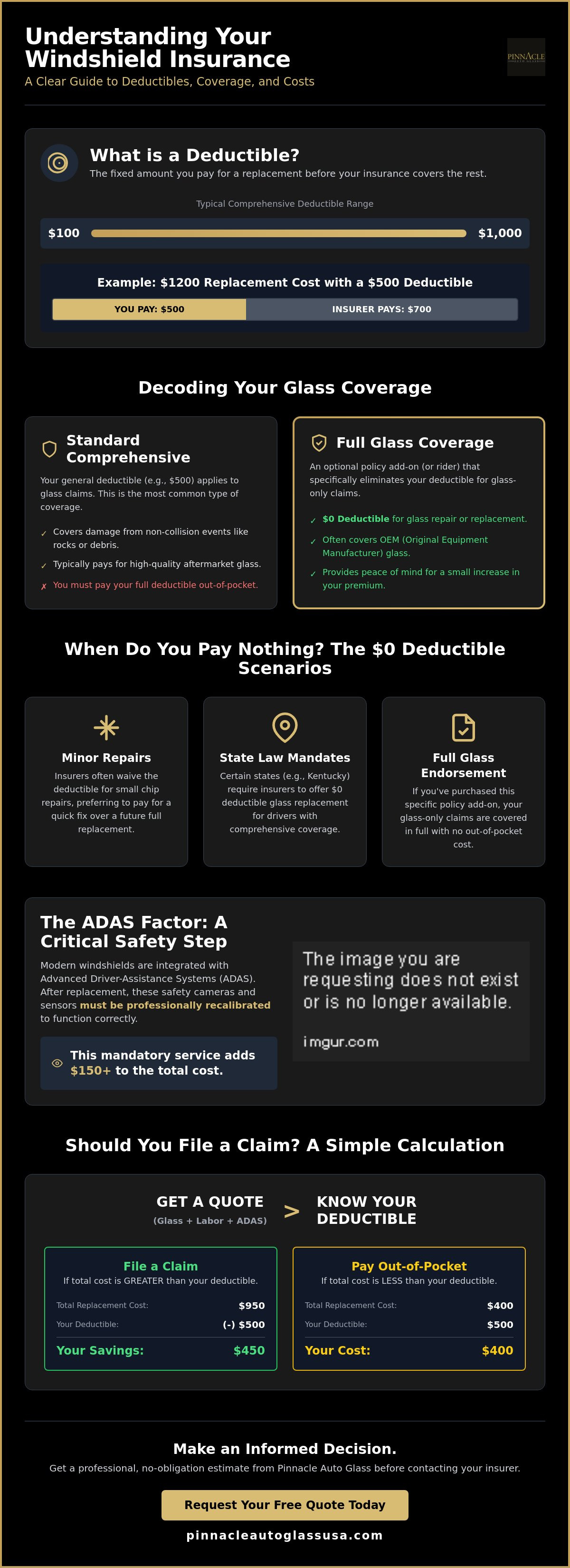
A windshield replacement insurance deductible is the fixed cost a policyholder pays for glass replacement before the insurer covers the remaining balance. When you sign your auto insurance policy, you agree to this specific out-of-pocket amount. Most auto glass damage falls under the comprehensive portion of your coverage rather than collision. These deductible amounts typically range from $100 to $1,000 depending on your specific policy structure and the level of risk you chose to assume.
Modern vehicles rely on sophisticated laminated safety glass to maintain structural integrity. This material consists of two glass layers with a plastic interlayer, designed to prevent shattering during an impact. Because this technology is specialized, the total cost of a replacement often exceeds the deductible, making insurance a valuable tool for many drivers. Understanding your windshield replacement insurance deductible helps you determine if filing a claim is the most cost-effective choice for your budget.
Comprehensive vs. Collision Coverage for Glass
Glass damage usually occurs from external factors beyond your control. Rock chips, falling branches, or storm debris are classified as comprehensive claims. Collision coverage only applies if the glass broke during a multi-vehicle accident or a single-vehicle crash. One major benefit of comprehensive claims is that they rarely impact your insurance premiums. Insurers view these incidents as no-fault events. This allows you to fix your vehicle without worrying about a long-term rate hike.
Because severe weather events often cause damage to both vehicles and buildings, homeowners facing these issues can visit Supreme Roofing and Reconstruction for expert assistance with residential or commercial roof repairs.
When Is the Deductible Waived?
You might not have to pay anything at all in certain scenarios. Many insurers waive deductibles for a professional windshield repair. They prefer to pay for a minor resin injection now rather than a full replacement later. This saves the insurer money and keeps your out-of-pocket costs at zero.
Some states have specific laws that mandate $0 deductible glass replacement for drivers with comprehensive coverage. As of June 2026, Kentucky continues to mandate this benefit. Other states like Arizona and New York require insurers to offer optional Full Glass Coverage riders. These endorsements remove the deductible entirely for glass-only claims, providing peace of mind for a small monthly fee. Always review your policy declarations page to see if you've already opted into this protection.
Standard Comprehensive vs. Full Glass Coverage
Most drivers assume their standard policy covers every type of damage. It doesn't. A standard policy applies your general windshield replacement insurance deductible to every claim. If your deductible is $500, you pay that amount before the insurer contributes a single dollar. Comprehensive coverage is the broad category for these claims, but "Full Glass Coverage" is a specific endorsement that often eliminates this cost entirely.
Some insurers offer a middle ground called a glass-only deductible. This is a separate, lower amount specifically for windows and windshields. You might have a $1,000 comprehensive deductible for theft or fire but only a $50 deductible for glass. This structure keeps your monthly premiums manageable while protecting you from high out-of-pocket costs when a rock hits your glass. It's a strategic choice for vehicle owners who want to balance monthly savings with emergency readiness.
Policy language also dictates the quality of the materials used. Standard comprehensive policies typically pay for aftermarket glass. This glass meets safety standards but isn't made by the original manufacturer. Premium glass endorsements might cover Original Equipment Manufacturer (OEM) glass. This is often preferred for newer vehicles to ensure perfect fitment and sensor compatibility. If you aren't sure what your policy covers, you can request a quote from Pinnacle Auto Glass to see how your current coverage aligns with actual replacement costs.
The Benefits of a $0 Glass Deductible
A $0 deductible provides immediate access to replacement without the need for financial planning. This is especially critical for modern vehicles. A full glass endorsement includes both the physical glass and the necessary ADAS calibration auto glass services. Recalibration is a mandatory safety step for cameras and sensors. Because these specialized services can cost between $150 and $600, having a zero-deductible policy prevents these technical requirements from becoming a financial burden. It offers peace of mind for drivers who frequently travel in high-debris areas or construction zones.
How to Add Glass Coverage to Your Policy
You can usually add glass coverage by contacting your insurance agent to adjust your comprehensive limits. The premium increase is often minor, sometimes just a few dollars per month. This small investment is significantly lower than the cost of a new windshield and recalibration. Timing is the most important factor. You cannot add this coverage after the damage has already occurred. Check your policy today to ensure you're protected before the next chip appears.
The Deductible Math: When to File a Claim
Deciding whether to use your windshield replacement insurance deductible comes down to simple arithmetic. You must compare your agreed-upon out-of-pocket expense against the total professional estimate. This estimate includes the glass, labor, and specialized moldings required for a leak-free seal. If you have a high deductible, paying in cash for minor chips is often faster and prevents unnecessary paperwork. It's a pragmatic approach to vehicle maintenance.
Understanding windshield replacement insurance coverage is essential before making this call. For older vehicles with basic glass, a $500 deductible might actually be higher than the total replacement cost. In these cases, filing a claim offers no financial benefit. However, for newer models, the math shifts quickly. The complexity of modern glass often makes insurance the only logical path forward. The age and value of your vehicle are the primary anchors for this decision.
High Deductibles and Out-of-Pocket Decisions
If your deductible is $500 or $1,000, you are essentially self-insuring for most minor glass damage. Basic economy cars often use standard glass that is relatively inexpensive to replace. Paying cash in these instances is efficient. Be wary of "bargain" glass providers who offer suspiciously low prices to beat your deductible. Poor quality glass can lead to optical distortion or structural weaknesses that compromise your safety. Always prioritize quality over the lowest possible cash price.
Luxury and High-Tech Glass Variables
The math changes for premium vehicles. Luxury cars often require Original Equipment Manufacturer (OEM) glass to maintain features like rain sensors and acoustic laminates. These components drive up the price significantly. For example, a windshield replacement cost with heads up display can easily exceed $1,500 when you include the specialized glass and recalibration. In these high-tech scenarios, your windshield replacement insurance deductible is a small price to pay for a high-value repair. Insurance becomes the better choice when the total bill far exceeds your out-of-pocket limit.
How ADAS Recalibration Affects Your Deductible Choice
Modern windshields are no longer just passive barriers. They serve as the mounting point for Advanced Driver Assistance Systems (ADAS). These cameras and sensors control critical safety features like lane-keep assist and automatic emergency braking. Because these systems are precision-tuned, a windshield replacement requires a mandatory recalibration to ensure the sensors "see" the road correctly. This technical requirement significantly increases the total service cost, often by several hundred dollars.
When you evaluate your windshield replacement insurance deductible, you must look at the combined price of the glass and the tech labor. Recalibration alone typically costs between $150 and $600. When added to the price of the glass, the total invoice frequently reaches $600 to $1,500. Most insurance companies recognize recalibration as a necessary safety procedure and cover it under the same glass claim. This makes your deductible a much smaller percentage of the total bill than it was a decade ago.
Why Recalibration Is Non-Negotiable
Skipping recalibration isn't an option for safety-conscious drivers. An uncalibrated camera might miscalculate the distance to the car ahead or fail to detect lane markings. This directly impacts your emergency braking and lane departure warnings. Driving a vehicle with misaligned sensors creates a liability and a safety hazard. At Pinnacle Auto Glass, we manage the entire recalibration process as part of your claim. We ensure your safety systems are restored to factory specifications before you leave the shop. You can schedule your ADAS recalibration and glass replacement with our expert team today.
Bundling Glass and Tech Costs into One Claim
One of the biggest advantages of filing a claim is that your windshield replacement insurance deductible applies to the entire service. You don't pay one deductible for the glass and another for the tech work. This bundling makes insurance coverage highly attractive for owners of modern vehicles. Even a $500 deductible is a bargain when the total safety restoration costs exceed $1,200. We work directly with your provider to ensure they recognize the necessity of these calibration steps so you aren't left with unexpected tech fees.
Filing Your Auto Glass Claim with Pinnacle Auto Glass
Filing a claim doesn't have to be a headache. The most efficient way to start is by contacting Pinnacle Auto Glass before you call your insurance provider. We provide an accurate, professional estimate of the damage to your vehicle. Having this data ready ensures your insurance adjuster has the correct information from the start. It prevents delays and helps you understand exactly how your windshield replacement insurance deductible will apply to the final bill.
Our team acts as your dependable guide throughout the entire process. Once we provide the estimate, we assist you in verifying your coverage and deductible. We understand the nuances of different policy types and can help you determine if your claim qualifies for a waiver or specialized glass endorsement. After confirming your coverage, we schedule your service with a certified technician. You can choose an in-shop appointment or take advantage of our mobile service options that meet you at your home or office.
The billing and paperwork shouldn't be your concern. Our glass specialists handle the communication with your insurer directly. This direct billing approach saves you time and ensures all technical requirements, such as ADAS recalibration, are documented correctly. We don't consider the job complete until every safety system is tested and verified. You'll drive away with the confidence that your vehicle's structural integrity and electronic safety features are fully restored.
Working with Major Insurance Providers
Pinnacle Auto Glass maintains strong professional relationships with all top national insurance carriers. We navigate their specific claim requirements daily. This expertise allows us to streamline approvals and minimize the time your vehicle is off the road. For business owners, we offer specialized support for commercial fleet glass needs. Managing a commercial fleet involves complex logistics, but our direct billing and mobile capabilities minimize downtime for your drivers. We ensure your windshield replacement insurance deductible is processed accurately for every vehicle in your care.
The Pinnacle Difference: Safety and Convenience
We prioritize quality and safety in every installation. Our technicians are certified and use high-quality materials that meet or exceed industry standards. We understand that your time is valuable. Our mobile service brings our expertise directly to you, providing a seamless experience from the initial quote to the final recalibration. Don't let a cracked windshield compromise your safety or your schedule. Contact Pinnacle Auto Glass for a quote or claim assistance today and let our professionals handle the rest.
Restore Your Vehicle's Safety and Clarity
Modern auto glass is a complex component of your vehicle's safety system. Navigating your windshield replacement insurance deductible is easier when you understand how comprehensive coverage and ADAS recalibration work together. You now have the tools to calculate whether a claim is your best financial move and how to leverage specialized endorsements for zero out-of-pocket repairs.
Pinnacle Auto Glass acts as your dependable partner throughout this process. We are certified ADAS recalibration specialists with extensive experience working with all major national insurance providers. Our team offers both mobile and in-shop service options available nationally to fit your busy schedule. We handle the technical details and the insurance paperwork so you don't have to.
Get a Professional Quote or Start Your Claim with Pinnacle Auto Glass
Don't let a damaged windshield compromise your safety. Take the first step toward a clear view and a secure drive today.
Frequently Asked Questions
Does insurance cover windshield replacement if I only have liability?
Liability insurance does not cover your windshield replacement. This type of policy only pays for damages you cause to other people's vehicles or property in an accident. To have coverage for your own auto glass, you must carry comprehensive insurance on your policy. If you only have liability coverage, you'll be responsible for the full cost of any glass repair or replacement out of pocket.
Will my insurance premium go up if I file a windshield claim?
Filing a windshield claim typically does not cause your insurance premium to increase. Most insurers categorize glass damage as a no-fault comprehensive claim because it results from external factors like road debris or weather. Because these incidents are beyond your control, they are viewed differently than at-fault collisions. However, filing multiple claims within a short timeframe could potentially lead to a review of your policy rates.
Can I choose my own auto glass shop for an insurance claim?
You have the legal right to choose your own auto glass repair shop in most states. Insurance companies might suggest a "preferred provider" to simplify their internal paperwork, but they cannot legally force you to use a specific business. Choosing an expert like Pinnacle Auto Glass ensures you receive high-quality materials and certified recalibration services. Always verify that your chosen shop works with your insurance carrier to simplify the billing process.
What happens if my deductible is higher than the cost of the windshield?
If your windshield replacement insurance deductible is higher than the total cost of the service, the insurance company won't pay anything. For example, if a replacement costs $400 and your deductible is $500, you are responsible for the entire $400 bill. In this scenario, it's better to pay the shop directly. Filing a claim that doesn't provide financial assistance only adds unnecessary paperwork to your insurance history.
Is ADAS recalibration covered by my insurance deductible?
Insurance companies generally cover ADAS recalibration as a mandatory safety requirement of the glass claim. Since cameras and sensors are mounted directly to the windshield, the system must be recalibrated to ensure safety features like lane-keep assist function correctly. This technical service is bundled with the glass replacement under a single deductible. It is essential to choose a shop that can perform both the glass installation and the recalibration simultaneously.
How do I know if I have a $0 glass deductible on my policy?
You can determine if you have a $0 glass deductible by reviewing your insurance policy's declarations page. Look for specific endorsements like "Full Glass Coverage" or "Safety Glass." Certain states also mandate a zero-deductible option if you carry comprehensive coverage. If the policy language is unclear, contact your insurance agent to confirm your windshield replacement insurance deductible status before you schedule your appointment to avoid unexpected costs.
Does insurance cover rock chip repairs without a deductible?
Many insurance providers waive the deductible for rock chip repairs to encourage drivers to fix small cracks before they spread. This prevents the need for a more expensive full replacement later. If you have comprehensive coverage, the insurer often pays the entire cost of the repair. This is a proactive way to maintain your vehicle's safety and structural integrity without any out-of-pocket expense for the vehicle owner.
What is the difference between OEM and aftermarket glass in an insurance claim?
OEM glass is produced by the original vehicle manufacturer, while aftermarket glass is made by third-party companies. Most standard insurance policies cover the cost of aftermarket glass because it meets all federal safety standards. If you prefer OEM glass for a newer vehicle or specific sensor compatibility, check if your policy has an OEM endorsement. Without this specific coverage, you might be required to pay the price difference yourself.


